
File
... 2. This congressional compromise tried to use the principle of popular sovereignty to solve the conflict about whether territories would come in as free or slave states and it led to a physical conflict called “Bloody Kansas.” a. Compromise of 1850 b. Kansas-Nebraska Act c. Missouri Compromise d. El ...
... 2. This congressional compromise tried to use the principle of popular sovereignty to solve the conflict about whether territories would come in as free or slave states and it led to a physical conflict called “Bloody Kansas.” a. Compromise of 1850 b. Kansas-Nebraska Act c. Missouri Compromise d. El ...
Chapter 21 1. First major battle of civil war , in which
... 3. Key battle of 1862 that forestalled European intervention to aid the Confederacy and led to them Emancipation Proclamation 4. Document that proclaimed a war against slavery and guaranteed a fight to the finish 5. General U.S Grant’s nickname, taken from his military demand to the enemy at fort Do ...
... 3. Key battle of 1862 that forestalled European intervention to aid the Confederacy and led to them Emancipation Proclamation 4. Document that proclaimed a war against slavery and guaranteed a fight to the finish 5. General U.S Grant’s nickname, taken from his military demand to the enemy at fort Do ...

The War that Changed America 37
... * First bloodshed on the battlefield occurred about three months after Fort Sumter fell * Near the little creek of Bull Run, just 25 miles from Washington, D.C. * Confederate victory but the Confederates were too exhausted to follow up their victory with an attack on Washington The Battle of Antieta ...
... * First bloodshed on the battlefield occurred about three months after Fort Sumter fell * Near the little creek of Bull Run, just 25 miles from Washington, D.C. * Confederate victory but the Confederates were too exhausted to follow up their victory with an attack on Washington The Battle of Antieta ...
4-Civil_War - IB-History-of-the-Americas
... thought it would make an excellent rifle pit and it would be well to take cover and so they moved down into the crater itself, wasting valuable time while the Confederates, gathered as many troops together as they could for a counterattack. In about an hour's time, they had formed up around the crat ...
... thought it would make an excellent rifle pit and it would be well to take cover and so they moved down into the crater itself, wasting valuable time while the Confederates, gathered as many troops together as they could for a counterattack. In about an hour's time, they had formed up around the crat ...
1) The nickname given to Confederate soldiers was .
... 18) The process of selecting people for mandatory military service is the _______________. 19) The ____________________________ was the most famous speech given by President Lincoln after the bloody three day battle in Pennsylvania. 20) A _______________________ is designed to cut off an area to st ...
... 18) The process of selecting people for mandatory military service is the _______________. 19) The ____________________________ was the most famous speech given by President Lincoln after the bloody three day battle in Pennsylvania. 20) A _______________________ is designed to cut off an area to st ...

18.1 The Two Sides
... War in the Eastern States 8. Why was the Confederacy victorious in the East? ...
... War in the Eastern States 8. Why was the Confederacy victorious in the East? ...
CIVIL WAR BATTLES – CLASS COPY DO NOT WRITE ON
... On April 27, Maj. Gen. Joseph Hooker led the V, IX, and XII Corps on a campaign to turn the Confederate left flank by crossing the Rappahannock and Rapidan Rivers above Fredericksburg. Passing the Rapidan via Germanna and Ely’s Fords, the Federals concentrated near Chancellorsville on April 30 and M ...
... On April 27, Maj. Gen. Joseph Hooker led the V, IX, and XII Corps on a campaign to turn the Confederate left flank by crossing the Rappahannock and Rapidan Rivers above Fredericksburg. Passing the Rapidan via Germanna and Ely’s Fords, the Federals concentrated near Chancellorsville on April 30 and M ...

Total War
... ◦ This is an addition to the Northern reason for fighting the war. Not only for preservation of the Union, but know the war is about ending slavery too ...
... ◦ This is an addition to the Northern reason for fighting the war. Not only for preservation of the Union, but know the war is about ending slavery too ...
battle of chickamauga - Flushing Community Schools
... General Bragg began to gain ground but could not break the Union lines General Bragg divided his line into two parts with General James Longstreet commanding the left and Lt. General Leonidas Polk commanding the right It seemed like the Confederates would not be successful, but were able to dr ...
... General Bragg began to gain ground but could not break the Union lines General Bragg divided his line into two parts with General James Longstreet commanding the left and Lt. General Leonidas Polk commanding the right It seemed like the Confederates would not be successful, but were able to dr ...

11.1Revised - dullbrownhistory
... “I, Abraham Lincoln, President of the United States, by virtue of the power in me vested as Commander-inChief, of the Army and Navy of the United States in time of actual armed rebellion against the authority and government of the United States, and as a fit and ...
... “I, Abraham Lincoln, President of the United States, by virtue of the power in me vested as Commander-inChief, of the Army and Navy of the United States in time of actual armed rebellion against the authority and government of the United States, and as a fit and ...

The Furnace of Civil War 1861-1865
... ‘Stonewall’ Jackson and James E.B. (Jeb) Stuart, forced McClellan’s army to retreat back down the peninsula – a strategic victory that saved Richmond ...
... ‘Stonewall’ Jackson and James E.B. (Jeb) Stuart, forced McClellan’s army to retreat back down the peninsula – a strategic victory that saved Richmond ...

African Americans and the War
... south could go on the offensive. If successful he believed he would receive his foreign aid and the border states would combine with him and he could take the fight to the Union. Everything was going pretty close to plan for Lee except, he didn’t receive as much support from the border states as ...
... south could go on the offensive. If successful he believed he would receive his foreign aid and the border states would combine with him and he could take the fight to the Union. Everything was going pretty close to plan for Lee except, he didn’t receive as much support from the border states as ...

Lesson 2: Primarily Primary Class Notes 2: Teacher Edition I. Union
... transportation of soldiers and necessary wartime supplies which would make it difficult for the Confederacy to survive. There were three parts to the Anaconda Plan . 1.naval blockade all along the Confederate coast 2.Union occupation of the Mississippi River 3.capture Confederate capital, Richmond S ...
... transportation of soldiers and necessary wartime supplies which would make it difficult for the Confederacy to survive. There were three parts to the Anaconda Plan . 1.naval blockade all along the Confederate coast 2.Union occupation of the Mississippi River 3.capture Confederate capital, Richmond S ...

The Civil War The Civil War It was the most devastating war in U.S.
... The losses in the Battle of Shiloh were enormous. Together the two armies suffered more than 20,000 casualties. The Union troops failed to capture the city because McClellan gave the Confederate army time to prepare a defense even though Lincoln kept prodding him to fight. After reports that he was ...
... The losses in the Battle of Shiloh were enormous. Together the two armies suffered more than 20,000 casualties. The Union troops failed to capture the city because McClellan gave the Confederate army time to prepare a defense even though Lincoln kept prodding him to fight. After reports that he was ...
Fort Sumter, in Charleston Harbor (one of the most important federal
... • Confederate leaders decided to attack Fort Sumter before the ships arrived. They opened fire at 4:30 a.m. on April 12, ...
... • Confederate leaders decided to attack Fort Sumter before the ships arrived. They opened fire at 4:30 a.m. on April 12, ...
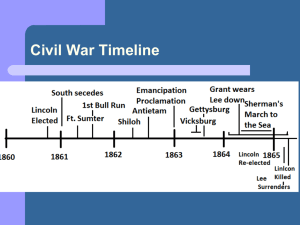
Lincoln & the Union Command & handout
... He did however move quickly and brilliantly surprising Lee with an aggressive move to Fredericksburg, VA He then stalled and waited for pontoon bridges instead of fording the river While foolishly waiting, Lee moved troops into the hills around Fredericksburg Burnside finally attacked Lee’s troo ...
... He did however move quickly and brilliantly surprising Lee with an aggressive move to Fredericksburg, VA He then stalled and waited for pontoon bridges instead of fording the river While foolishly waiting, Lee moved troops into the hills around Fredericksburg Burnside finally attacked Lee’s troo ...

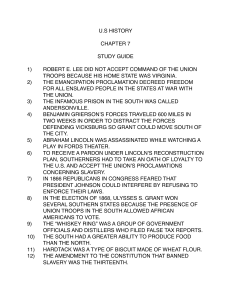
Chapter 7 Study Guide
... 20)AFRICAN AMERICANS IN THE NORTH GREETED THE EMANCIPATION PROCLAMATION JOYFULLY. 21)WILLIAM TECUMSEH SHERMANʼS “MARCH TO THE SEA” HEADED TOWARD SAVANNAH, GEORGIA. 22)IN THE CIVIL WAR, FOR THE FIRST TIME, THOUSANDS OF WOMEN SERVED AS NURSES. 23)“ PEACE DEMOCRATS” BECAME KNOWN AS COPPERHEADS. 24)HABE ...
... 20)AFRICAN AMERICANS IN THE NORTH GREETED THE EMANCIPATION PROCLAMATION JOYFULLY. 21)WILLIAM TECUMSEH SHERMANʼS “MARCH TO THE SEA” HEADED TOWARD SAVANNAH, GEORGIA. 22)IN THE CIVIL WAR, FOR THE FIRST TIME, THOUSANDS OF WOMEN SERVED AS NURSES. 23)“ PEACE DEMOCRATS” BECAME KNOWN AS COPPERHEADS. 24)HABE ...

File
... • January 25, 1863: Lincoln appoints Gen. Joseph Hooker as Commander of the Union Army, replacing Burnside. • March 3: The U.S. Congress enacts a draft, affecting male citizens aged 20 to 45, but also exempts those who pay $300 or provide a substitute. • May 1-4: Union Army defeated by Lee's much sm ...
... • January 25, 1863: Lincoln appoints Gen. Joseph Hooker as Commander of the Union Army, replacing Burnside. • March 3: The U.S. Congress enacts a draft, affecting male citizens aged 20 to 45, but also exempts those who pay $300 or provide a substitute. • May 1-4: Union Army defeated by Lee's much sm ...
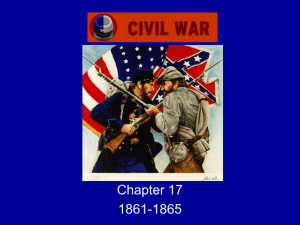
The Civil War
... abolishing slavery was not an official goal of the North. • In fact, many northerners, guided by feelings of racism, approved of slavery. ...
... abolishing slavery was not an official goal of the North. • In fact, many northerners, guided by feelings of racism, approved of slavery. ...
Major Battles of the Civil War
... • Confederate armies are outnumbered but inflict more damage on Union forces – Largely because of poor Union, and good Confederate leadership ...
... • Confederate armies are outnumbered but inflict more damage on Union forces – Largely because of poor Union, and good Confederate leadership ...

The Civil War
... Southern territory, forts, and armies. Robert E. Lee surrendered, and giving the victory to Ulysses S. Grant. The victory was unnecessary, but the surrendered terms include, handing in the guns, the soldiers going home promising never to hold slaves again. Otherwise you’d be tried for treason. ...
... Southern territory, forts, and armies. Robert E. Lee surrendered, and giving the victory to Ulysses S. Grant. The victory was unnecessary, but the surrendered terms include, handing in the guns, the soldiers going home promising never to hold slaves again. Otherwise you’d be tried for treason. ...
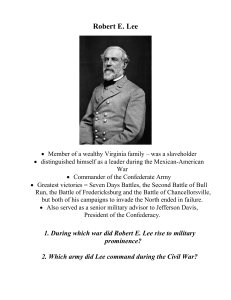
Important People of the Civil War
... Also served as a senior military advisor to Jefferson Davis, President of the Confederacy. ...
... Also served as a senior military advisor to Jefferson Davis, President of the Confederacy. ...
Jeopardy - Alvin ISD
... C. General Robert E. Lee surrenders his forces at Appomattox Court House D. John Brown captured at Harpers Ferry attempting a slave uprising. ...
... C. General Robert E. Lee surrenders his forces at Appomattox Court House D. John Brown captured at Harpers Ferry attempting a slave uprising. ...

Battle of Antietam

The Battle of Antietam /ænˈtiːtəm/, also known as the Battle of Sharpsburg, particularly in the South, fought on September 17, 1862, near Sharpsburg, Maryland, and Antietam Creek as part of the Maryland Campaign, was the first major battle in the American Civil War to take place on Union soil. It is the bloodiest single-day battle in American history, with a combined tally of dead, wounded, and missing at 22,717.After pursuing Confederate General Robert E. Lee into Maryland, Union Army Maj. Gen. George B. McClellan launched attacks against Lee's army, in defensive positions behind Antietam Creek. At dawn on September 17, Maj. Gen. Joseph Hooker's corps mounted a powerful assault on Lee's left flank. Attacks and counterattacks swept across Miller's Cornfield and fighting swirled around the Dunker Church. Union assaults against the Sunken Road eventually pierced the Confederate center, but the Federal advantage was not followed up. In the afternoon, Union Maj. Gen. Ambrose Burnside's corps entered the action, capturing a stone bridge over Antietam Creek and advancing against the Confederate right. At a crucial moment, Confederate Maj. Gen. A. P. Hill's division arrived from Harpers Ferry and launched a surprise counterattack, driving back Burnside and ending the battle. Although outnumbered two-to-one, Lee committed his entire force, while McClellan sent in less than three-quarters of his army, enabling Lee to fight the Federals to a standstill. During the night, both armies consolidated their lines. In spite of crippling casualties, Lee continued to skirmish with McClellan throughout September 18, while removing his battered army south of the Potomac River.Despite having superiority of numbers, McClellan's attacks failed to achieve force concentration, allowing Lee to counter by shifting forces and moving interior lines to meet each challenge. Despite ample reserve forces that could have been deployed to exploit localized successes, McClellan failed to destroy Lee's army. McClellan had halted Lee's invasion of Maryland, but Lee was able to withdraw his army back to Virginia without interference from the cautious McClellan. Although the battle was tactically inconclusive, the Confederate troops had withdrawn first from the battlefield, making it, in military terms, a Union victory. It had significance as enough of a victory to give President Abraham Lincoln the confidence to announce his Emancipation Proclamation, which discouraged the British and French governments from potential plans for recognition of the Confederacy.