
The Civil War 1861
... Civil War. Why were so many of them in Virginia? The first real battle of the Civil War happened in Manassas, Virginia at the Battle of Bull Run. The north should have won, but superior leadership during the battle produced a Confederate victory, just a few miles from Washington DC, the Union capita ...
... Civil War. Why were so many of them in Virginia? The first real battle of the Civil War happened in Manassas, Virginia at the Battle of Bull Run. The north should have won, but superior leadership during the battle produced a Confederate victory, just a few miles from Washington DC, the Union capita ...

Name - USD 322
... True or False: For the false statements, cross out the incorrect part and correct it. T or F 17. The Emancipation Proclamation was meant to end slavery in the U.S. T or F 18. Most of the fighting took place in the North. T or F 19. General Lee commanded the Army of the Potomac throughout the war. T ...
... True or False: For the false statements, cross out the incorrect part and correct it. T or F 17. The Emancipation Proclamation was meant to end slavery in the U.S. T or F 18. Most of the fighting took place in the North. T or F 19. General Lee commanded the Army of the Potomac throughout the war. T ...

Chapter 15 Section 1
... Closing in on the Confederacy *1864 – Lincoln gave Grant command of all Union forces. Grant decided to attack Richmond (no matter how many Union losses of life). Grant Versus Lee *Spring 1864 - Grant’s army repeatedly attacked Lee in northern VA. Although Grant could not break through Lee’s troops, ...
... Closing in on the Confederacy *1864 – Lincoln gave Grant command of all Union forces. Grant decided to attack Richmond (no matter how many Union losses of life). Grant Versus Lee *Spring 1864 - Grant’s army repeatedly attacked Lee in northern VA. Although Grant could not break through Lee’s troops, ...

The Civil War
... • There was no clear winner of this battle • The North claimed they won this battle so that they could issue the Emancipation Proclamation. • This battle lasted for only one day • This one day resulted in the most injuries and deaths in American history about 23,000 people ...
... • There was no clear winner of this battle • The North claimed they won this battle so that they could issue the Emancipation Proclamation. • This battle lasted for only one day • This one day resulted in the most injuries and deaths in American history about 23,000 people ...
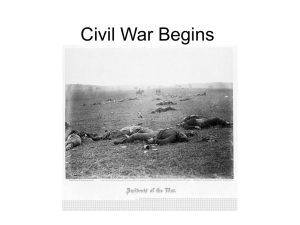
Civil War Begins - Mr. Hughes' Classes
... • Confederate center broken; McClellan refuses to send in reserve troops (Union can’t hold it) Burnside & Bridge fighting on the left is fierce • Burnside takes the bridge on the Southern right; could allow a sweep of Southern flank – A.P. Hill to rescue arrives in time to push back the Union forces ...
... • Confederate center broken; McClellan refuses to send in reserve troops (Union can’t hold it) Burnside & Bridge fighting on the left is fierce • Burnside takes the bridge on the Southern right; could allow a sweep of Southern flank – A.P. Hill to rescue arrives in time to push back the Union forces ...

Important Battles of the Civil War
... (23,700 causalities) “Bloody Pond” probably not there; definitely not that bloody In Hebrew, Shiloh means “place of peace” ...
... (23,700 causalities) “Bloody Pond” probably not there; definitely not that bloody In Hebrew, Shiloh means “place of peace” ...

The War between the States
... Lincoln ordered McClellan and his troops to return to Washington. As McClellan withdrew, Lee attacked the Union forces defending Washington. This became the Second Battle of Bull Run. The South forced the North to retreat. Confederate troops were just 20 miles from Washington. Robert E. Lee and Jeff ...
... Lincoln ordered McClellan and his troops to return to Washington. As McClellan withdrew, Lee attacked the Union forces defending Washington. This became the Second Battle of Bull Run. The South forced the North to retreat. Confederate troops were just 20 miles from Washington. Robert E. Lee and Jeff ...

Emancipation, Victory, and Assassination
... 1. After the Battles of _____________ and _____________, the South lost the support of England, who previously had supplied them with weapons and considered recognizing their independence. 2. After his victory at Vicksburg in 1863, Lincoln named ______________ commander of all the Union armies. 3. T ...
... 1. After the Battles of _____________ and _____________, the South lost the support of England, who previously had supplied them with weapons and considered recognizing their independence. 2. After his victory at Vicksburg in 1863, Lincoln named ______________ commander of all the Union armies. 3. T ...

File - Mr. Beckett`s Social Studies Web Page
... 18. Hardtack 19. Greenbacks 20. 54th Massachusetts Infantry D. People! What is the most important contribution each person contributed to the Civil War 1. Abraham Lincoln 2. Jefferson Davis 3. Clara Barton 4. William Seward 5. John Wilkes Booth 6. Andrew Johnson 7. General Robert E. Lee 8. General G ...
... 18. Hardtack 19. Greenbacks 20. 54th Massachusetts Infantry D. People! What is the most important contribution each person contributed to the Civil War 1. Abraham Lincoln 2. Jefferson Davis 3. Clara Barton 4. William Seward 5. John Wilkes Booth 6. Andrew Johnson 7. General Robert E. Lee 8. General G ...

File
... Objectives: Explain the importance of Union victories in Virginia and Deep South Discuss Lee’s surrender and the events of the war’s aftermath Grant Versus Lee General Ulysses S. Grant started a campaign to get Lee 1st battle was fought in the Wilderness near Fredericksburg, Va. 2nd battle was a ...
... Objectives: Explain the importance of Union victories in Virginia and Deep South Discuss Lee’s surrender and the events of the war’s aftermath Grant Versus Lee General Ulysses S. Grant started a campaign to get Lee 1st battle was fought in the Wilderness near Fredericksburg, Va. 2nd battle was a ...
Civil war
... speech Abraham Lincoln made • He made this speech during the Civil War • The battle of Gettysburg was the most ...
... speech Abraham Lincoln made • He made this speech during the Civil War • The battle of Gettysburg was the most ...
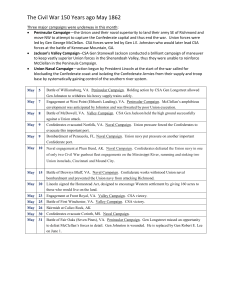
The Civil War 150 Years ago May 1862
... The Civil War 150 Years ago May 1862 Three major campaigns were underway in this month: Peninsular Campaign—the Union used their naval superiority to land their army SE of Richmond and move NW to attempt to capture the Confederate capital and thus end the war. Union forces were led by Gen George M ...
... The Civil War 150 Years ago May 1862 Three major campaigns were underway in this month: Peninsular Campaign—the Union used their naval superiority to land their army SE of Richmond and move NW to attempt to capture the Confederate capital and thus end the war. Union forces were led by Gen George M ...

The Civil War - Marion County Public Schools
... do. But, in a larger sense, we can not dedicate -- we can not consecrate -- we can not hallow, this ground-- The brave men, living and dead, who struggled here, have hallowed it, far above our poor power to add or detract. The world will little ...
... do. But, in a larger sense, we can not dedicate -- we can not consecrate -- we can not hallow, this ground-- The brave men, living and dead, who struggled here, have hallowed it, far above our poor power to add or detract. The world will little ...

American Civil War 1861- 1865 - Mr. Condry`s Social Studies Site
... • First shots of the Civil War • Major Robert Anderson of the United States Army and his men came under attack from Confederates • The Union fought back but were ineffective • Union forces surrendered a day later ...
... • First shots of the Civil War • Major Robert Anderson of the United States Army and his men came under attack from Confederates • The Union fought back but were ineffective • Union forces surrendered a day later ...


civil war unit - Amstud 2010
... Objective: Evaluate the significance of the military strategies and engagements, diplomacy, political leadership and economic policies of both sides that aided the North’s victory. Terms/Events/People to know: People Ulysses S. Grant (U) Robert E. Lee (C) Dorthea Dix Clara Barton George McClellan (U ...
... Objective: Evaluate the significance of the military strategies and engagements, diplomacy, political leadership and economic policies of both sides that aided the North’s victory. Terms/Events/People to know: People Ulysses S. Grant (U) Robert E. Lee (C) Dorthea Dix Clara Barton George McClellan (U ...

Lecture 14 - Upper Iowa University
... After the attack on Fort Sumter, Lincoln called for 75,000 volunteers for 90 days ...
... After the attack on Fort Sumter, Lincoln called for 75,000 volunteers for 90 days ...

Nomination - Jefferson County Historic Landmarks Commission
... army was dangerously divided, McClellan took chase catching up with the Confederate rear guard stationed near Boonsboro at South Mountain on the morning of September 14th. The small contingent of Confederates held the three South Mountain gaps throughout the day, blocking the Union army from passag ...
... army was dangerously divided, McClellan took chase catching up with the Confederate rear guard stationed near Boonsboro at South Mountain on the morning of September 14th. The small contingent of Confederates held the three South Mountain gaps throughout the day, blocking the Union army from passag ...

The Cultural Landscape of the Colony of Virginia
... Carolina. As the North and South prepared for the bloodiest and most tragic war ever fought by American soldiers, Virginia’s men and women took sides in the fighting. ...
... Carolina. As the North and South prepared for the bloodiest and most tragic war ever fought by American soldiers, Virginia’s men and women took sides in the fighting. ...

Slide 1
... Shiloh • Grant attacked by Confederates and suffered huge losses • Grant counterattacks the next day with reinforcements • Confederates retreat • Both sides see they are in for a long and bloody war • ¼ of 100,000 men who fought there were killed, wounded, or captured ...
... Shiloh • Grant attacked by Confederates and suffered huge losses • Grant counterattacks the next day with reinforcements • Confederates retreat • Both sides see they are in for a long and bloody war • ¼ of 100,000 men who fought there were killed, wounded, or captured ...

The U.S. Civil War 1861
... Confederate Army History. invade Union territory ● Approximately 23,000 are killed or in Maryland; after a wounded. brutal battle he ● Union Gen. McClellan does not retreats. pursue (gets fired) ● Allows Lincoln to issue Emancipation Proclamation from a position of strength ...
... Confederate Army History. invade Union territory ● Approximately 23,000 are killed or in Maryland; after a wounded. brutal battle he ● Union Gen. McClellan does not retreats. pursue (gets fired) ● Allows Lincoln to issue Emancipation Proclamation from a position of strength ...
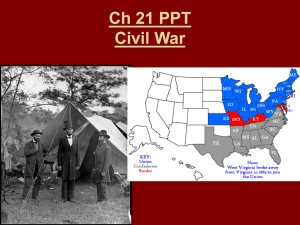
Ch. 21 – The Furnace of War
... • July 1861 - Battle of Bull Run: At 1st, battle went well for the Union, but Thomas “Stonewall” Jackson stood firm. Confederate reinforcements arrived – Union army fled. • Significance: Overconfidence in the South – Soldiers deserted; some feeling the war was over. • North – Realized war wasn’t goi ...
... • July 1861 - Battle of Bull Run: At 1st, battle went well for the Union, but Thomas “Stonewall” Jackson stood firm. Confederate reinforcements arrived – Union army fled. • Significance: Overconfidence in the South – Soldiers deserted; some feeling the war was over. • North – Realized war wasn’t goi ...
What factors and events led to the Union victory in the Civil War?
... Union’s favor in 1863. •After victory at Vicksburg, Union General Ulysses S. Grant achieved the Union goal of splitting the Confederacy in two. Next, the Union faced a Confederate invasion at the Battle of Gettysburg and defeated Lee’s troops there. The battle destroyed one third of Lee’s forces. ...
... Union’s favor in 1863. •After victory at Vicksburg, Union General Ulysses S. Grant achieved the Union goal of splitting the Confederacy in two. Next, the Union faced a Confederate invasion at the Battle of Gettysburg and defeated Lee’s troops there. The battle destroyed one third of Lee’s forces. ...

Battle at Bull Run
... The battle started March 8, 1862, as the Confederate-controlled Merrimack attacked several Union ships at Hampton Roads, near the James River in Virginia. Its mission was to break the Union blockade of southern ports. The Merrimack quickly sunk the USS Cumberland by ramming it below the waterline. N ...
... The battle started March 8, 1862, as the Confederate-controlled Merrimack attacked several Union ships at Hampton Roads, near the James River in Virginia. Its mission was to break the Union blockade of southern ports. The Merrimack quickly sunk the USS Cumberland by ramming it below the waterline. N ...

The War
... Union cavalry. Soon both sides called for reinforcements and the war’s greatest battle began. The Battle of Gettysburg would last for three days and culminate with a massive Confederate infantry charge led by Major General George Pickett. The Rebel charge was wiped out by the deadly effective fire f ...
... Union cavalry. Soon both sides called for reinforcements and the war’s greatest battle began. The Battle of Gettysburg would last for three days and culminate with a massive Confederate infantry charge led by Major General George Pickett. The Rebel charge was wiped out by the deadly effective fire f ...
Battle of Antietam

The Battle of Antietam /ænˈtiːtəm/, also known as the Battle of Sharpsburg, particularly in the South, fought on September 17, 1862, near Sharpsburg, Maryland, and Antietam Creek as part of the Maryland Campaign, was the first major battle in the American Civil War to take place on Union soil. It is the bloodiest single-day battle in American history, with a combined tally of dead, wounded, and missing at 22,717.After pursuing Confederate General Robert E. Lee into Maryland, Union Army Maj. Gen. George B. McClellan launched attacks against Lee's army, in defensive positions behind Antietam Creek. At dawn on September 17, Maj. Gen. Joseph Hooker's corps mounted a powerful assault on Lee's left flank. Attacks and counterattacks swept across Miller's Cornfield and fighting swirled around the Dunker Church. Union assaults against the Sunken Road eventually pierced the Confederate center, but the Federal advantage was not followed up. In the afternoon, Union Maj. Gen. Ambrose Burnside's corps entered the action, capturing a stone bridge over Antietam Creek and advancing against the Confederate right. At a crucial moment, Confederate Maj. Gen. A. P. Hill's division arrived from Harpers Ferry and launched a surprise counterattack, driving back Burnside and ending the battle. Although outnumbered two-to-one, Lee committed his entire force, while McClellan sent in less than three-quarters of his army, enabling Lee to fight the Federals to a standstill. During the night, both armies consolidated their lines. In spite of crippling casualties, Lee continued to skirmish with McClellan throughout September 18, while removing his battered army south of the Potomac River.Despite having superiority of numbers, McClellan's attacks failed to achieve force concentration, allowing Lee to counter by shifting forces and moving interior lines to meet each challenge. Despite ample reserve forces that could have been deployed to exploit localized successes, McClellan failed to destroy Lee's army. McClellan had halted Lee's invasion of Maryland, but Lee was able to withdraw his army back to Virginia without interference from the cautious McClellan. Although the battle was tactically inconclusive, the Confederate troops had withdrawn first from the battlefield, making it, in military terms, a Union victory. It had significance as enough of a victory to give President Abraham Lincoln the confidence to announce his Emancipation Proclamation, which discouraged the British and French governments from potential plans for recognition of the Confederacy.