
8thCivilWarPPTStudent
... • fought in and around the town of Gettysburg, Pennsylvania, • The largest number of casualties in the American Civil War on BOTH sides • Is frequently cited as the war's turning point. • Union Maj. Gen. George Gordon Meade defeated attacks by Confederate Gen. Robert E. Lee, ending Lee's invasion of ...
... • fought in and around the town of Gettysburg, Pennsylvania, • The largest number of casualties in the American Civil War on BOTH sides • Is frequently cited as the war's turning point. • Union Maj. Gen. George Gordon Meade defeated attacks by Confederate Gen. Robert E. Lee, ending Lee's invasion of ...

The Civil War in Texas and Beyond
... Battle of Gettysburg (July 1 – 3) • Robert E. Lee tried to invade Pennsylvania • 51,000 casualties in 3 day battle • Hood’s Texas Brigade played an important role. • Turning point of the Civil War • Huge Confederate defeat. ...
... Battle of Gettysburg (July 1 – 3) • Robert E. Lee tried to invade Pennsylvania • 51,000 casualties in 3 day battle • Hood’s Texas Brigade played an important role. • Turning point of the Civil War • Huge Confederate defeat. ...
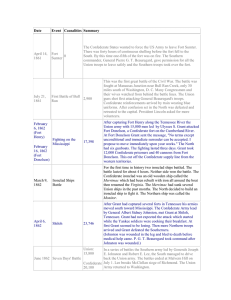
CivilWarTimeline
... moved south toward Mississippi. The Confederate Army lead by General Albert Sidney Johnston, met Grant at Shiloh, Tennessee. Grant had not expected the attack which started while the Yankee soldiers were cooking their breakfast. At first Grant seemed to be losing. Then more Northern troops arrived a ...
... moved south toward Mississippi. The Confederate Army lead by General Albert Sidney Johnston, met Grant at Shiloh, Tennessee. Grant had not expected the attack which started while the Yankee soldiers were cooking their breakfast. At first Grant seemed to be losing. Then more Northern troops arrived a ...

Chapter 16 Section 4 The Strain of War PowerPoint
... Meade held their positions • That night Meade made the decision not to retreat • The next day Lee order an attack designed to “create a panic and virtually destroy the [Union] army” ...
... Meade held their positions • That night Meade made the decision not to retreat • The next day Lee order an attack designed to “create a panic and virtually destroy the [Union] army” ...

Chapter 11 – The Civil War 1861-1865
... army. He again divided his forces and sent Stonewall Jackson to circle around BEHIND Pope’s forces and attack from the rear. Then, when Pope’s forces were fully engaged, Lee attacked with the rest of his army. This was almost at exactly the same spot as the First Battle of Bull Run, and again, the N ...
... army. He again divided his forces and sent Stonewall Jackson to circle around BEHIND Pope’s forces and attack from the rear. Then, when Pope’s forces were fully engaged, Lee attacked with the rest of his army. This was almost at exactly the same spot as the First Battle of Bull Run, and again, the N ...
Civil War Part I
... • Commander: General George Meade • Brig. Gen. John Buford’s cavalry (1st day) • Major Gen. John Reynolds (Union 1st Corps), 1st Day) • General Abner Doubleday (1st day ordered retreat from McPherson and Oak Ridge to Seminary Ridge and ultimately Cemetery Hill) • Major General Winfield S. Hancock (t ...
... • Commander: General George Meade • Brig. Gen. John Buford’s cavalry (1st day) • Major Gen. John Reynolds (Union 1st Corps), 1st Day) • General Abner Doubleday (1st day ordered retreat from McPherson and Oak Ridge to Seminary Ridge and ultimately Cemetery Hill) • Major General Winfield S. Hancock (t ...


USA Civil War (1861-1865)
... War Introduction There are many causes that led to the American Civil War. Slavery is known as the main cause for the war, but other political and cultural differences between the North and the South certainly contributed. The economies of many northern states moved away from farming to industry. A ...
... War Introduction There are many causes that led to the American Civil War. Slavery is known as the main cause for the war, but other political and cultural differences between the North and the South certainly contributed. The economies of many northern states moved away from farming to industry. A ...

Advantages and Disadvantages
... The war was the battle of ATTRITION=the wearing down of one side by the other through exhaustion of soldiers and resources. SOUTH’S STRATEGY Pick battles carefully Retreat when necessary Wage a defensive war of attrition ...
... The war was the battle of ATTRITION=the wearing down of one side by the other through exhaustion of soldiers and resources. SOUTH’S STRATEGY Pick battles carefully Retreat when necessary Wage a defensive war of attrition ...

Civil War Key Events
... Charleston S.C. from Union Lincoln declares a state of insurrection Virginia, Arkansas, Tennessee, and North Carolina secede 1st Major Battle- 1st Battle of Bull Run or Manassas, VA ...
... Charleston S.C. from Union Lincoln declares a state of insurrection Virginia, Arkansas, Tennessee, and North Carolina secede 1st Major Battle- 1st Battle of Bull Run or Manassas, VA ...

Chapter 13 Notes
... increased, and England began to consider officially recognizing the South as a independent nation e. Battle of Antietam (Sharpsburg) – September 1862 Lee moved north into Maryland hoped to gain support from pro-southern citizens needed big victory in north to get British recognition divided ...
... increased, and England began to consider officially recognizing the South as a independent nation e. Battle of Antietam (Sharpsburg) – September 1862 Lee moved north into Maryland hoped to gain support from pro-southern citizens needed big victory in north to get British recognition divided ...

Civil War 1861-1865
... we say here…” (possibly the most famous speech in history) George Meade vs. Lee Pickett’s Charge (Pettigrew-Trimble or Longstreet) Confederates lost 50% Between 46,000-51,000 Americans killed ...
... we say here…” (possibly the most famous speech in history) George Meade vs. Lee Pickett’s Charge (Pettigrew-Trimble or Longstreet) Confederates lost 50% Between 46,000-51,000 Americans killed ...

Ch. 21 Notes The Furnace of the Civil War
... 1. After Antietam, Lincoln gives the Union troops to Ambrose E. Burnside (even though he ...
... 1. After Antietam, Lincoln gives the Union troops to Ambrose E. Burnside (even though he ...

Chapter 21 The Furnace of the Civil War
... and overwhelm Union troops • Union soldiers and onlookers retreat back to Washington DC • Why didn’t the Confederates ...
... and overwhelm Union troops • Union soldiers and onlookers retreat back to Washington DC • Why didn’t the Confederates ...

Chancellorsville PowerPoint
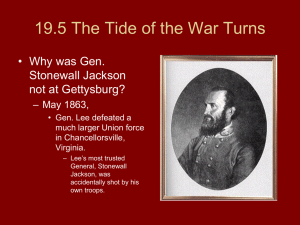
... Lee's force instead. Jackson routs the Union XI Corps with a surprise attack. Jackson is accidentally shot by his own troops command passes to J.E.B Stuart. May 3: Lee and Stuart reunite after a desperate morning of punishing frontal attacks. Lee is diverted from attacking Hooker's last line by an u ...
... Lee's force instead. Jackson routs the Union XI Corps with a surprise attack. Jackson is accidentally shot by his own troops command passes to J.E.B Stuart. May 3: Lee and Stuart reunite after a desperate morning of punishing frontal attacks. Lee is diverted from attacking Hooker's last line by an u ...

The North Takes Charge
... Many historians consider the battle to be a major turning point in the American Civil War November 19th, 1863, President Lincoln delivered his famous “Gettysburg Address” at the dedication ceremony for the Gettysburg National Cemetery ...
... Many historians consider the battle to be a major turning point in the American Civil War November 19th, 1863, President Lincoln delivered his famous “Gettysburg Address” at the dedication ceremony for the Gettysburg National Cemetery ...

35. Battles Every American Should Remember
... plans had gone awry, and General Halleck took over. Halleck advanced, but slowly, since he fortified his camp every night. A blow to the Confederacy at Shiloh came in that their highest ranking general, Johnston, was shot and left to bleed to death accidentally, but they got Robert E. Lee in command ...
... plans had gone awry, and General Halleck took over. Halleck advanced, but slowly, since he fortified his camp every night. A blow to the Confederacy at Shiloh came in that their highest ranking general, Johnston, was shot and left to bleed to death accidentally, but they got Robert E. Lee in command ...
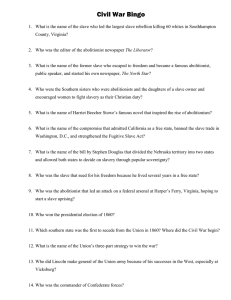
Civil War Bingo - Troup County Schools
... 11. Which southern state was the first to secede from the Union in 1860? Where did the Civil War begin? 12. What is the name of the Union’s three-part strategy to win the war? ...
... 11. Which southern state was the first to secede from the Union in 1860? Where did the Civil War begin? 12. What is the name of the Union’s three-part strategy to win the war? ...

civil_war_highlights_student_notes
... Johnson pardons all southerners but one: Major Henry Wirtz, commander of the Confederate prison in Georgia. What did the Civil War cost America Union had enlisted 2,324,516 soldiers: approximately 360,000 were killed. The Confederate army had about 1,000,000 soldiers with losses of 260,000 Union: 6 ...
... Johnson pardons all southerners but one: Major Henry Wirtz, commander of the Confederate prison in Georgia. What did the Civil War cost America Union had enlisted 2,324,516 soldiers: approximately 360,000 were killed. The Confederate army had about 1,000,000 soldiers with losses of 260,000 Union: 6 ...

Chapter 17, Lesson 2 Notes
... 1. July 21 – Union troops, commanded by General Irvin McDowell attacked Confederate force led by General P.G.T. Beauregard i. Virginia near small river called Bull Run ii. Spectators watched from a few miles away iii. Initially Yankees drove Confederates back iv. Rebels under General Thomas Jackson ...
... 1. July 21 – Union troops, commanded by General Irvin McDowell attacked Confederate force led by General P.G.T. Beauregard i. Virginia near small river called Bull Run ii. Spectators watched from a few miles away iii. Initially Yankees drove Confederates back iv. Rebels under General Thomas Jackson ...

civil_war_timeline
... The Battle of Shiloh The Battle of Shiloh occurred soon after the Union had divided into the East and West. General Grant led his army through the woods only to find that the Confederates were there to attack near Shiloh. This battle lasted two days with many casualties. And even though the Union w ...
... The Battle of Shiloh The Battle of Shiloh occurred soon after the Union had divided into the East and West. General Grant led his army through the woods only to find that the Confederates were there to attack near Shiloh. This battle lasted two days with many casualties. And even though the Union w ...
Slide 1
... that all federal property in the state be surrendered to state authorities. Major Robert Aniston concentrated his unit at the site, and when Lincoln took office, this site was one of the only two forts in the South still under Union control. ...
... that all federal property in the state be surrendered to state authorities. Major Robert Aniston concentrated his unit at the site, and when Lincoln took office, this site was one of the only two forts in the South still under Union control. ...

The Civil War: Important Battles and Events
... Robert E. Lee’s troops ran into George Meade’s troops in a small Pennsylvania town called Gettysburg. (3 days of fighting; 51,000 casualties). ...
... Robert E. Lee’s troops ran into George Meade’s troops in a small Pennsylvania town called Gettysburg. (3 days of fighting; 51,000 casualties). ...
Battle of Antietam

The Battle of Antietam /ænˈtiːtəm/, also known as the Battle of Sharpsburg, particularly in the South, fought on September 17, 1862, near Sharpsburg, Maryland, and Antietam Creek as part of the Maryland Campaign, was the first major battle in the American Civil War to take place on Union soil. It is the bloodiest single-day battle in American history, with a combined tally of dead, wounded, and missing at 22,717.After pursuing Confederate General Robert E. Lee into Maryland, Union Army Maj. Gen. George B. McClellan launched attacks against Lee's army, in defensive positions behind Antietam Creek. At dawn on September 17, Maj. Gen. Joseph Hooker's corps mounted a powerful assault on Lee's left flank. Attacks and counterattacks swept across Miller's Cornfield and fighting swirled around the Dunker Church. Union assaults against the Sunken Road eventually pierced the Confederate center, but the Federal advantage was not followed up. In the afternoon, Union Maj. Gen. Ambrose Burnside's corps entered the action, capturing a stone bridge over Antietam Creek and advancing against the Confederate right. At a crucial moment, Confederate Maj. Gen. A. P. Hill's division arrived from Harpers Ferry and launched a surprise counterattack, driving back Burnside and ending the battle. Although outnumbered two-to-one, Lee committed his entire force, while McClellan sent in less than three-quarters of his army, enabling Lee to fight the Federals to a standstill. During the night, both armies consolidated their lines. In spite of crippling casualties, Lee continued to skirmish with McClellan throughout September 18, while removing his battered army south of the Potomac River.Despite having superiority of numbers, McClellan's attacks failed to achieve force concentration, allowing Lee to counter by shifting forces and moving interior lines to meet each challenge. Despite ample reserve forces that could have been deployed to exploit localized successes, McClellan failed to destroy Lee's army. McClellan had halted Lee's invasion of Maryland, but Lee was able to withdraw his army back to Virginia without interference from the cautious McClellan. Although the battle was tactically inconclusive, the Confederate troops had withdrawn first from the battlefield, making it, in military terms, a Union victory. It had significance as enough of a victory to give President Abraham Lincoln the confidence to announce his Emancipation Proclamation, which discouraged the British and French governments from potential plans for recognition of the Confederacy.