The North Wins 17-3
... Burnside as General but Burnside led 12,600 troops to their death at Fredericksburg John Hooker replaced Burnside as General but he was defeated at Chancellorsville by Lee with half as many troops Stonewall Jackson would be killed after the battle but Lee would plan to invade the North again to ...
... Burnside as General but Burnside led 12,600 troops to their death at Fredericksburg John Hooker replaced Burnside as General but he was defeated at Chancellorsville by Lee with half as many troops Stonewall Jackson would be killed after the battle but Lee would plan to invade the North again to ...

African Americans and the War Completed
... The Battle of Antietam or Sharpsburg (fought near Sharpsburg, Maryland) on Wednesday, September 17, 1862 put an end to General Robert E. Lee's first serious attempt to bring the American Civil War to the North, gave President Abraham Lincoln the victory he needed to issue the crucial Emancipation Pr ...
... The Battle of Antietam or Sharpsburg (fought near Sharpsburg, Maryland) on Wednesday, September 17, 1862 put an end to General Robert E. Lee's first serious attempt to bring the American Civil War to the North, gave President Abraham Lincoln the victory he needed to issue the crucial Emancipation Pr ...

A Nation Divided
... Battle of Bull Run • Manassas, Virginia (Battle of Manassas) • Union army is trying to get to the Confederate capital • Thomas J. Jackson and “rebel yell” rally Confederate troops and shock Union troops • “Stonewall” Jackson led troops to victory— the North had underestimated the South • Southerner ...
... Battle of Bull Run • Manassas, Virginia (Battle of Manassas) • Union army is trying to get to the Confederate capital • Thomas J. Jackson and “rebel yell” rally Confederate troops and shock Union troops • “Stonewall” Jackson led troops to victory— the North had underestimated the South • Southerner ...


The_Emancipation_Proclamationforcloseread
... The Emancipation Proclamation On September 17, 1862, 75,000 Union troops under the command of George McClellan, clashed with about 40,000 Confederate troops under the command of Robert E. Lee at Sharpsburg, Maryland. The horrible battle, which was the bloodiest day in American history, became known ...
... The Emancipation Proclamation On September 17, 1862, 75,000 Union troops under the command of George McClellan, clashed with about 40,000 Confederate troops under the command of Robert E. Lee at Sharpsburg, Maryland. The horrible battle, which was the bloodiest day in American history, became known ...
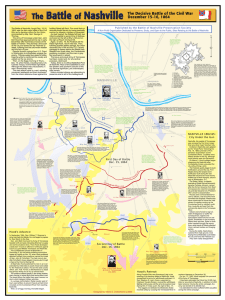
Battle of Nashville Preservation Society, Inc.
... losses at Franklin on Nov. 30, when Hood recklessly attacked fortified Union positions manned by troops of Gen. John M. Schofield. This had come a day after Schofield’s troops slipped miraculously through a trap set by Hood at Spring Hill. At Nashville, Hood positioned his men in an overextended fou ...
... losses at Franklin on Nov. 30, when Hood recklessly attacked fortified Union positions manned by troops of Gen. John M. Schofield. This had come a day after Schofield’s troops slipped miraculously through a trap set by Hood at Spring Hill. At Nashville, Hood positioned his men in an overextended fou ...
The Civil War
... In the North, most of the Union commanded by General George G. Meade, lined up on a strip of high ground. Then, 15,000 troops attacked the middle of General Meade’s defensive line. The South lost the Battle of Gettysburg. ...
... In the North, most of the Union commanded by General George G. Meade, lined up on a strip of high ground. Then, 15,000 troops attacked the middle of General Meade’s defensive line. The South lost the Battle of Gettysburg. ...

CHAPTER 16: THE CIVIL WAR BEGINS Section 3: No End in
... B. Several high-ranking officers were killed on both sides. C. It was the bloodiest single day in all of American history. D. Lee lost nearly one-third of his fighting force. E. Lincoln fired McClellan for being too cautious. F. Cavalry commander Jeb Stuart rode around the entire Union army. G. Lee ...
... B. Several high-ranking officers were killed on both sides. C. It was the bloodiest single day in all of American history. D. Lee lost nearly one-third of his fighting force. E. Lincoln fired McClellan for being too cautious. F. Cavalry commander Jeb Stuart rode around the entire Union army. G. Lee ...

The Civil War (1861
... Win foreign recognition from France or Britain (because of Cotton trade) ...
... Win foreign recognition from France or Britain (because of Cotton trade) ...

The 1940s 14-C 10 points NAME
... on the battlefield occurred about three months after Fort Sumter fell, near the little creek of Bull Run. 20. In the afternoon Confederate reinforcements helped win the first Southern victory ...
... on the battlefield occurred about three months after Fort Sumter fell, near the little creek of Bull Run. 20. In the afternoon Confederate reinforcements helped win the first Southern victory ...

Document
... command of Union army. – Grant forced Lee to fight series of battles in Virginia that stretched Confederate soldiers and supplies to limit. • Wilderness Campaign: series of battles designed to capture Confederate capital of Richmond, Virginia, in 1864. ...
... command of Union army. – Grant forced Lee to fight series of battles in Virginia that stretched Confederate soldiers and supplies to limit. • Wilderness Campaign: series of battles designed to capture Confederate capital of Richmond, Virginia, in 1864. ...

Civil War Did Not St..
... President Lincoln had trouble finding a general to lead the Union army as effectively as General Robert E. Lee commanded the Confederate army. One popular but not very successful general was George "Little Mac" McClellan. General McClellan frustrated Lincoln by repeatedly asking for more troops, sup ...
... President Lincoln had trouble finding a general to lead the Union army as effectively as General Robert E. Lee commanded the Confederate army. One popular but not very successful general was George "Little Mac" McClellan. General McClellan frustrated Lincoln by repeatedly asking for more troops, sup ...


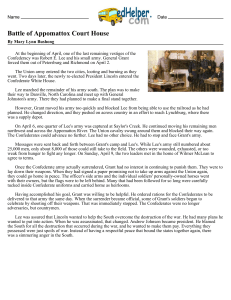
Battle of Appomattox Court House
... their way to Danville, North Carolina and meet up with General Johnston's army. There they had planned to make a final stand together. However, Grant moved his army too quickly and blocked Lee from being able to use the railroad as he had planned. He changed direction, and they pushed on across coun ...
... their way to Danville, North Carolina and meet up with General Johnston's army. There they had planned to make a final stand together. However, Grant moved his army too quickly and blocked Lee from being able to use the railroad as he had planned. He changed direction, and they pushed on across coun ...

Name - Schoolwires.net
... B. after the Thirteenth Amendment was passed C. when they were conscripted D. when their masters freed them from slavery 12. In general, how could one describe the life of a soldier during the Civil War? A. much as he had lived it at home B. far more prosperous than he could have lived at home C. us ...
... B. after the Thirteenth Amendment was passed C. when they were conscripted D. when their masters freed them from slavery 12. In general, how could one describe the life of a soldier during the Civil War? A. much as he had lived it at home B. far more prosperous than he could have lived at home C. us ...
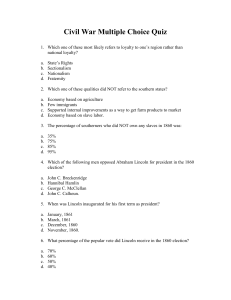
Civil War Multiple Choice Quiz
... 10. Which of the following was a strength of the Union during the Civil War? a. b. c. d. ...
... 10. Which of the following was a strength of the Union during the Civil War? a. b. c. d. ...

12.4 Devastation and New Freedom
... On April 2, 1865, Lee tried to slip around Grant’s army. He planned to unite his troops with those of General Johnston. Lee hoped that together they would be able to continue the war. On April 9, 1865, Lee’s forces came to the Virginia town of Appomattox Court House. They were surrounded by a much ...
... On April 2, 1865, Lee tried to slip around Grant’s army. He planned to unite his troops with those of General Johnston. Lee hoped that together they would be able to continue the war. On April 9, 1865, Lee’s forces came to the Virginia town of Appomattox Court House. They were surrounded by a much ...

CHAPTER 16: THE CIVIL WAR BEGINS Section 3: No End in
... B. Several high-ranking officers were killed on both sides. C. It was the bloodiest single day in all of American history. D. Lee lost nearly one-third of his fighting force. E. Lincoln fired McClellan for being too cautious. F. Cavalry commander Jeb Stuart rode around the entire Union army. G. Lee ...
... B. Several high-ranking officers were killed on both sides. C. It was the bloodiest single day in all of American history. D. Lee lost nearly one-third of his fighting force. E. Lincoln fired McClellan for being too cautious. F. Cavalry commander Jeb Stuart rode around the entire Union army. G. Lee ...

LESSON PLAN 4 by Corbin
... 3. Students will form groups of 3-4 students and move their desks together to begin formulating battle plans based off of the interception of “Special Orders 191” by the Union army. Procedure: Introduction/Motivation: General Robert E. Lee was arguably the most decorated Civil War general. On Septem ...
... 3. Students will form groups of 3-4 students and move their desks together to begin formulating battle plans based off of the interception of “Special Orders 191” by the Union army. Procedure: Introduction/Motivation: General Robert E. Lee was arguably the most decorated Civil War general. On Septem ...

Chapter 15 Section 5 Union victories in 1863
... hoping to capture Little Round Top from Union forces. Union troops fired down upon the Confederatesvicious fighting but Union forces held on. ...
... hoping to capture Little Round Top from Union forces. Union troops fired down upon the Confederatesvicious fighting but Union forces held on. ...

The Civil War in Texas and Beyond
... Battle of Gettysburg (July 1 – 3) • Robert E. Lee tried to invade Pennsylvania • 51,000 casualties in 3 day battle • Hood’s Texas Brigade played an important role. • Turning point of the Civil War • Huge Confederate defeat. ...
... Battle of Gettysburg (July 1 – 3) • Robert E. Lee tried to invade Pennsylvania • 51,000 casualties in 3 day battle • Hood’s Texas Brigade played an important role. • Turning point of the Civil War • Huge Confederate defeat. ...

Chapter 10 Section 2 - Early Years of War
... a ceremony at Gettysburg honoring Union soldiers who died in the battle. Lincoln gave a speech known today as the Gettysburg Address. The speech lasted a little over two minutes. Lincoln said the Civil War had to be fought to make sure that "government of the people, by the people, for the people, s ...
... a ceremony at Gettysburg honoring Union soldiers who died in the battle. Lincoln gave a speech known today as the Gettysburg Address. The speech lasted a little over two minutes. Lincoln said the Civil War had to be fought to make sure that "government of the people, by the people, for the people, s ...
Battle of Antietam

The Battle of Antietam /ænˈtiːtəm/, also known as the Battle of Sharpsburg, particularly in the South, fought on September 17, 1862, near Sharpsburg, Maryland, and Antietam Creek as part of the Maryland Campaign, was the first major battle in the American Civil War to take place on Union soil. It is the bloodiest single-day battle in American history, with a combined tally of dead, wounded, and missing at 22,717.After pursuing Confederate General Robert E. Lee into Maryland, Union Army Maj. Gen. George B. McClellan launched attacks against Lee's army, in defensive positions behind Antietam Creek. At dawn on September 17, Maj. Gen. Joseph Hooker's corps mounted a powerful assault on Lee's left flank. Attacks and counterattacks swept across Miller's Cornfield and fighting swirled around the Dunker Church. Union assaults against the Sunken Road eventually pierced the Confederate center, but the Federal advantage was not followed up. In the afternoon, Union Maj. Gen. Ambrose Burnside's corps entered the action, capturing a stone bridge over Antietam Creek and advancing against the Confederate right. At a crucial moment, Confederate Maj. Gen. A. P. Hill's division arrived from Harpers Ferry and launched a surprise counterattack, driving back Burnside and ending the battle. Although outnumbered two-to-one, Lee committed his entire force, while McClellan sent in less than three-quarters of his army, enabling Lee to fight the Federals to a standstill. During the night, both armies consolidated their lines. In spite of crippling casualties, Lee continued to skirmish with McClellan throughout September 18, while removing his battered army south of the Potomac River.Despite having superiority of numbers, McClellan's attacks failed to achieve force concentration, allowing Lee to counter by shifting forces and moving interior lines to meet each challenge. Despite ample reserve forces that could have been deployed to exploit localized successes, McClellan failed to destroy Lee's army. McClellan had halted Lee's invasion of Maryland, but Lee was able to withdraw his army back to Virginia without interference from the cautious McClellan. Although the battle was tactically inconclusive, the Confederate troops had withdrawn first from the battlefield, making it, in military terms, a Union victory. It had significance as enough of a victory to give President Abraham Lincoln the confidence to announce his Emancipation Proclamation, which discouraged the British and French governments from potential plans for recognition of the Confederacy.