
The Civil War
... south from Illinois to gain more control of the Mississippi. In 1862, Grant won a series of victories that put Kentucky and much of Tennessee under Union control. Grant refused to accept any battle outcome besides “unconditional surrender.” ...
... south from Illinois to gain more control of the Mississippi. In 1862, Grant won a series of victories that put Kentucky and much of Tennessee under Union control. Grant refused to accept any battle outcome besides “unconditional surrender.” ...

CHAPTER 10, 11, 12 2017 STUDY GUIDE
... The Confederate victory at Bull Run made the South think they had won the war It also made the North realize that they had underestimated their opponent ...
... The Confederate victory at Bull Run made the South think they had won the war It also made the North realize that they had underestimated their opponent ...

The Civil War 1861-1865
... home with their personal possessions, horse’s, and three days’ rations. Officers were allowed to keep their ...
... home with their personal possessions, horse’s, and three days’ rations. Officers were allowed to keep their ...

slaves in the “rebelling” states (seceded Southern states)
... The war was now underway, but without any major conflicts in the first few months. Both sides were eager for a quick victory that might force the other side to give up the war and surrender. First Battle of Bull Run (July 1861) – first major battle of the Civil War between nearly 30,000 Union and Co ...
... The war was now underway, but without any major conflicts in the first few months. Both sides were eager for a quick victory that might force the other side to give up the war and surrender. First Battle of Bull Run (July 1861) – first major battle of the Civil War between nearly 30,000 Union and Co ...
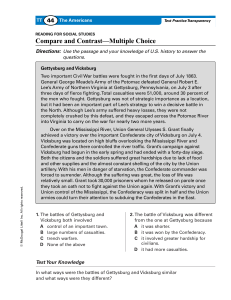
Gettysburg and Vicksburg compared
... General George Meade’s Army of the Potomac defeated General Robert E. Lee’s Army of Northern Virginia at Gettysburg, Pennsylvania, on July 3 after three days of fierce fighting. Total casualties were 51,000, around 30 percent of the men who fought. Gettysburg was not of strategic importance as a loc ...
... General George Meade’s Army of the Potomac defeated General Robert E. Lee’s Army of Northern Virginia at Gettysburg, Pennsylvania, on July 3 after three days of fierce fighting. Total casualties were 51,000, around 30 percent of the men who fought. Gettysburg was not of strategic importance as a loc ...

THE CIVIL WAR
... • Gen. McDowell was replaced by Gen. George B. McClellan in the east. He was too cautious & could not make decisions quickly. • Confederate Gen. Johnston was wounded in the Union conflict to take Richmond, VA. Gen. Robert E. Lee replaced him & caused the North to retreat. N. & S. together lost 30,00 ...
... • Gen. McDowell was replaced by Gen. George B. McClellan in the east. He was too cautious & could not make decisions quickly. • Confederate Gen. Johnston was wounded in the Union conflict to take Richmond, VA. Gen. Robert E. Lee replaced him & caused the North to retreat. N. & S. together lost 30,00 ...

Civil War Battles
... finest general in either army before the war began. He bled to death on the first day of Shiloh from a wound to the leg while leading a charge through an orchard. ...
... finest general in either army before the war began. He bled to death on the first day of Shiloh from a wound to the leg while leading a charge through an orchard. ...

Civil War PowerPoint
... battles of the war Lee attempts to retreat and join other Confederates in NC, but is caught and surrounded by Grant Appomattox Court House – April 9, 1865 – Lee surrenders his army April 14, 1865 – Lincoln is assassinated by John Wilkes Booth – ...
... battles of the war Lee attempts to retreat and join other Confederates in NC, but is caught and surrounded by Grant Appomattox Court House – April 9, 1865 – Lee surrenders his army April 14, 1865 – Lincoln is assassinated by John Wilkes Booth – ...

Bull Run Ft. Sumter Shiloh Antietam Fredericksburg Chancellorsville
... 1. Trace in the division between North/South by tracing a dark line along the northern boundary of Texas, up the western boundary of Arkansas, and northern boundary of Tennessee and Virginia. Atlas P. 56 2. Color in the northern states, southern states, and border states according to the KEY on the ...
... 1. Trace in the division between North/South by tracing a dark line along the northern boundary of Texas, up the western boundary of Arkansas, and northern boundary of Tennessee and Virginia. Atlas P. 56 2. Color in the northern states, southern states, and border states according to the KEY on the ...
PowerPoint - Century of Progress
... beautifully expressed what the war had come to mean: • It is for the living to make sure the dead had not died in vain • That the United States will experience ...
... beautifully expressed what the war had come to mean: • It is for the living to make sure the dead had not died in vain • That the United States will experience ...
Antietam Animated Map Lesson Plan with Materials
... time to retreat slowly toward the Richmond defenses. A surprise attack by Rebels at the battle of Seven Pines (or Fair Oaks) blunted the already sluggish Federal advance. Although the Union army repulsed the attacks, McClellan to again delayed any further movement, hoping for more reinforcements to ...
... time to retreat slowly toward the Richmond defenses. A surprise attack by Rebels at the battle of Seven Pines (or Fair Oaks) blunted the already sluggish Federal advance. Although the Union army repulsed the attacks, McClellan to again delayed any further movement, hoping for more reinforcements to ...

The War Between the States
... Lincoln issued an executive order freeing all slaves in any state which was in armed rebellion, but not in states which had stayed in the Union! ...
... Lincoln issued an executive order freeing all slaves in any state which was in armed rebellion, but not in states which had stayed in the Union! ...
10 Days - Antietam
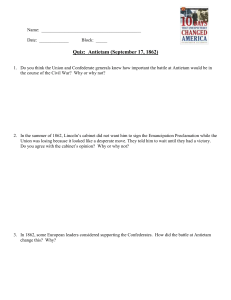
... 2. In the summer of 1862, Lincoln’s cabinet did not want him to sign the Emancipation Proclamation while the Union was losing because it looked like a desperate move. They told him to wait until they had a victory. Do you agree with the cabinet’s opinion? Why or why not? ...
... 2. In the summer of 1862, Lincoln’s cabinet did not want him to sign the Emancipation Proclamation while the Union was losing because it looked like a desperate move. They told him to wait until they had a victory. Do you agree with the cabinet’s opinion? Why or why not? ...

Civil War - Northwest ISD Moodle
... epitomized by the name Stonewall because of his slow response to aid other troops • Stonewall Jackson also ordered the first rebel yell during the attack • The number of casualties and ferocity of the fighting gave evident that this was not going to be quick, decisive war ...
... epitomized by the name Stonewall because of his slow response to aid other troops • Stonewall Jackson also ordered the first rebel yell during the attack • The number of casualties and ferocity of the fighting gave evident that this was not going to be quick, decisive war ...

THE BATTLE OF WISE (WYSE) - Brunswick Civil War Round Table
... to be thoroughly chewed or digested. His goal was to do just that. How do you move and position up to 13,000 (three union divisions) from Wilmington to Goldsboro without efficient transportation? The good old Wilmington/Weldon, (known as “willing but slow”) had been completely destroyed by retreatin ...
... to be thoroughly chewed or digested. His goal was to do just that. How do you move and position up to 13,000 (three union divisions) from Wilmington to Goldsboro without efficient transportation? The good old Wilmington/Weldon, (known as “willing but slow”) had been completely destroyed by retreatin ...
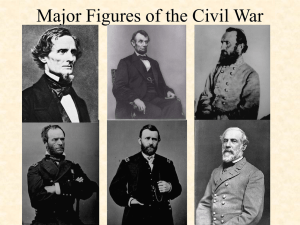
Major Figures of the Civil War
... In Feb., 1861 (after the secession of the lower South), General Scott, with whom Lee was a great favorite, recalled him from Texas. Lee had no sympathy with either secession or slavery and, loving the Union and the army, deprecated the thought of sectional conflict. But in his tradition, loyalty to ...
... In Feb., 1861 (after the secession of the lower South), General Scott, with whom Lee was a great favorite, recalled him from Texas. Lee had no sympathy with either secession or slavery and, loving the Union and the army, deprecated the thought of sectional conflict. But in his tradition, loyalty to ...

Battle of Gettysburg
... The 1st battle of the 1862 Valley Campaign. The CSA was commanded by General Thomas J. “Stonewall” Jackson. The US was led by Colonel Nathan Kimball. The Union Army was able to stop the advancing Confederate forces. The Union Army’s counterattack forced Jackson’s army to retreat. There were 590 Unio ...
... The 1st battle of the 1862 Valley Campaign. The CSA was commanded by General Thomas J. “Stonewall” Jackson. The US was led by Colonel Nathan Kimball. The Union Army was able to stop the advancing Confederate forces. The Union Army’s counterattack forced Jackson’s army to retreat. There were 590 Unio ...


Name - Central CUSD 4
... T 4. The Battle of Bull Run showed both sides that their soldiers needed more training. Q 5. The commander of the Union armies in 1861 was a cautious person and his name was George McClellan. T 6. The battle between the ironclads the Monitor and the Merrimack resulted in the building of many more ir ...
... T 4. The Battle of Bull Run showed both sides that their soldiers needed more training. Q 5. The commander of the Union armies in 1861 was a cautious person and his name was George McClellan. T 6. The battle between the ironclads the Monitor and the Merrimack resulted in the building of many more ir ...

Civil War Timeline October 16–18, 1859 John Brown, in an attempt
... Confederate forces win a victory at the First Battle of Manassas. Confederate General Thomas J. Jackson earns the nickname “Stonewall” for his tenacity in the battle. November 1 George B. McClellan, thirty-four, replaces the aging Winfield Scott as general-in-chief of the Union armies. November 8 Th ...
... Confederate forces win a victory at the First Battle of Manassas. Confederate General Thomas J. Jackson earns the nickname “Stonewall” for his tenacity in the battle. November 1 George B. McClellan, thirty-four, replaces the aging Winfield Scott as general-in-chief of the Union armies. November 8 Th ...

The War Between the States
... use gunboats to seize control of the Mississippi River – this would isolate and divide the South, strangling their access to resources Would take time, but be less costly in lives Keep Europe out of the war ...
... use gunboats to seize control of the Mississippi River – this would isolate and divide the South, strangling their access to resources Would take time, but be less costly in lives Keep Europe out of the war ...

Success Academy Day 1 Period 3 - ushistory
... Women mostly took up jobs and joined support groups to help out in the war. However, most of the stronger women took jobs in the factory to make guns and ammunition for the men in the war. Each of the women had different shifts, and the factories were working 24/7 ...
... Women mostly took up jobs and joined support groups to help out in the war. However, most of the stronger women took jobs in the factory to make guns and ammunition for the men in the war. Each of the women had different shifts, and the factories were working 24/7 ...

The Civil War Notes
... makes first move at attacking the north on Union territory Draw- no true winner (south retreats- north does not follow) Bloodiest ...
... makes first move at attacking the north on Union territory Draw- no true winner (south retreats- north does not follow) Bloodiest ...
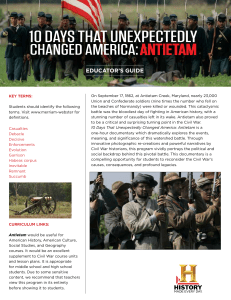
EduCaToR`S GuidE
... American History, American Culture, Social Studies, and Geography courses. It would be an excellent supplement to Civil War course units and lesson plans. It is appropriate for middle school and high school students. Due to some sensitive content, we recommend that teachers view this program in its ...
... American History, American Culture, Social Studies, and Geography courses. It would be an excellent supplement to Civil War course units and lesson plans. It is appropriate for middle school and high school students. Due to some sensitive content, we recommend that teachers view this program in its ...
Battle of Antietam

The Battle of Antietam /ænˈtiːtəm/, also known as the Battle of Sharpsburg, particularly in the South, fought on September 17, 1862, near Sharpsburg, Maryland, and Antietam Creek as part of the Maryland Campaign, was the first major battle in the American Civil War to take place on Union soil. It is the bloodiest single-day battle in American history, with a combined tally of dead, wounded, and missing at 22,717.After pursuing Confederate General Robert E. Lee into Maryland, Union Army Maj. Gen. George B. McClellan launched attacks against Lee's army, in defensive positions behind Antietam Creek. At dawn on September 17, Maj. Gen. Joseph Hooker's corps mounted a powerful assault on Lee's left flank. Attacks and counterattacks swept across Miller's Cornfield and fighting swirled around the Dunker Church. Union assaults against the Sunken Road eventually pierced the Confederate center, but the Federal advantage was not followed up. In the afternoon, Union Maj. Gen. Ambrose Burnside's corps entered the action, capturing a stone bridge over Antietam Creek and advancing against the Confederate right. At a crucial moment, Confederate Maj. Gen. A. P. Hill's division arrived from Harpers Ferry and launched a surprise counterattack, driving back Burnside and ending the battle. Although outnumbered two-to-one, Lee committed his entire force, while McClellan sent in less than three-quarters of his army, enabling Lee to fight the Federals to a standstill. During the night, both armies consolidated their lines. In spite of crippling casualties, Lee continued to skirmish with McClellan throughout September 18, while removing his battered army south of the Potomac River.Despite having superiority of numbers, McClellan's attacks failed to achieve force concentration, allowing Lee to counter by shifting forces and moving interior lines to meet each challenge. Despite ample reserve forces that could have been deployed to exploit localized successes, McClellan failed to destroy Lee's army. McClellan had halted Lee's invasion of Maryland, but Lee was able to withdraw his army back to Virginia without interference from the cautious McClellan. Although the battle was tactically inconclusive, the Confederate troops had withdrawn first from the battlefield, making it, in military terms, a Union victory. It had significance as enough of a victory to give President Abraham Lincoln the confidence to announce his Emancipation Proclamation, which discouraged the British and French governments from potential plans for recognition of the Confederacy.