Chapter 3.
... About half of General Lee’s mean were killed or wounded. After the battle, his weakened army had to retreat ...
... About half of General Lee’s mean were killed or wounded. After the battle, his weakened army had to retreat ...

3 No End in Sight
... of South Carolina, the wife of an aide to President Davis, wrote in her diary, “New Orleans gone—and with it the Confederacy. Are we not cut in two?” Indeed, after the victories of General Grant and Admiral Farragut, only a 150-mile stretch of the Mississippi remained in Southern hands. The Union wa ...
... of South Carolina, the wife of an aide to President Davis, wrote in her diary, “New Orleans gone—and with it the Confederacy. Are we not cut in two?” Indeed, after the victories of General Grant and Admiral Farragut, only a 150-mile stretch of the Mississippi remained in Southern hands. The Union wa ...

American History
... Victory at Vicksburg Vicksburg, MS surrenders; Gen Grant, July 4th,1863 Port Hudson in Louisiana was seized TX, LA, AR were cut off from the rest of the confederacy Union now holds the entire MS Lee’s army out of PA © 2009 abcteach.com ...
... Victory at Vicksburg Vicksburg, MS surrenders; Gen Grant, July 4th,1863 Port Hudson in Louisiana was seized TX, LA, AR were cut off from the rest of the confederacy Union now holds the entire MS Lee’s army out of PA © 2009 abcteach.com ...

Civil War Timeline
... Lee took command telling the Confederate forces that he planned to carry the fight to the enemy. He crossed the Potomac River into Maryland, but was blocked from Washington, D. C. by Union troops in a bloody battle at Sharpsburg near Antietam Creek. Lee realized that his army was in a bad position t ...
... Lee took command telling the Confederate forces that he planned to carry the fight to the enemy. He crossed the Potomac River into Maryland, but was blocked from Washington, D. C. by Union troops in a bloody battle at Sharpsburg near Antietam Creek. Lee realized that his army was in a bad position t ...

Leaders
... Run: Union is defeated-SOME OF PARLIAMENT MEMBERS THINK TO HELP THE SOUTH • A replaced McClellan is put back in charge after this defeat • Things not looking good for Union ...
... Run: Union is defeated-SOME OF PARLIAMENT MEMBERS THINK TO HELP THE SOUTH • A replaced McClellan is put back in charge after this defeat • Things not looking good for Union ...

Civil War - Cobb Learning
... • Rifled cannon used by U.S. Army in warfare for the first time; the Confederates surrendered the fort in less than two days • No brick American forts were built after this battle ...
... • Rifled cannon used by U.S. Army in warfare for the first time; the Confederates surrendered the fort in less than two days • No brick American forts were built after this battle ...


Emancipation Proclamation
... orders a series of bloody assaults against Lee’s forces(Union suffers 12K casualties) • Distressed by the defeat, Lincoln replaces Burnside with Joseph Hooker • May 1863 at Chancellorsville, Lee’s troops outnumbered 2-to-1, attack and force Hooker’s Union army to retreat ...
... orders a series of bloody assaults against Lee’s forces(Union suffers 12K casualties) • Distressed by the defeat, Lincoln replaces Burnside with Joseph Hooker • May 1863 at Chancellorsville, Lee’s troops outnumbered 2-to-1, attack and force Hooker’s Union army to retreat ...

Ch. 11 PPT Notes
... Jefferson Davis chooses to turn peaceful secession into war>>fires on Ft. Sumter • Fall of Ft. Sumter unites North • Virginia unwilling to fight South >secedes • Union’s goals>>>> • advantages?? • Anaconda Plan • Blockade southern ports, divide confederacy in the west, capture Richmond, Confederate ...
... Jefferson Davis chooses to turn peaceful secession into war>>fires on Ft. Sumter • Fall of Ft. Sumter unites North • Virginia unwilling to fight South >secedes • Union’s goals>>>> • advantages?? • Anaconda Plan • Blockade southern ports, divide confederacy in the west, capture Richmond, Confederate ...

The Civil War - North Platte R
... • Graduate of West Point. He is brilliant at training an army. • He is too cautious to engage, he has superior numbers and resources. • His men love him, he never makes them fight. • From 7/1861 to 3/1862 McClellan does nothing Lincoln is furious. ...
... • Graduate of West Point. He is brilliant at training an army. • He is too cautious to engage, he has superior numbers and resources. • His men love him, he never makes them fight. • From 7/1861 to 3/1862 McClellan does nothing Lincoln is furious. ...

Chapter 21 - The Furnace of Civil War
... 2. Britain, who would ordinarily protest such interference in the seas that she “owned,” recognized the blockade as binding, since Britain herself often used blockades in her wars. 3. Blockade-running, or the process of smuggling materials through the blockade, was a risky but profitable business, b ...
... 2. Britain, who would ordinarily protest such interference in the seas that she “owned,” recognized the blockade as binding, since Britain herself often used blockades in her wars. 3. Blockade-running, or the process of smuggling materials through the blockade, was a risky but profitable business, b ...

Ch.21
... o However, after initial success by the Union, Confederate o reinforcements arrived and, coupled with Stonewall Jackson’s line o holding, sent the Union soldiers into disarray. • The Battle of Bull Run showed the North that this would not be a • short, easy war and swelled the South’s already too-la ...
... o However, after initial success by the Union, Confederate o reinforcements arrived and, coupled with Stonewall Jackson’s line o holding, sent the Union soldiers into disarray. • The Battle of Bull Run showed the North that this would not be a • short, easy war and swelled the South’s already too-la ...

Union and Confederate Resources Main Idea: As the
... Seized possessions would be kept by the enemy; included slaves Union generals declared slaves as contraband, refusing to return them to their owners General John Frémont declared enslaved people under his command in Missouri were free Used to build fortifications, etc. 1863, used to fight ...
... Seized possessions would be kept by the enemy; included slaves Union generals declared slaves as contraband, refusing to return them to their owners General John Frémont declared enslaved people under his command in Missouri were free Used to build fortifications, etc. 1863, used to fight ...
The Civil War Begins - Lake County Schools
... Confederate army at Appomattox Court House, Virginia, on April 9, 1865. Lee’s army had diminished, which contributed to Union General Grant’s many victories near the end of the war. In a sign of respect, Grant allowed Lee to keep his saber and horse. - General Joseph Johnston was the last Confederat ...
... Confederate army at Appomattox Court House, Virginia, on April 9, 1865. Lee’s army had diminished, which contributed to Union General Grant’s many victories near the end of the war. In a sign of respect, Grant allowed Lee to keep his saber and horse. - General Joseph Johnston was the last Confederat ...

Civil War Test - Troy City Schools
... _____24. Burnside ordered a charge towards entrenched Confederates up Marye’s heights; only battle in which Burnside led ...
... _____24. Burnside ordered a charge towards entrenched Confederates up Marye’s heights; only battle in which Burnside led ...
Social Studies Chapter 6 Review
... Union General whose March to the Sea destroyed Confederate supplies. • Andrew Johnson: President of the U.S. after the war when Lincoln was assassinated. ...
... Union General whose March to the Sea destroyed Confederate supplies. • Andrew Johnson: President of the U.S. after the war when Lincoln was assassinated. ...

CHAPTER 16: THE CIVIL WAR BEGINS Section 3: No End in
... B. Several high-ranking officers were killed on both sides. C. It was the bloodiest single day in all of American history. D. Lee lost nearly one-third of his fighting force. E. Lincoln fired McClellan for being too cautious. F. Cavalry commander Jeb Stuart rode around the entire Union army. G. Lee ...
... B. Several high-ranking officers were killed on both sides. C. It was the bloodiest single day in all of American history. D. Lee lost nearly one-third of his fighting force. E. Lincoln fired McClellan for being too cautious. F. Cavalry commander Jeb Stuart rode around the entire Union army. G. Lee ...

The Civil War - Social Circle City Schools
... corporal discovered that Lee and Jackson’s armies were separated for the time being. McClellan decided to attack and the two armies fought on September 17 near a creek called Antietam. ...
... corporal discovered that Lee and Jackson’s armies were separated for the time being. McClellan decided to attack and the two armies fought on September 17 near a creek called Antietam. ...


The Civil War
... Though most action was in the East, forces also clashed west of the Mississippi River over natural resources, additional soldiers, and territory. ...
... Though most action was in the East, forces also clashed west of the Mississippi River over natural resources, additional soldiers, and territory. ...

Chapter 11 Section 1 Notes: Contrast the resources and strategies
... 6. border states – 4 states that bordered Southern states, allowed slavery but did not join the Confederacy 7. Stonewall Jackson – Confederate military hero who refused to yield to the Union army at Bull Run 8. George B. McClellan – second leader of the Union army 9. Ulysses S. Grant – successful Un ...
... 6. border states – 4 states that bordered Southern states, allowed slavery but did not join the Confederacy 7. Stonewall Jackson – Confederate military hero who refused to yield to the Union army at Bull Run 8. George B. McClellan – second leader of the Union army 9. Ulysses S. Grant – successful Un ...

Chapter 8 Section1 and two vocab answer key
... Mississippi River and split the Confederacy in half leaving Texas, Arkansas, and Louisiana without support. This was known as the Anaconda Plan. The last part was Sherman’s march to the Sea. It was to destroy confederate armies and waste the land so that southern civilians would stop supporting the ...
... Mississippi River and split the Confederacy in half leaving Texas, Arkansas, and Louisiana without support. This was known as the Anaconda Plan. The last part was Sherman’s march to the Sea. It was to destroy confederate armies and waste the land so that southern civilians would stop supporting the ...
Am St I CP 114 end of civil war
... Grant takes control 1864 Confederate had a plan Hold on and keep the Union out of Richmond There was going to be an election in November If we can subsist… we may have peace ...
... Grant takes control 1864 Confederate had a plan Hold on and keep the Union out of Richmond There was going to be an election in November If we can subsist… we may have peace ...
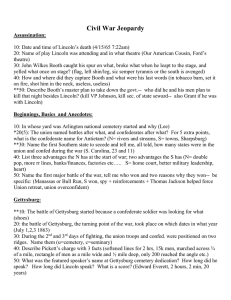
Civil War Jeopardy
... 50: Name the first major battle of the war, tell me who won and two reasons why they won-- be specific: (Manassas or Bull Run, S won, spy + reinforcements + Thomas Jackson helped force Union retreat, union overconfident) Gettysburg: **10: The battle of Gettysburg started because a confederate soldie ...
... 50: Name the first major battle of the war, tell me who won and two reasons why they won-- be specific: (Manassas or Bull Run, S won, spy + reinforcements + Thomas Jackson helped force Union retreat, union overconfident) Gettysburg: **10: The battle of Gettysburg started because a confederate soldie ...
Battle of Antietam

The Battle of Antietam /ænˈtiːtəm/, also known as the Battle of Sharpsburg, particularly in the South, fought on September 17, 1862, near Sharpsburg, Maryland, and Antietam Creek as part of the Maryland Campaign, was the first major battle in the American Civil War to take place on Union soil. It is the bloodiest single-day battle in American history, with a combined tally of dead, wounded, and missing at 22,717.After pursuing Confederate General Robert E. Lee into Maryland, Union Army Maj. Gen. George B. McClellan launched attacks against Lee's army, in defensive positions behind Antietam Creek. At dawn on September 17, Maj. Gen. Joseph Hooker's corps mounted a powerful assault on Lee's left flank. Attacks and counterattacks swept across Miller's Cornfield and fighting swirled around the Dunker Church. Union assaults against the Sunken Road eventually pierced the Confederate center, but the Federal advantage was not followed up. In the afternoon, Union Maj. Gen. Ambrose Burnside's corps entered the action, capturing a stone bridge over Antietam Creek and advancing against the Confederate right. At a crucial moment, Confederate Maj. Gen. A. P. Hill's division arrived from Harpers Ferry and launched a surprise counterattack, driving back Burnside and ending the battle. Although outnumbered two-to-one, Lee committed his entire force, while McClellan sent in less than three-quarters of his army, enabling Lee to fight the Federals to a standstill. During the night, both armies consolidated their lines. In spite of crippling casualties, Lee continued to skirmish with McClellan throughout September 18, while removing his battered army south of the Potomac River.Despite having superiority of numbers, McClellan's attacks failed to achieve force concentration, allowing Lee to counter by shifting forces and moving interior lines to meet each challenge. Despite ample reserve forces that could have been deployed to exploit localized successes, McClellan failed to destroy Lee's army. McClellan had halted Lee's invasion of Maryland, but Lee was able to withdraw his army back to Virginia without interference from the cautious McClellan. Although the battle was tactically inconclusive, the Confederate troops had withdrawn first from the battlefield, making it, in military terms, a Union victory. It had significance as enough of a victory to give President Abraham Lincoln the confidence to announce his Emancipation Proclamation, which discouraged the British and French governments from potential plans for recognition of the Confederacy.