
Unit III A : Civil War 1861
... C. The _________________________ Compromise would have reinstated the Missouri Compromise line for slavery but this was rejected by the Republicans. D. The states that had seceded established the ___________________________________ aka. “the Confederacy “ which emphasized the power of the __________ ...
... C. The _________________________ Compromise would have reinstated the Missouri Compromise line for slavery but this was rejected by the Republicans. D. The states that had seceded established the ___________________________________ aka. “the Confederacy “ which emphasized the power of the __________ ...

U.S. Civil War
... The Battle of Bull Run near Washington D.C. was the first major battle. It was chaos, and ended hopes of a short war. General Ulysses S. Grant led Union troops to victory at the Battle of Shiloh in Tennessee. *The Battle of Shiloh forced the North to acknowledge that the rebellion would not collapse ...
... The Battle of Bull Run near Washington D.C. was the first major battle. It was chaos, and ended hopes of a short war. General Ulysses S. Grant led Union troops to victory at the Battle of Shiloh in Tennessee. *The Battle of Shiloh forced the North to acknowledge that the rebellion would not collapse ...

Civil War Study Guide
... 1. What were the North’s strategies as they entered the war? The South’s? North-Anaconda plan South-planned to fight and thought that the north would quickly wear out; planned on assistance from Britain 2. Describe the early Civil War battles. First Battle of Bull Run-first major battle in the war-C ...
... 1. What were the North’s strategies as they entered the war? The South’s? North-Anaconda plan South-planned to fight and thought that the north would quickly wear out; planned on assistance from Britain 2. Describe the early Civil War battles. First Battle of Bull Run-first major battle in the war-C ...

Civil War Guided Notes Part 2
... ____________________________________On the third day of this battle, Confederate General George Pickett marched nearly 15,000 men up a hill, called Cemetery Ridge, to attack the Union line. ...
... ____________________________________On the third day of this battle, Confederate General George Pickett marched nearly 15,000 men up a hill, called Cemetery Ridge, to attack the Union line. ...

The Civil War - thecivilwarforeighthgrade
... The Battle of Antietam: General Robert E. Lee, the commander of the Confederate forces, met McClellan and his Union troops along the Antietam Creek. All day long McClellan’s troops pounded Lee’s outnumbered troops. The next day, Lee retreated back to Virginia. ...
... The Battle of Antietam: General Robert E. Lee, the commander of the Confederate forces, met McClellan and his Union troops along the Antietam Creek. All day long McClellan’s troops pounded Lee’s outnumbered troops. The next day, Lee retreated back to Virginia. ...
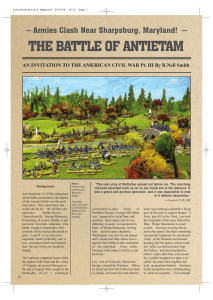
Antietam:Article Template
... Corps, and in the south Burnside’ s 9th Corps waited for the order to cross the creek by the Rohrbach Bridge, soon to be named after the Union General. Opposing the Union men on the northern flank were “Stonewall” Jackson’s, gathered around the Dunker Church and carefully positioned across a cornfie ...
... Corps, and in the south Burnside’ s 9th Corps waited for the order to cross the creek by the Rohrbach Bridge, soon to be named after the Union General. Opposing the Union men on the northern flank were “Stonewall” Jackson’s, gathered around the Dunker Church and carefully positioned across a cornfie ...

The American Civil War PP
... Results of Battle: •South’s hopes of ___________ were dashed •Lincoln issued preliminary _________________________ ...
... Results of Battle: •South’s hopes of ___________ were dashed •Lincoln issued preliminary _________________________ ...

Chapter 16
... 3. Placed Missouri under Martial Law: rule by the Army to keep it in the Union 4. Placed a naval blockade of the South to prevent imports to or exports from Confederate ports 5. To capture the Confederate capital of Richmond, a way of ending the war early by capturing its main city 6. Wanted control ...
... 3. Placed Missouri under Martial Law: rule by the Army to keep it in the Union 4. Placed a naval blockade of the South to prevent imports to or exports from Confederate ports 5. To capture the Confederate capital of Richmond, a way of ending the war early by capturing its main city 6. Wanted control ...
Assessment: The Civil War
... Mastering the Content Circle the letter next to the best answer. 1. Which of these was a Northern advantage at the start of the Civil War? A. highly trained soldiers B. abundant natural resources C. fighting in familiar territory D. control of the Mississippi River 2. Why did General Lee join the Co ...
... Mastering the Content Circle the letter next to the best answer. 1. Which of these was a Northern advantage at the start of the Civil War? A. highly trained soldiers B. abundant natural resources C. fighting in familiar territory D. control of the Mississippi River 2. Why did General Lee join the Co ...

KEY BATTLES OF THE CIVIL WAR
... of Lee’s battle plans wrapped around three cigars at a campsite. When Union troops stopped to rest at the abandoned campsite, a Union soldier stumbled on the plans. The captured plans gave ...
... of Lee’s battle plans wrapped around three cigars at a campsite. When Union troops stopped to rest at the abandoned campsite, a Union soldier stumbled on the plans. The captured plans gave ...

SSUSH 9 - LessonPaths
... The Union refused to surrender the fort and J. Davis ordered Southern troops to bombard the fort. The fort surrenders, starting the Civil War (April 1861). ...
... The Union refused to surrender the fort and J. Davis ordered Southern troops to bombard the fort. The fort surrenders, starting the Civil War (April 1861). ...

Gettysburg - ANSWER KEY
... 17. To whom was Pickett referring when he said, “That old man had my division slaughtered”? General Lee – Walked out into the field and met the retreating men there - “All this has been my fault.” Offered his resignation to Jefferson Davis. 18. How many men were lost at Gettysburg? ...
... 17. To whom was Pickett referring when he said, “That old man had my division slaughtered”? General Lee – Walked out into the field and met the retreating men there - “All this has been my fault.” Offered his resignation to Jefferson Davis. 18. How many men were lost at Gettysburg? ...
DOWNLOAD image list - History Wall Charts Collection
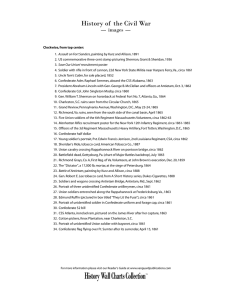
... 4. Soldier with rifle in front of cannon, 22d New York State Militia near Harpers Ferry, Va., circa 1861 5. Uncle Tom's Cabin, for sale placard, 1852 6. Confederate Adm. Raphael Semmes, aboard the CSS Alabama, 1863 7. President Abraham Lincoln with Gen. George B. McClellan and officers at Antietam, ...
... 4. Soldier with rifle in front of cannon, 22d New York State Militia near Harpers Ferry, Va., circa 1861 5. Uncle Tom's Cabin, for sale placard, 1852 6. Confederate Adm. Raphael Semmes, aboard the CSS Alabama, 1863 7. President Abraham Lincoln with Gen. George B. McClellan and officers at Antietam, ...

Civil War Chronological Order
... historians believe that this was the turning point of the war. Lee escaped with his remaining troops to Virginia. The North won another battle at Vicksburg when General Grant captured the Confederate city of Vicksburg. The starving city of Vicksburg and 30,000 Confederate troops had to surrender to ...
... historians believe that this was the turning point of the war. Lee escaped with his remaining troops to Virginia. The North won another battle at Vicksburg when General Grant captured the Confederate city of Vicksburg. The starving city of Vicksburg and 30,000 Confederate troops had to surrender to ...
Effects of the Civil War
... 1861 in Virginia • Confederacy led by Thomas “Stonewall” Jackson (he stood firm against the Union like a “stone wall”) • The South won! • This was a major morale boost ...
... 1861 in Virginia • Confederacy led by Thomas “Stonewall” Jackson (he stood firm against the Union like a “stone wall”) • The South won! • This was a major morale boost ...

House Divided File - Northwest ISD Moodle
... enemy to seek peace. Union and Confederate troops met up at Gettysburg, Pennsylvania on July 1, 1863. After three days of fighting, both sides faced great losses. But Robert E. Lee lost a third of his army and was forced to withdraw back to Virginia on July 4. This would mark the last time the Confe ...
... enemy to seek peace. Union and Confederate troops met up at Gettysburg, Pennsylvania on July 1, 1863. After three days of fighting, both sides faced great losses. But Robert E. Lee lost a third of his army and was forced to withdraw back to Virginia on July 4. This would mark the last time the Confe ...
Trails map - Civil War Traveler
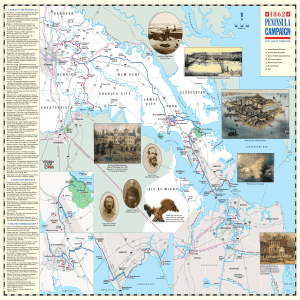
... scene of the April 5, 1862, engagement which prompted Maj. Gen. George B. McClellan to besiege Magruder’s Warwick -Yorktown Line. ...
... scene of the April 5, 1862, engagement which prompted Maj. Gen. George B. McClellan to besiege Magruder’s Warwick -Yorktown Line. ...
The War ends in Wilbur McLean`s living room. “Surrender at
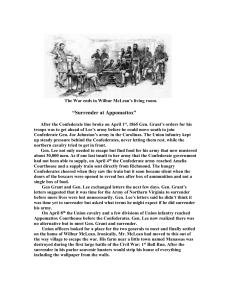
... political statement but it was ratified by Congress nearly unanimously and was now the law of the land. There would be no treason trials. As Ulysses stepped out of the McLean House onto the porch the Union cannons began to fire in celebration. Grant stopped the firing and said, “The war is over. The ...
... political statement but it was ratified by Congress nearly unanimously and was now the law of the land. There would be no treason trials. As Ulysses stepped out of the McLean House onto the porch the Union cannons began to fire in celebration. Grant stopped the firing and said, “The war is over. The ...

The Civil War
... After the Battle of Chancelorsville, Lee follows Union troops. He needs supplies and can only get them in the North Day 1: Looks like a Confederate victory Day 2: Rebel loss for the day, tired from 25 mile walk the day before and literal uphill battle. Day 3: South pummeled by Northern artillery and ...
... After the Battle of Chancelorsville, Lee follows Union troops. He needs supplies and can only get them in the North Day 1: Looks like a Confederate victory Day 2: Rebel loss for the day, tired from 25 mile walk the day before and literal uphill battle. Day 3: South pummeled by Northern artillery and ...

Historically Speaking
... certed Confederate counterattack. Baker was from its share of setbacks. A battlefield debacle shot dead and his command soundly deat Ball’s Bluff, 30 miles northwest of Washingfeated. Withdrawal became rout when the ton, D.C., cast doubts on efforts to recover victorious Confederates caught the retr ...
... certed Confederate counterattack. Baker was from its share of setbacks. A battlefield debacle shot dead and his command soundly deat Ball’s Bluff, 30 miles northwest of Washingfeated. Withdrawal became rout when the ton, D.C., cast doubts on efforts to recover victorious Confederates caught the retr ...

Document
... a horrible defeat at Fredericksburg in December of 1862, Lincoln replaced him with Gen. Joseph Hooker. Burnside is known more for the term “sideburns” which was taken from his facial whiskers in the 19th century known as “burnsides.” ...
... a horrible defeat at Fredericksburg in December of 1862, Lincoln replaced him with Gen. Joseph Hooker. Burnside is known more for the term “sideburns” which was taken from his facial whiskers in the 19th century known as “burnsides.” ...

Major Battles - Chiles Social Studies
... "Fourscore and seven years ago our fathers brought forth on this continent, a new nation, conceived in Liberty, and dedicated to the proposition that all men are created equal.” "Now we are engaged in a great civil war, testing whether that nation or any nation so conceived and so dedicated, can lo ...
... "Fourscore and seven years ago our fathers brought forth on this continent, a new nation, conceived in Liberty, and dedicated to the proposition that all men are created equal.” "Now we are engaged in a great civil war, testing whether that nation or any nation so conceived and so dedicated, can lo ...

Civil War Packet File - Northwest ISD Moodle
... In September 1862, General Lee went on the offensive against Union forces by marching his troops into Maryland. Lee believed a Confederate victory in the North would crush the enemy’s morale. But luck was not on Lee’s side. His battle plans were lost and then retrieved by the enemy. On September 17, ...
... In September 1862, General Lee went on the offensive against Union forces by marching his troops into Maryland. Lee believed a Confederate victory in the North would crush the enemy’s morale. But luck was not on Lee’s side. His battle plans were lost and then retrieved by the enemy. On September 17, ...

Goal 3
... • The Battle of Gettysburg was fought July 1-3, 1863 in Gettysburg, Pennsylvania. • This is considered the turning point of the war. After this defeat, the South never attempted a northern invasion again. • 51,000 soldiers killed, wounded, or missing this was the bloodiest battle of the Civil War. • ...
... • The Battle of Gettysburg was fought July 1-3, 1863 in Gettysburg, Pennsylvania. • This is considered the turning point of the war. After this defeat, the South never attempted a northern invasion again. • 51,000 soldiers killed, wounded, or missing this was the bloodiest battle of the Civil War. • ...
Battle of Antietam

The Battle of Antietam /ænˈtiːtəm/, also known as the Battle of Sharpsburg, particularly in the South, fought on September 17, 1862, near Sharpsburg, Maryland, and Antietam Creek as part of the Maryland Campaign, was the first major battle in the American Civil War to take place on Union soil. It is the bloodiest single-day battle in American history, with a combined tally of dead, wounded, and missing at 22,717.After pursuing Confederate General Robert E. Lee into Maryland, Union Army Maj. Gen. George B. McClellan launched attacks against Lee's army, in defensive positions behind Antietam Creek. At dawn on September 17, Maj. Gen. Joseph Hooker's corps mounted a powerful assault on Lee's left flank. Attacks and counterattacks swept across Miller's Cornfield and fighting swirled around the Dunker Church. Union assaults against the Sunken Road eventually pierced the Confederate center, but the Federal advantage was not followed up. In the afternoon, Union Maj. Gen. Ambrose Burnside's corps entered the action, capturing a stone bridge over Antietam Creek and advancing against the Confederate right. At a crucial moment, Confederate Maj. Gen. A. P. Hill's division arrived from Harpers Ferry and launched a surprise counterattack, driving back Burnside and ending the battle. Although outnumbered two-to-one, Lee committed his entire force, while McClellan sent in less than three-quarters of his army, enabling Lee to fight the Federals to a standstill. During the night, both armies consolidated their lines. In spite of crippling casualties, Lee continued to skirmish with McClellan throughout September 18, while removing his battered army south of the Potomac River.Despite having superiority of numbers, McClellan's attacks failed to achieve force concentration, allowing Lee to counter by shifting forces and moving interior lines to meet each challenge. Despite ample reserve forces that could have been deployed to exploit localized successes, McClellan failed to destroy Lee's army. McClellan had halted Lee's invasion of Maryland, but Lee was able to withdraw his army back to Virginia without interference from the cautious McClellan. Although the battle was tactically inconclusive, the Confederate troops had withdrawn first from the battlefield, making it, in military terms, a Union victory. It had significance as enough of a victory to give President Abraham Lincoln the confidence to announce his Emancipation Proclamation, which discouraged the British and French governments from potential plans for recognition of the Confederacy.