
Civil War review 2008-9 for wiki
... What issue led to the Civil war in the era of manifest destiny, the early and mid 1800’s ? • Whether, if and how should slavery spread across the USA from sea to ...
... What issue led to the Civil war in the era of manifest destiny, the early and mid 1800’s ? • Whether, if and how should slavery spread across the USA from sea to ...
Shoot them in the back
... Yet even this amazing opportunity went begging as the Northern advanced with his wonted caution. So slow were his movements that Jackson took Harper's Ferry and reunited with Lee on September 16 to accept battle the next day. Lynn Montross, 605. Due to the Confederate vice of straggling, Lee's army ...
... Yet even this amazing opportunity went begging as the Northern advanced with his wonted caution. So slow were his movements that Jackson took Harper's Ferry and reunited with Lee on September 16 to accept battle the next day. Lynn Montross, 605. Due to the Confederate vice of straggling, Lee's army ...

The Civil War
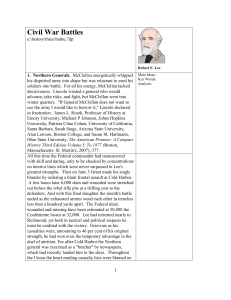
... 1. Robert E. Lee 2. Extremely smart southern general 3. Placed greater loyalty in his home state (Virginia) than the federal gov’t. Thus he fought for the south ...
... 1. Robert E. Lee 2. Extremely smart southern general 3. Placed greater loyalty in his home state (Virginia) than the federal gov’t. Thus he fought for the south ...

Civil War battles
... finest general in either army before the war began. He bled to death on the first day of Shiloh from a wound to the leg while leading a charge through an orchard. ...
... finest general in either army before the war began. He bled to death on the first day of Shiloh from a wound to the leg while leading a charge through an orchard. ...

Battle of Galveston
... to retreat through the town of Gettysburg to the south side of town. General Lee wanted his men to continue the attack and finish off the Union troops. However, his men delayed, and the Union had the opportunity to dig in and set up their defenses. By the second day, the armies from both sides were ...
... to retreat through the town of Gettysburg to the south side of town. General Lee wanted his men to continue the attack and finish off the Union troops. However, his men delayed, and the Union had the opportunity to dig in and set up their defenses. By the second day, the armies from both sides were ...


Civil War and Reconstruction Study Guide
... Abraham Lincoln, that freed enslaved people in the Confederate states. It did not free slaves in the border states. The Emancipation Proclamation made the war about ending slavery in the South and took away the chance that Great Britain and France might help the South, since they were against slaver ...
... Abraham Lincoln, that freed enslaved people in the Confederate states. It did not free slaves in the border states. The Emancipation Proclamation made the war about ending slavery in the South and took away the chance that Great Britain and France might help the South, since they were against slaver ...

- Hesston Middle School
... ----Joshua Lawrence Chamberlain, quoted in The Civil War • During the war, Chamberlain fought in 24 battles. He was wounded six times and had six horses shot out from under him. He is best remembered for his actions at the Battle of Gettysburg, where he courageously held off a fierce rebel attack. T ...
... ----Joshua Lawrence Chamberlain, quoted in The Civil War • During the war, Chamberlain fought in 24 battles. He was wounded six times and had six horses shot out from under him. He is best remembered for his actions at the Battle of Gettysburg, where he courageously held off a fierce rebel attack. T ...

The North Wins
... ----Joshua Lawrence Chamberlain, quoted in The Civil War During the war, Chamberlain fought in 24 battles. He was wounded six times and had six horses shot out from under him. He is best remembered for his actions at the Battle of Gettysburg, where he courageously held off a fierce rebel attack. T ...
... ----Joshua Lawrence Chamberlain, quoted in The Civil War During the war, Chamberlain fought in 24 battles. He was wounded six times and had six horses shot out from under him. He is best remembered for his actions at the Battle of Gettysburg, where he courageously held off a fierce rebel attack. T ...

Chapter 16 Study Guide
... 13th Amendment: officially outlawed slavery in the U.S. 14th Amendment: granted slaves U.S. citizenship and rights. 15th Amendment: granted African American men the right to vote. The Battle of Gettysburg: Southern casualties were so severe that they would never again launch an attack in the North; ...
... 13th Amendment: officially outlawed slavery in the U.S. 14th Amendment: granted slaves U.S. citizenship and rights. 15th Amendment: granted African American men the right to vote. The Battle of Gettysburg: Southern casualties were so severe that they would never again launch an attack in the North; ...

History Lecture 6a Civil War
... • Geography unit identity Where you’re from = what unit you served in Militia structure = units organized by state, county, neighborhood “54th Massachusetts,” “33rd Alabama,” e.g. Result for hometowns: Casualties unevenly distributed One part of one battle could kill most of the men from a single ...
... • Geography unit identity Where you’re from = what unit you served in Militia structure = units organized by state, county, neighborhood “54th Massachusetts,” “33rd Alabama,” e.g. Result for hometowns: Casualties unevenly distributed One part of one battle could kill most of the men from a single ...

Total war - BHCS History
... Union line shaped like fishhook along ridges Confederates attack both ends of Union line in late afternoon/early evening Lee’s second in command, Longstreet, wants to move around Union army, Lee refuses Little Round Top - hill at edge of Union line Union soldiers at end of line run out of ammo, can’ ...
... Union line shaped like fishhook along ridges Confederates attack both ends of Union line in late afternoon/early evening Lee’s second in command, Longstreet, wants to move around Union army, Lee refuses Little Round Top - hill at edge of Union line Union soldiers at end of line run out of ammo, can’ ...

Civil War Study Guide
... • Key battle of the war – South hoped that beating North in Maryland would bring in England and France on their side. • Lost Orders – McClellan finds a copy of Lee’s battle plan • Bloodiest single day of the war • Casualties – Union – 12,000 • Confederacy – 13,000 • Basically a draw, but long-term i ...
... • Key battle of the war – South hoped that beating North in Maryland would bring in England and France on their side. • Lost Orders – McClellan finds a copy of Lee’s battle plan • Bloodiest single day of the war • Casualties – Union – 12,000 • Confederacy – 13,000 • Basically a draw, but long-term i ...

Unit 8 - PowerPoints - The American Civil War
... • Confederate General John Hood had led troops in a raid on Tennessee, leaving Sherman’s soldiers to face fewer than 5,000 Confederate soldiers. • Sherman’s troops burned buildings and infrastructures along the way, destroying many towns and cities. • Sherman’s troops defeated the depleted Confedera ...
... • Confederate General John Hood had led troops in a raid on Tennessee, leaving Sherman’s soldiers to face fewer than 5,000 Confederate soldiers. • Sherman’s troops burned buildings and infrastructures along the way, destroying many towns and cities. • Sherman’s troops defeated the depleted Confedera ...

Total war - BHCS History
... Union line shaped like fishhook along ridges Confederates attack both ends of Union line in late afternoon/early evening Lee’s second in command, Longstreet, wants to move around Union army, Lee refuses Little Round Top - hill at edge of Union line Union soldiers at end of line run out of ammo, can’ ...
... Union line shaped like fishhook along ridges Confederates attack both ends of Union line in late afternoon/early evening Lee’s second in command, Longstreet, wants to move around Union army, Lee refuses Little Round Top - hill at edge of Union line Union soldiers at end of line run out of ammo, can’ ...

March Camp Meeting - Lt. Gen Wade Hampton Camp No. 273 SCV
... There were 1 8 confirmed lieutenant generals in the Confederate Army. Typically, these officers were corps commanders within armies or military department heads in charge of geographic sections and all the soldiers/ forces in those boundaries. All of the Confederate lieutenant generals were in the P ...
... There were 1 8 confirmed lieutenant generals in the Confederate Army. Typically, these officers were corps commanders within armies or military department heads in charge of geographic sections and all the soldiers/ forces in those boundaries. All of the Confederate lieutenant generals were in the P ...

Chapter 21 Notes - Spokane Public Schools
... First Day at Gettysburg by James Walker During the summer of 1863, Confederate General Robert E. Lee proposed a daring invasion into Pennsylvania in hopes that it might force the Union to end the war. It proved to be a turning point, but not the one Lee anticipated. At Gettysburg, a series of battl ...
... First Day at Gettysburg by James Walker During the summer of 1863, Confederate General Robert E. Lee proposed a daring invasion into Pennsylvania in hopes that it might force the Union to end the war. It proved to be a turning point, but not the one Lee anticipated. At Gettysburg, a series of battl ...


Causes of the Civil War
... land and his owner died. He lost because slaves didn’t have any privileges and • Slaves were labeled as- property. The judge said property is protected under the Constitution. • Missouri Compromise- was keeping people from owning property and this was unconstitutional. • North- was very upset; made ...
... land and his owner died. He lost because slaves didn’t have any privileges and • Slaves were labeled as- property. The judge said property is protected under the Constitution. • Missouri Compromise- was keeping people from owning property and this was unconstitutional. • North- was very upset; made ...

Leaders During the Civil War
... death was a severe setback for the Confederacy, affecting not only its military prospects, but also the morale of its army and of the general public. ...
... death was a severe setback for the Confederacy, affecting not only its military prospects, but also the morale of its army and of the general public. ...

Battles of the Civil War Part 2
... But, in a larger sense, we can not dedicate, we can not consecrate, we can not hallow this ground. The brave men, living and dead, who struggled here, have consecrated it, far above our poor power to add or detract. The world will little note, nor long remember what we say here, but it can never for ...
... But, in a larger sense, we can not dedicate, we can not consecrate, we can not hallow this ground. The brave men, living and dead, who struggled here, have consecrated it, far above our poor power to add or detract. The world will little note, nor long remember what we say here, but it can never for ...

Civil_War_Battles
... finest general in either army before the war began. He bled to death on the first day of Shiloh from a wound to the leg while leading a charge through an orchard. ...
... finest general in either army before the war began. He bled to death on the first day of Shiloh from a wound to the leg while leading a charge through an orchard. ...
Battle of Antietam

The Battle of Antietam /ænˈtiːtəm/, also known as the Battle of Sharpsburg, particularly in the South, fought on September 17, 1862, near Sharpsburg, Maryland, and Antietam Creek as part of the Maryland Campaign, was the first major battle in the American Civil War to take place on Union soil. It is the bloodiest single-day battle in American history, with a combined tally of dead, wounded, and missing at 22,717.After pursuing Confederate General Robert E. Lee into Maryland, Union Army Maj. Gen. George B. McClellan launched attacks against Lee's army, in defensive positions behind Antietam Creek. At dawn on September 17, Maj. Gen. Joseph Hooker's corps mounted a powerful assault on Lee's left flank. Attacks and counterattacks swept across Miller's Cornfield and fighting swirled around the Dunker Church. Union assaults against the Sunken Road eventually pierced the Confederate center, but the Federal advantage was not followed up. In the afternoon, Union Maj. Gen. Ambrose Burnside's corps entered the action, capturing a stone bridge over Antietam Creek and advancing against the Confederate right. At a crucial moment, Confederate Maj. Gen. A. P. Hill's division arrived from Harpers Ferry and launched a surprise counterattack, driving back Burnside and ending the battle. Although outnumbered two-to-one, Lee committed his entire force, while McClellan sent in less than three-quarters of his army, enabling Lee to fight the Federals to a standstill. During the night, both armies consolidated their lines. In spite of crippling casualties, Lee continued to skirmish with McClellan throughout September 18, while removing his battered army south of the Potomac River.Despite having superiority of numbers, McClellan's attacks failed to achieve force concentration, allowing Lee to counter by shifting forces and moving interior lines to meet each challenge. Despite ample reserve forces that could have been deployed to exploit localized successes, McClellan failed to destroy Lee's army. McClellan had halted Lee's invasion of Maryland, but Lee was able to withdraw his army back to Virginia without interference from the cautious McClellan. Although the battle was tactically inconclusive, the Confederate troops had withdrawn first from the battlefield, making it, in military terms, a Union victory. It had significance as enough of a victory to give President Abraham Lincoln the confidence to announce his Emancipation Proclamation, which discouraged the British and French governments from potential plans for recognition of the Confederacy.