
Civil War Battles PowerPoint
... finest general in either army before the war began. He bled to death on the first day of Shiloh from a wound to the leg while leading a charge through an orchard. ...
... finest general in either army before the war began. He bled to death on the first day of Shiloh from a wound to the leg while leading a charge through an orchard. ...

Part 2 Civil War Battles
... slaves. Also, the Proclamation obviously did not have any effect in the Confederacy. However, Lincoln’s proclamation immediately made some runaway slaves that were being held under military control in the “Sea Islands” off the Georgia coast free men. It was not until the Thirteenth Amendment, passed ...
... slaves. Also, the Proclamation obviously did not have any effect in the Confederacy. However, Lincoln’s proclamation immediately made some runaway slaves that were being held under military control in the “Sea Islands” off the Georgia coast free men. It was not until the Thirteenth Amendment, passed ...
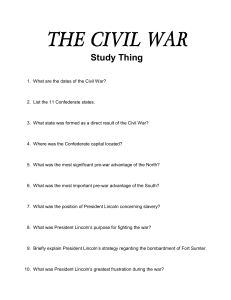

CIVIL WAR ADVANTAGES/DISADVANTAGES
... 2nd Battle of Bull Run (Virginia) August 29-30, 1862 Stonewall Jackson and Robert E Lee are making things embarrassing for President Lincoln. After the failure of the Peninsula Campaign, the Rebels force the Union boys to retreat once again at Bull Run. ...
... 2nd Battle of Bull Run (Virginia) August 29-30, 1862 Stonewall Jackson and Robert E Lee are making things embarrassing for President Lincoln. After the failure of the Peninsula Campaign, the Rebels force the Union boys to retreat once again at Bull Run. ...
vol. xxxvii, no. 2 november 1996
... “Boys, he ain’t much for looks, but if we’d had him we wouldn’t have been caught in this trap.” So stated a Federal prisoner at Harpers Ferry as he viewed Confederate General Thomas “Stonewall” Jackson on September 15, 1862. This unnamed prisoner was one of over 11,000 Federal soldiers captured that ...
... “Boys, he ain’t much for looks, but if we’d had him we wouldn’t have been caught in this trap.” So stated a Federal prisoner at Harpers Ferry as he viewed Confederate General Thomas “Stonewall” Jackson on September 15, 1862. This unnamed prisoner was one of over 11,000 Federal soldiers captured that ...

Battle of Antietam
... Lincoln announce his Proclamation to the world giving the succeeded states a choice to surrender or keep fighting. Describe the Emancipation Proclamation, the moral and feelings of America on both sides, and ultimately its devastating results. Add a prediction of what you think will happen now that ...
... Lincoln announce his Proclamation to the world giving the succeeded states a choice to surrender or keep fighting. Describe the Emancipation Proclamation, the moral and feelings of America on both sides, and ultimately its devastating results. Add a prediction of what you think will happen now that ...
Chapter 14
... 3. The Gov’t. would retain all federal property in seceded states. • clear reference to mounting trouble at Ft. Sumter ...
... 3. The Gov’t. would retain all federal property in seceded states. • clear reference to mounting trouble at Ft. Sumter ...

USHG 8-Mr. Garcia Name Civil War Battle Timeline Chapters 16
... 2. the invasion would give VA farmers a break from war during harvest season 3. Confederate soldiers could plunder Northern farms for food 4. Lee wanted to convince European countries to side with South ...
... 2. the invasion would give VA farmers a break from war during harvest season 3. Confederate soldiers could plunder Northern farms for food 4. Lee wanted to convince European countries to side with South ...

The Civil War part 3
... Orleans, the Union now controlled the Mississippi River and had divided the south into two parts. • Abraham Lincoln was so impressed by Ulysses S. Grant he gave him command of the entire Union Army. He would now go East to take on Robert E. Lee. ...
... Orleans, the Union now controlled the Mississippi River and had divided the south into two parts. • Abraham Lincoln was so impressed by Ulysses S. Grant he gave him command of the entire Union Army. He would now go East to take on Robert E. Lee. ...
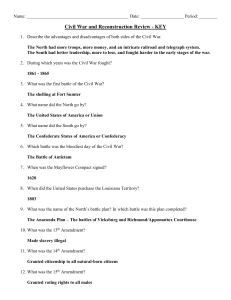
CIvil War/Reconstruction Review
... 1. Describe the advantages and disadvantages of both sides of the Civil War. The North had more troops, more money, and an intricate railroad and telegraph system. The South had better leadership, more to lose, and fought harder in the early stages of the war. 2. During which years was the Civil War ...
... 1. Describe the advantages and disadvantages of both sides of the Civil War. The North had more troops, more money, and an intricate railroad and telegraph system. The South had better leadership, more to lose, and fought harder in the early stages of the war. 2. During which years was the Civil War ...
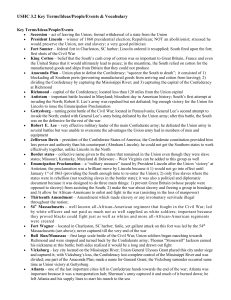
Key Terms/Ideas/People/Events
... Fort Wagner – located in Charleston, SC harbor; futile, yet gallant attack on this fort was led by the 54th Massachusetts (see above); never captured till the very end of the war Bull Run/Manassas – first large scale battle of the Civil War; Union soldiers began marching towards Richmond and wer ...
... Fort Wagner – located in Charleston, SC harbor; futile, yet gallant attack on this fort was led by the 54th Massachusetts (see above); never captured till the very end of the war Bull Run/Manassas – first large scale battle of the Civil War; Union soldiers began marching towards Richmond and wer ...


apush - Lincoln Park High School
... Joshua Lawrence Chamberlain (Colonel) Thomas Davee Chamberlain (Lieutenant) Ellis Spear (Captain) John Buford (Brigadier General) John F. Reynolds (Major General) George Gordon Meade (Commanding general, Army of the Potomac) Winfield Scott Hancock (Major General) Buster Kilrain (Sergeant) ...
... Joshua Lawrence Chamberlain (Colonel) Thomas Davee Chamberlain (Lieutenant) Ellis Spear (Captain) John Buford (Brigadier General) John F. Reynolds (Major General) George Gordon Meade (Commanding general, Army of the Potomac) Winfield Scott Hancock (Major General) Buster Kilrain (Sergeant) ...

AP U.S. History “Unit Seven Map Exercise” Mr. Fernandez Map #49
... 3. Create a key in the box provided Map #50 – “Major Battles of the Civil War” 1. Locate and label the states outlined on the map, the Tennessee, Cumberland, and Mississippi Rivers, and the Appalachian Mountains. Use different patterns or colors to identify Union and Confederate states. 2. Fill in t ...
... 3. Create a key in the box provided Map #50 – “Major Battles of the Civil War” 1. Locate and label the states outlined on the map, the Tennessee, Cumberland, and Mississippi Rivers, and the Appalachian Mountains. Use different patterns or colors to identify Union and Confederate states. 2. Fill in t ...

Gettysburg: Prelude - Fall River Public Schools
... • McClellan selected as commander after Bull Run • McClellan popular with troops • A thorough administrator • Overly cautious ...
... • McClellan selected as commander after Bull Run • McClellan popular with troops • A thorough administrator • Overly cautious ...

The Battle of Gettysburg July 1 – 3, 1863
... • Northern artillery resumed its fire and crippled the Confederate attackers. • Lee sent General Jeb Stuart’s forces to surprise attack Union General Meade’s forces. • Stuart’s forces were stalled due to a conflict with Union forces ...
... • Northern artillery resumed its fire and crippled the Confederate attackers. • Lee sent General Jeb Stuart’s forces to surprise attack Union General Meade’s forces. • Stuart’s forces were stalled due to a conflict with Union forces ...
Bailey Chapter 21
... “I say that we must not interfere with the institution of slavery where it exists, because the Constitution forbids it, and the general welfare does not require us to do so.” ~Lincoln 1851 “…all persons held as slaves within any State or designated part of a State, the people whereof shall then be i ...
... “I say that we must not interfere with the institution of slavery where it exists, because the Constitution forbids it, and the general welfare does not require us to do so.” ~Lincoln 1851 “…all persons held as slaves within any State or designated part of a State, the people whereof shall then be i ...
Pickett`s Charge
... the time the Emmitsburg road was reached both divisions were on a line, and they crossed the road together. Brockenbrough's Virginians, Pettigrew's left brigade, were disheartened by the flank fire of Hays' troops and Woodruff's battery after a loss of only twenty-five killed, and these troops eith ...
... the time the Emmitsburg road was reached both divisions were on a line, and they crossed the road together. Brockenbrough's Virginians, Pettigrew's left brigade, were disheartened by the flank fire of Hays' troops and Woodruff's battery after a loss of only twenty-five killed, and these troops eith ...
90 Day War - Faculty Access for the Web
... General Winfield Scott's scheme to surround the South and await a seizure of power by southern Unionists drew scorn from critics who called it the Anaconda plan. In this lithograph, the "great snake" prepares to thrust down the Mississippi, seal off the Confederacy, and crush it. (Library of Congres ...
... General Winfield Scott's scheme to surround the South and await a seizure of power by southern Unionists drew scorn from critics who called it the Anaconda plan. In this lithograph, the "great snake" prepares to thrust down the Mississippi, seal off the Confederacy, and crush it. (Library of Congres ...

US History Chapter 21 Notes The Furnace of Civil War (1861
... o He said he didn’t want to interfere with slavery- he only wanted to reunite the union by showing the south how silly it was to secede. o But the war lasted four years, killed thousands of soldiers, and ended slavery. Bull Run Ends the “Ninety-Day War” o Summer 1861- 30,000 men did drills in DC. Th ...
... o He said he didn’t want to interfere with slavery- he only wanted to reunite the union by showing the south how silly it was to secede. o But the war lasted four years, killed thousands of soldiers, and ended slavery. Bull Run Ends the “Ninety-Day War” o Summer 1861- 30,000 men did drills in DC. Th ...

Battle Of Shiloh Handout
... Buell. The Confederates hoped to defeat the Union army before it could be reinforced by General Don Carlos Buell’s Army, which was marching from Nashville. General Johnston decided to surprise attack Grant before the two Union armies could join together. On April 6, 1862, The Confederate army attack ...
... Buell. The Confederates hoped to defeat the Union army before it could be reinforced by General Don Carlos Buell’s Army, which was marching from Nashville. General Johnston decided to surprise attack Grant before the two Union armies could join together. On April 6, 1862, The Confederate army attack ...

Chapter 7
... He then headed NE and captured Jackson, MS and cut off the main RR thus cutting off supplies to Vicksburg He then put Vicksburg under siege for over a month ...
... He then headed NE and captured Jackson, MS and cut off the main RR thus cutting off supplies to Vicksburg He then put Vicksburg under siege for over a month ...

Junior High American History Chapter 16 - Meile
... 16. What was the outcome of McClellan’s offensive? He failed to capture Richmond 17. What took place on August 29, 1862? The Second Battle of Bull Run 18. Who was victorious? The South ...
... 16. What was the outcome of McClellan’s offensive? He failed to capture Richmond 17. What took place on August 29, 1862? The Second Battle of Bull Run 18. Who was victorious? The South ...
Battle of Antietam

The Battle of Antietam /ænˈtiːtəm/, also known as the Battle of Sharpsburg, particularly in the South, fought on September 17, 1862, near Sharpsburg, Maryland, and Antietam Creek as part of the Maryland Campaign, was the first major battle in the American Civil War to take place on Union soil. It is the bloodiest single-day battle in American history, with a combined tally of dead, wounded, and missing at 22,717.After pursuing Confederate General Robert E. Lee into Maryland, Union Army Maj. Gen. George B. McClellan launched attacks against Lee's army, in defensive positions behind Antietam Creek. At dawn on September 17, Maj. Gen. Joseph Hooker's corps mounted a powerful assault on Lee's left flank. Attacks and counterattacks swept across Miller's Cornfield and fighting swirled around the Dunker Church. Union assaults against the Sunken Road eventually pierced the Confederate center, but the Federal advantage was not followed up. In the afternoon, Union Maj. Gen. Ambrose Burnside's corps entered the action, capturing a stone bridge over Antietam Creek and advancing against the Confederate right. At a crucial moment, Confederate Maj. Gen. A. P. Hill's division arrived from Harpers Ferry and launched a surprise counterattack, driving back Burnside and ending the battle. Although outnumbered two-to-one, Lee committed his entire force, while McClellan sent in less than three-quarters of his army, enabling Lee to fight the Federals to a standstill. During the night, both armies consolidated their lines. In spite of crippling casualties, Lee continued to skirmish with McClellan throughout September 18, while removing his battered army south of the Potomac River.Despite having superiority of numbers, McClellan's attacks failed to achieve force concentration, allowing Lee to counter by shifting forces and moving interior lines to meet each challenge. Despite ample reserve forces that could have been deployed to exploit localized successes, McClellan failed to destroy Lee's army. McClellan had halted Lee's invasion of Maryland, but Lee was able to withdraw his army back to Virginia without interference from the cautious McClellan. Although the battle was tactically inconclusive, the Confederate troops had withdrawn first from the battlefield, making it, in military terms, a Union victory. It had significance as enough of a victory to give President Abraham Lincoln the confidence to announce his Emancipation Proclamation, which discouraged the British and French governments from potential plans for recognition of the Confederacy.