
Later Stages of CW Ppt - Taylor County Schools
... In November, Lincoln won re-election, capturing 55% of the popular vote to George McClellan’s 45%, along with a landslide victory in the Electoral College. “With malice toward none; with charity for all; with firmness in the right, as God gives us to see the right, let us strive on to finish the wor ...
... In November, Lincoln won re-election, capturing 55% of the popular vote to George McClellan’s 45%, along with a landslide victory in the Electoral College. “With malice toward none; with charity for all; with firmness in the right, as God gives us to see the right, let us strive on to finish the wor ...


Civil War – Year by Year
... – Delegates from 7 southern states – including GA – met in Montgomery and formed a new country named the Confederate States of America or the Confederacy. – Jefferson Davis was president of the CSA and Alexander Stephens (from Georgia) was the vice-president. ...
... – Delegates from 7 southern states – including GA – met in Montgomery and formed a new country named the Confederate States of America or the Confederacy. – Jefferson Davis was president of the CSA and Alexander Stephens (from Georgia) was the vice-president. ...

The Civil War - Cloudfront.net
... great trainer but worried about sending men into battle. • The extra time this took allowed Lee to prepare is defenses. • Lee and McClellan met in the Seven Days’ Battles. • After retreating and joining with Major General Pope, the Union forces were attacked by Stonewall Jackson and Lee. • The North ...
... great trainer but worried about sending men into battle. • The extra time this took allowed Lee to prepare is defenses. • Lee and McClellan met in the Seven Days’ Battles. • After retreating and joining with Major General Pope, the Union forces were attacked by Stonewall Jackson and Lee. • The North ...


Civil War in a Nutshell
... Southern States secede As soon as Lincoln won the election, the South started to secede. This means the South split from the Union. They no longer wanted to be part of the United States. Supporters of secession based their arguments on the idea of states’ rights. They said they had voluntarily ...
... Southern States secede As soon as Lincoln won the election, the South started to secede. This means the South split from the Union. They no longer wanted to be part of the United States. Supporters of secession based their arguments on the idea of states’ rights. They said they had voluntarily ...

The Battle of Brandy Station
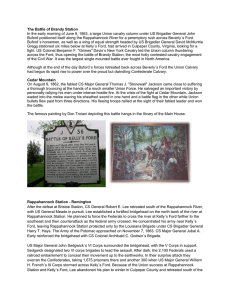
... Ford, leaving Rappahannock Station protected only by the Louisiana Brigade under CS Brigadier General Harry T. Hays. The Army of the Potomac approached on November 7, 1863. CS Major General Jubal A. Early reinforced the bridgehead with CS Colonel Archibald C. Godwin´s Brigade. US Major General John ...
... Ford, leaving Rappahannock Station protected only by the Louisiana Brigade under CS Brigadier General Harry T. Hays. The Army of the Potomac approached on November 7, 1863. CS Major General Jubal A. Early reinforced the bridgehead with CS Colonel Archibald C. Godwin´s Brigade. US Major General John ...

Chapter 16
... –“shoddy,” 20% fraudulent expenditures the Homestead Act and Land Grant College Act of 1862. ...
... –“shoddy,” 20% fraudulent expenditures the Homestead Act and Land Grant College Act of 1862. ...

Chapter 17 p.555 homework 1. Check out terms in textbook. All
... The war was over the South was defeated. It was time to let the nation start to heal. Harsh terms would have only added to bitter feelings. ...
... The war was over the South was defeated. It was time to let the nation start to heal. Harsh terms would have only added to bitter feelings. ...


CIVIL WAR Time-Line 1861-1865 - Miami Beach Senior High School
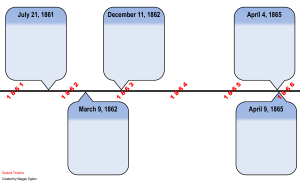
... April 2 Petersburg falls, and the Confederate government evacuates its capital, Richmond. Confederate corps commander Ambrose Powell Hill is killed in action while attempting to rally his men. April 3 Union troops occupy Richmond. April 9 Robert E. Lee surrenders the Army of Northern Virginia to Gra ...
... April 2 Petersburg falls, and the Confederate government evacuates its capital, Richmond. Confederate corps commander Ambrose Powell Hill is killed in action while attempting to rally his men. April 3 Union troops occupy Richmond. April 9 Robert E. Lee surrenders the Army of Northern Virginia to Gra ...
first Battle of Bull Run - Virginia and the Civil War
... The first Battle of Bull Run (or Manassas) was the first major clash at the Civil War. Confederate General Thomas “Stonewall” Jackson played a major role in this battle. This battle signified the beginning of a long, devastating war. ...
... The first Battle of Bull Run (or Manassas) was the first major clash at the Civil War. Confederate General Thomas “Stonewall” Jackson played a major role in this battle. This battle signified the beginning of a long, devastating war. ...

Chapter 16 Notes
... McClellan restored soldiers’ confidence and organized and trained the army 3. McClellan continuously drilled his troops instead of attacking Richmond; Lincoln said that McClellan had “the slows.” B. Grant Opens Up the South 1. Ulysses S. Grant: Union general who won battles in the west 2. Grant fai ...
... McClellan restored soldiers’ confidence and organized and trained the army 3. McClellan continuously drilled his troops instead of attacking Richmond; Lincoln said that McClellan had “the slows.” B. Grant Opens Up the South 1. Ulysses S. Grant: Union general who won battles in the west 2. Grant fai ...

rebels of the Union
... 2. How did states in the upper South respond to Lincoln’s call-up of the militia? ...
... 2. How did states in the upper South respond to Lincoln’s call-up of the militia? ...
Antietam 150th Anniversary: The Battle That Changed American
... It's a handwritten copy of Gen. Robert E. Lee's secret Special Orders No. 191, detailing the Southern commander's audacious plans for an invasion of enemy territory that would propel the Confederates to victory. Carelessly left behind as Lee's army marched north, the copy was spotted in a field by t ...
... It's a handwritten copy of Gen. Robert E. Lee's secret Special Orders No. 191, detailing the Southern commander's audacious plans for an invasion of enemy territory that would propel the Confederates to victory. Carelessly left behind as Lee's army marched north, the copy was spotted in a field by t ...


civil war 1 - AP United States History
... march on Richmond - was delayed for more than 2 weeks due to late supplies. • General Lee positioned his army, deploying snipers to easily pick off Federal troops. • Many Union soldiers were left in the open after crossing military pontoon bridges, becoming easy prey for Confederate troops. • Burnsi ...
... march on Richmond - was delayed for more than 2 weeks due to late supplies. • General Lee positioned his army, deploying snipers to easily pick off Federal troops. • Many Union soldiers were left in the open after crossing military pontoon bridges, becoming easy prey for Confederate troops. • Burnsi ...


Chapter 11-4: The War Continues
... • Lee sent Stonewall Jackson in a surprise attack, nearly destroying the Union army on the first day. • Battle was General Lee’s greatest victory, defeating a force twice its size. Lee determined to invade the North again, hoping a victory there would end the war. • Lee marched north, and Lincoln re ...
... • Lee sent Stonewall Jackson in a surprise attack, nearly destroying the Union army on the first day. • Battle was General Lee’s greatest victory, defeating a force twice its size. Lee determined to invade the North again, hoping a victory there would end the war. • Lee marched north, and Lincoln re ...
Battle of Antietam

The Battle of Antietam /ænˈtiːtəm/, also known as the Battle of Sharpsburg, particularly in the South, fought on September 17, 1862, near Sharpsburg, Maryland, and Antietam Creek as part of the Maryland Campaign, was the first major battle in the American Civil War to take place on Union soil. It is the bloodiest single-day battle in American history, with a combined tally of dead, wounded, and missing at 22,717.After pursuing Confederate General Robert E. Lee into Maryland, Union Army Maj. Gen. George B. McClellan launched attacks against Lee's army, in defensive positions behind Antietam Creek. At dawn on September 17, Maj. Gen. Joseph Hooker's corps mounted a powerful assault on Lee's left flank. Attacks and counterattacks swept across Miller's Cornfield and fighting swirled around the Dunker Church. Union assaults against the Sunken Road eventually pierced the Confederate center, but the Federal advantage was not followed up. In the afternoon, Union Maj. Gen. Ambrose Burnside's corps entered the action, capturing a stone bridge over Antietam Creek and advancing against the Confederate right. At a crucial moment, Confederate Maj. Gen. A. P. Hill's division arrived from Harpers Ferry and launched a surprise counterattack, driving back Burnside and ending the battle. Although outnumbered two-to-one, Lee committed his entire force, while McClellan sent in less than three-quarters of his army, enabling Lee to fight the Federals to a standstill. During the night, both armies consolidated their lines. In spite of crippling casualties, Lee continued to skirmish with McClellan throughout September 18, while removing his battered army south of the Potomac River.Despite having superiority of numbers, McClellan's attacks failed to achieve force concentration, allowing Lee to counter by shifting forces and moving interior lines to meet each challenge. Despite ample reserve forces that could have been deployed to exploit localized successes, McClellan failed to destroy Lee's army. McClellan had halted Lee's invasion of Maryland, but Lee was able to withdraw his army back to Virginia without interference from the cautious McClellan. Although the battle was tactically inconclusive, the Confederate troops had withdrawn first from the battlefield, making it, in military terms, a Union victory. It had significance as enough of a victory to give President Abraham Lincoln the confidence to announce his Emancipation Proclamation, which discouraged the British and French governments from potential plans for recognition of the Confederacy.