Survey
* Your assessment is very important for improving the work of artificial intelligence, which forms the content of this project
Magnesium transporter wikipedia , lookup
Expression vector wikipedia , lookup
G protein–coupled receptor wikipedia , lookup
Paracrine signalling wikipedia , lookup
Point mutation wikipedia , lookup
Interactome wikipedia , lookup
Protein structure prediction wikipedia , lookup
Protein purification wikipedia , lookup
Nuclear magnetic resonance spectroscopy of proteins wikipedia , lookup
Clinical neurochemistry wikipedia , lookup
Western blot wikipedia , lookup
Protein–protein interaction wikipedia , lookup
Two-hybrid screening wikipedia , lookup
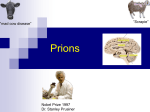
150 Kumiati andWanandi Med J Indones tious particles which resist inactivation by procedures that modify nucleic acids. The term prion emphasizes that the infectivity of this transmissible pathogen of the neurodegenerative diseases depends on a protein com- ponent.à Prion diseases are neurodegenerative disorders of humans and animals causing severe neurologic dysfunction and death. Prions cause four transmissible neurodegenerative diseases of humans and six of animals. Human prion diseases, can manifest as infectious, sporadic, and inherited forms, include kuru, Creutzfeldt-Jakob disease (CJD), fatal familial insom- nia (FFI), and Gerstmann-Strâussler-Scheinker syndrome (GSS). The animal prion diseases include the following: scrapie of sheep, transmissible mink encephalopathy (TME), chronic wasting disease (CWD) of mule, deer and elk, bovine spongiform encephalopathy (B SE), feline spongiform encephalopathy (FSE), and exotic ungulate encephalopathy. Characteristic of the cellular prion protein and scrapie prion protein The PrPc and PrPS" have a molecular weight (Mr) of 33 to 35 kD.l Both PrPc and PrPs" are encoded by a single exon of the chromosomal gene as proteins with the same 254 amino acid sequence. The first 22- ma membrane by a glycosyl-phosphatidylinositol (GPI) moiety located at the COOH terminus of the polypeptide chain. The anchor is added post-translationally in the endoplasmic reticulum, following cleavage of a 23-residue COOH-terminal hydrophobic sequence which serves as a signal for the anchor attachment.-' The two PrP isoforms can be distinguished by their K digestion, only the first Table l. of prion and viroids against physical, chemical and enzymatic treatrnent (modified from Stabilities of irPs" are hydrolyzed and converted PrP 33-35s" to P.P 27-30 Prusiner2) Viroid Prion Physical treatment: UV irradiation 254 nm Chemical treatment SDS Phenol Urea 3 : + + + M Guanidium thiocyanate Psoralen Enzymatic treatment IM + + : RNase A DNase Proteinase K Trypsin + + + = inactivated; - = no change in infectivity The mal The ally modified process that involves a change in the conformation without evidence for chemical modification. Both PrP isoforms are encoded by a chromosomal gene. The human PrP gene maps to the short arm of chromosome 20 and is designated PRNP; the mouse PrP gene maps to chromosome 2 and is designated P*-p.' presence of PrP amyloid rods in some prion diseases has led to assumptions that amyloid formation is essential for the formation of PrPs". However, PrPs" can be formed in the absence of amyloid, and the presence of amyloid plaques is not obligâtory for prion diseases.3 The physiological function of PrPc is unknown, but it appears to be unnecessary since mice in which the PrP gene has been deleted develop normally and are healthy for more than 9 months.' Recently, some inves- tigators suggested several roles of PrP, such as: postsynaptic PrP might be necessary for GABA-dependent synapses to be fully functional, PrP lacking animals exhibit altered sleep patterns and rhythms of circadian activity. PrP also contributes to the prion diseases; the PrP fragment,-PrP 106-126, is toxic to cortical and cerebellar cells.'t The studies of PrP indicate that there are two distinct strains of transmissible mink encephalopathy prions, designated hyper (HY) and drowsy (DY). These different physicoDY PrPs" ieems to Y PrPs".