Personality Disorders - Cornwall Partnership NHS Foundation Trust
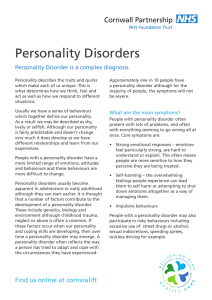
... lively or selfish. Although our personality is fairly predictable and doesn’t change very much it does develop as we have different relationships and learn from our experiences. ...
... lively or selfish. Although our personality is fairly predictable and doesn’t change very much it does develop as we have different relationships and learn from our experiences. ...
Recent revisions to the Diagnostic and Statistical Manual of Mental
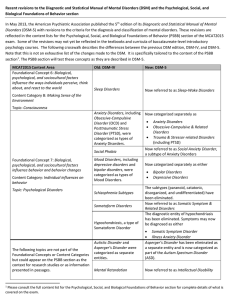
... In May 2013, the American Psychiatric Association published the 5th edition of its Diagnostic and Statistical Manual of Mental Disorders (DSM‐5) with revisions to the criteria for the diagnosis and classification of mental disorders. These revisions are reflected in the content lists for the Psych ...
... In May 2013, the American Psychiatric Association published the 5th edition of its Diagnostic and Statistical Manual of Mental Disorders (DSM‐5) with revisions to the criteria for the diagnosis and classification of mental disorders. These revisions are reflected in the content lists for the Psych ...
Treating Anxiety and OCD: Past, Present and Future
... • Recurrent and persistent thoughts, impulses, or images that are experienced as intrusive and inappropriate and that cause marked anxiety or distress. ...
... • Recurrent and persistent thoughts, impulses, or images that are experienced as intrusive and inappropriate and that cause marked anxiety or distress. ...

ho-2301-chap14powerpoint
... become separated or divided. – Dissociative amnesia – Dissociative fugue ...
... become separated or divided. – Dissociative amnesia – Dissociative fugue ...

Social Phobia Lecture Overview
... Limitations of Combined Treatment Studies for OCD • Fails to provide a conclusive comparison of the relative short and long-term effects of the individual monotherapies; • Fail to adequately examine whether combined treatment is superior to either drug or ERP administered alone • Fail to adequately ...
... Limitations of Combined Treatment Studies for OCD • Fails to provide a conclusive comparison of the relative short and long-term effects of the individual monotherapies; • Fail to adequately examine whether combined treatment is superior to either drug or ERP administered alone • Fail to adequately ...

Medically Unexplained Physical Symptoms
... Temporal link with stressful event/ situation No medical explanation ...
... Temporal link with stressful event/ situation No medical explanation ...
Abnormal Psychology
... …of Grandeur: More important than you really are …of persecution: People are out to get you …of sin or guilt: Being responsible for misfortunes …of influence: Being controlled by outside forces ...
... …of Grandeur: More important than you really are …of persecution: People are out to get you …of sin or guilt: Being responsible for misfortunes …of influence: Being controlled by outside forces ...

Diagnostic Criteria
... environment and self). At least two of these identities or personality states recurrently take control of the person's behavior. Inability to recall important personal information that is too extensive to be ...
... environment and self). At least two of these identities or personality states recurrently take control of the person's behavior. Inability to recall important personal information that is too extensive to be ...
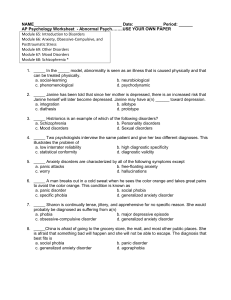
DisordersMultipleChoice - Homework due date to be
... c. statistical conformity d. diagnostic validity 5. _____ Anxiety disorders are characterized by all of the following symptoms except a. panic attacks b. free-floating anxiety c. worry d. hallucinations 6. _____ A man breaks out in a cold sweat when he sees the color orange and takes great pains to ...
... c. statistical conformity d. diagnostic validity 5. _____ Anxiety disorders are characterized by all of the following symptoms except a. panic attacks b. free-floating anxiety c. worry d. hallucinations 6. _____ A man breaks out in a cold sweat when he sees the color orange and takes great pains to ...
types of mental disorders
... • A pattern of behavior in which the rights of others or basic social rules are violated. • Lying, theft, aggression, violence, truancy, arson, and vandalism. • More common amongst males than females. • Although they may act “tough” usually they have low self-esteem. • May also have symptoms of othe ...
... • A pattern of behavior in which the rights of others or basic social rules are violated. • Lying, theft, aggression, violence, truancy, arson, and vandalism. • More common amongst males than females. • Although they may act “tough” usually they have low self-esteem. • May also have symptoms of othe ...

Psychology-Module-31-Study
... A person who is diagnosed with major depressive disorder must have at least five of the depressive symptoms, including at least one of which of the following symptoms? ...
... A person who is diagnosed with major depressive disorder must have at least five of the depressive symptoms, including at least one of which of the following symptoms? ...

PDF Fulltext - Electronic Physician Journal
... on patients’ psychosocial and occupational functioning (4). Researchers have reported the existence of OCD in patients with multiple sclerosis (MS) (5-7) at a rate of 8.6%. The etiology of OCD in MS is unknown, but some researchers believe that OCD is the result of the disruption of the functional c ...
... on patients’ psychosocial and occupational functioning (4). Researchers have reported the existence of OCD in patients with multiple sclerosis (MS) (5-7) at a rate of 8.6%. The etiology of OCD in MS is unknown, but some researchers believe that OCD is the result of the disruption of the functional c ...


Psychopathology
... Moods tend to fluctuate on a cycle with the extremes being mania & depression. Accounts for 5-10% of mood disorders. Less than 1% of the population has it (& it’s equally common in men & women). Compared to a depressive disorder, it tends to occur at an earlier age & has a ...
... Moods tend to fluctuate on a cycle with the extremes being mania & depression. Accounts for 5-10% of mood disorders. Less than 1% of the population has it (& it’s equally common in men & women). Compared to a depressive disorder, it tends to occur at an earlier age & has a ...
Cognitive therapy
... thoughts. This combined approach reduced the frequency of the obsessive thoughts and the associated compulsive behaviours Q= how would you structure this for this question ‘Outline one study into the treatment of OCD using a cognitive approach. Include why the study was done, method used, results ...
... thoughts. This combined approach reduced the frequency of the obsessive thoughts and the associated compulsive behaviours Q= how would you structure this for this question ‘Outline one study into the treatment of OCD using a cognitive approach. Include why the study was done, method used, results ...

Oppositional Defiant Disorder
... • show consistent, unconditional love and acceptance of your child — even during difficult and disruptive situations • Don't be too hard on yourself • This process can be tough for even the most patient parents • Helping your child through tough times without a label can benefit them their entire li ...
... • show consistent, unconditional love and acceptance of your child — even during difficult and disruptive situations • Don't be too hard on yourself • This process can be tough for even the most patient parents • Helping your child through tough times without a label can benefit them their entire li ...
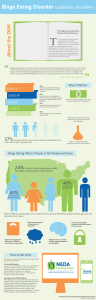
Binge Eating Disorder is added to the DSM-5
... navigating the complex and overwhelming systems and emotions involved with the diagnosis and process of seeking help for an eating disorder. Volunteers are trained by NEDA staff and Clinical Advisors to be a knowledgeable, informal source of support and guidance to those who are new to the illness. ...
... navigating the complex and overwhelming systems and emotions involved with the diagnosis and process of seeking help for an eating disorder. Volunteers are trained by NEDA staff and Clinical Advisors to be a knowledgeable, informal source of support and guidance to those who are new to the illness. ...

General Psychology - Pearson Education
... Diagnosis – act of recognizing a disorder on the basis of a specified set of symptoms The Diagnostic and Statistical Manual of Mental Disorders (DSM) DSM-IV lists 297 different diagnostic categories ...
... Diagnosis – act of recognizing a disorder on the basis of a specified set of symptoms The Diagnostic and Statistical Manual of Mental Disorders (DSM) DSM-IV lists 297 different diagnostic categories ...

Review Exam 3 Format: 48 questions, 2 pts each. Mostly Multiple
... Chap 14: You are responsible for all material in this chapter. Make sure you know the bold-faced terms on the margins. Most was also covered in class. We did not cover Childhood Disorders in class, but be sure you read that section as it may be on the exam. Topics covered include - Classifying ...
... Chap 14: You are responsible for all material in this chapter. Make sure you know the bold-faced terms on the margins. Most was also covered in class. We did not cover Childhood Disorders in class, but be sure you read that section as it may be on the exam. Topics covered include - Classifying ...
MS-Word - Business Information Management
... Social/cultural factors (again, more than one) … more complex, more inclusive, more difficult to investigate Neurosis A term no longer used medically Diagnosis for a relatively mild mental or emotional disorder that may involve anxiety or phobias but does not involve losing touch with reality. A ...
... Social/cultural factors (again, more than one) … more complex, more inclusive, more difficult to investigate Neurosis A term no longer used medically Diagnosis for a relatively mild mental or emotional disorder that may involve anxiety or phobias but does not involve losing touch with reality. A ...
Psychological disorders
... • Twice as likely among female compared to male • Reasons: Conflicting roles of wife, lover and friend • Boys – twice as likely before puberty, Female – twice as likely after ...
... • Twice as likely among female compared to male • Reasons: Conflicting roles of wife, lover and friend • Boys – twice as likely before puberty, Female – twice as likely after ...
CHAPTER 9: MENTAL AND EMOTIONAL PROBLEMS
... • A pattern of behavior in which the rights of others or basic social rules are violated. • Lying, theft, aggression, violence, truancy, arson, and vandalism. • More common amongst makes than females. • Although they may act “tough” usually they have low self-esteem. • May also have symptoms of othe ...
... • A pattern of behavior in which the rights of others or basic social rules are violated. • Lying, theft, aggression, violence, truancy, arson, and vandalism. • More common amongst makes than females. • Although they may act “tough” usually they have low self-esteem. • May also have symptoms of othe ...

Lecture Notes
... May have "panic attacks" - a minutes-long episode of intense fear that something horrible is about to happen to them Panic attacks usually display: shortness of breath, choking sensations, trembling, or dizziness. They are unpredictable and not associated with any one stimulus. Ago ...
... May have "panic attacks" - a minutes-long episode of intense fear that something horrible is about to happen to them Panic attacks usually display: shortness of breath, choking sensations, trembling, or dizziness. They are unpredictable and not associated with any one stimulus. Ago ...