chapter 15 power point - Doral Academy Preparatory
... Avoidant, dependent, obsessivecompulsive Dramatic-impulsive cluster Histrionic, narcissistic, borderline, antisocial Odd-eccentric cluster Schizoid, schizotypal, paranoid Etiology Genetic predispositions, inadequate socialization in dysfunctional families Prognosis ...
... Avoidant, dependent, obsessivecompulsive Dramatic-impulsive cluster Histrionic, narcissistic, borderline, antisocial Odd-eccentric cluster Schizoid, schizotypal, paranoid Etiology Genetic predispositions, inadequate socialization in dysfunctional families Prognosis ...
Psyc 213: Abnormal Psychology
... 7. Briefly describe PTSD. Provide an example of an experience that may result in PTSD and identify the various symptoms that may accompany this disorder. 8. While some professionals believe that multiple personalities are real and more common than previously thought, others believe that the conditio ...
... 7. Briefly describe PTSD. Provide an example of an experience that may result in PTSD and identify the various symptoms that may accompany this disorder. 8. While some professionals believe that multiple personalities are real and more common than previously thought, others believe that the conditio ...

Dissociative, Personality, and Somatoform Disorders
... 50-3. Contrast the three clusters of personality disorders. Personality disorders are psychological disorders characterized by inflexible and enduring behavior patterns that impair social functioning. One cluster expresses anxiety (e.g., avoidant), a second cluster expresses eccentric behaviors (e.g ...
... 50-3. Contrast the three clusters of personality disorders. Personality disorders are psychological disorders characterized by inflexible and enduring behavior patterns that impair social functioning. One cluster expresses anxiety (e.g., avoidant), a second cluster expresses eccentric behaviors (e.g ...
DISSOCIATIVE DISORDERS
... Culturally sanctioned behavior – The term culture-bound syndrome denotes recurrent, localityspecific patterns of aberrant behavior and troubling experience that may or may not be linked to a particular DSM-IV diagnostic category. Many of these patterns are indigenously considered to be “illnesses,” ...
... Culturally sanctioned behavior – The term culture-bound syndrome denotes recurrent, localityspecific patterns of aberrant behavior and troubling experience that may or may not be linked to a particular DSM-IV diagnostic category. Many of these patterns are indigenously considered to be “illnesses,” ...

Feeding and Eating Disorders
... disorder and the common phenomenon of overeating. While overeating is a challenge for many Americans, recurrent binge eating is much less common, far more severe, and is associated with significant physical and psychological problems. ...
... disorder and the common phenomenon of overeating. While overeating is a challenge for many Americans, recurrent binge eating is much less common, far more severe, and is associated with significant physical and psychological problems. ...
has
... _______________________________________________________ _______________________________________________________ _______________________________________________________ ...
... _______________________________________________________ _______________________________________________________ _______________________________________________________ ...


Chapter 1 - Redlands Community College
... terror with high physiological arousal • Very frightening—sufferers live in fear of having them ...
... terror with high physiological arousal • Very frightening—sufferers live in fear of having them ...
ICD-9-CM coding for patients with Tourette syndrome* Comorbid
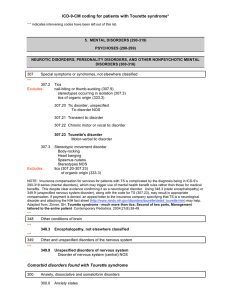
... NOTE: Insurance compensation for services for patients with TS is complicated by the diagnosis being in ICD-9’s 290-319 series (mental disorders), which may trigger use of mental health benefit rules rather than those for medical benefits. This despite clear evidence confirming it as a neurological ...
... NOTE: Insurance compensation for services for patients with TS is complicated by the diagnosis being in ICD-9’s 290-319 series (mental disorders), which may trigger use of mental health benefit rules rather than those for medical benefits. This despite clear evidence confirming it as a neurological ...
Somatoform disorders (part 1)
... • In a study about the use of traditional and spiritual healers is was found that 35.1% of the cases who go to those healers were complaining of somatoform disorders, while 24.8% of the cases were having schizophrenic disorders (2). ...
... • In a study about the use of traditional and spiritual healers is was found that 35.1% of the cases who go to those healers were complaining of somatoform disorders, while 24.8% of the cases were having schizophrenic disorders (2). ...

Personality Disorders
... wouldn’t know it. You may know that you have trouble forming stable relationships. Your work and personal life would probably suffer. But you would probably think it is other people, not you, who are the problem. If you also suffer from depression or anxiety, treatments that help other people likely ...
... wouldn’t know it. You may know that you have trouble forming stable relationships. Your work and personal life would probably suffer. But you would probably think it is other people, not you, who are the problem. If you also suffer from depression or anxiety, treatments that help other people likely ...
Bulimia Nervosa - Cloudfront.net
... by the disorder? Clauses or scars on the knuckles or hands: fromsticking fingers down the throat to induce vomiting. Discolored teeth: From exposure to stomach acid when ...
... by the disorder? Clauses or scars on the knuckles or hands: fromsticking fingers down the throat to induce vomiting. Discolored teeth: From exposure to stomach acid when ...

Study Guide: Chapter 14 Introduction: Understanding Psychological
... associated with having a mental disorder, including the accuracy of the stereotype that people with a psychological disorder are prone to violence. 3. Define a psychological disorder, and discuss the development and role of DSM-IV-TR in classifying psychological disorders. 4. Discuss the key finding ...
... associated with having a mental disorder, including the accuracy of the stereotype that people with a psychological disorder are prone to violence. 3. Define a psychological disorder, and discuss the development and role of DSM-IV-TR in classifying psychological disorders. 4. Discuss the key finding ...
Bianca_Paranoid Personality Disorder
... It’s hard for them to trust their friends or associates. They would accuse a spouse or partner of being unfaithful, even if it’s not true. ...
... It’s hard for them to trust their friends or associates. They would accuse a spouse or partner of being unfaithful, even if it’s not true. ...

Child and Adolescent Mental Health
... Level of thinking allows the person to transfer information from one situation to another, deal efficiently with complex problems, and plan realistically for the future. ...
... Level of thinking allows the person to transfer information from one situation to another, deal efficiently with complex problems, and plan realistically for the future. ...

Antisocial Personality Disorder
... Studies have shown that it is very difficult to treat because people with it may not even want or think that they need any type of treatment. Long term one on one therapy might work but getting the patient to stick to it is difficult. Treatment for depression & anxiety may be needed to be give ...
... Studies have shown that it is very difficult to treat because people with it may not even want or think that they need any type of treatment. Long term one on one therapy might work but getting the patient to stick to it is difficult. Treatment for depression & anxiety may be needed to be give ...

DEFINITION OF MENTAL ILLNESS
... Feels need to repeat physical behaviors (hand washing) or mental behaviors (counting things, silently repeating words) Behaviors occur as response to obsession or in accordance with strictly applied rules ...
... Feels need to repeat physical behaviors (hand washing) or mental behaviors (counting things, silently repeating words) Behaviors occur as response to obsession or in accordance with strictly applied rules ...

these questions
... resource for basic information about the disorders. Therefore, it’s imperative that you watch these and answer all the questions. Don’t split up the work with someone. Don’t copy the answers. ...
... resource for basic information about the disorders. Therefore, it’s imperative that you watch these and answer all the questions. Don’t split up the work with someone. Don’t copy the answers. ...

pptx
... • Self-Esteem: One’s feelings of high or low selfworth (How do you feel about your selfconcept?) ...
... • Self-Esteem: One’s feelings of high or low selfworth (How do you feel about your selfconcept?) ...
Psychological Disorders
... There is usually a feeling of tension before stealing, and a sense of pleasure at the time of the theft A rare problem; more common in women ...
... There is usually a feeling of tension before stealing, and a sense of pleasure at the time of the theft A rare problem; more common in women ...
Personality Disorders
... Can’t make choices, needs complete guidance, fails to take responsibility, lacks self-confidence in abilities. Obsessive-Compulsive Personality Disorder Primary feature: Preoccupation with orderliness, perfectionism, and control (think: Anal retentive) Preoccupied with rules, perfection, wor ...
... Can’t make choices, needs complete guidance, fails to take responsibility, lacks self-confidence in abilities. Obsessive-Compulsive Personality Disorder Primary feature: Preoccupation with orderliness, perfectionism, and control (think: Anal retentive) Preoccupied with rules, perfection, wor ...
Chapter 4 Reading Guide
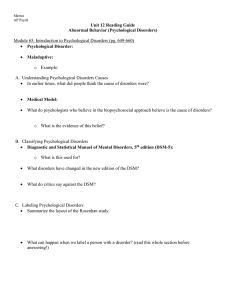
... Give an example of how an anxiety disorder might have been passed down from our biological ancestors. ...
... Give an example of how an anxiety disorder might have been passed down from our biological ancestors. ...
Anxiety Disorders
... Social Phobia • Fear of being in situations that call for some kind of “performance” that may be judged – speaking in public, meeting new people, going to work ...
... Social Phobia • Fear of being in situations that call for some kind of “performance” that may be judged – speaking in public, meeting new people, going to work ...
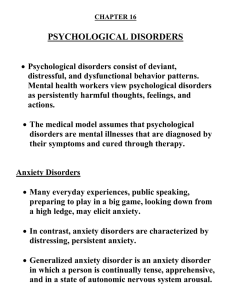
chapter 16: psychological disorders
... Panic disorder is an anxiety disorder in which the anxiety may at times suddenly escalate into a terrifying panic attack, a minutes-long episode of intense dread in which a person experiences terror and accompanying chest pain, choking, or other frightening sensations. A phobia is an anxiety di ...
... Panic disorder is an anxiety disorder in which the anxiety may at times suddenly escalate into a terrifying panic attack, a minutes-long episode of intense dread in which a person experiences terror and accompanying chest pain, choking, or other frightening sensations. A phobia is an anxiety di ...
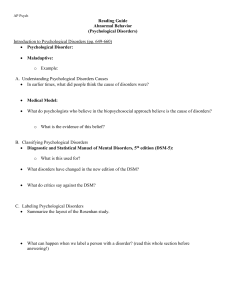
Disorders Reading Guide
... Give an example of how an anxiety disorder might have been passed down from our biological ancestors. ...
... Give an example of how an anxiety disorder might have been passed down from our biological ancestors. ...