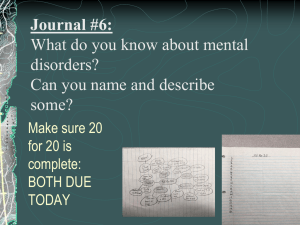
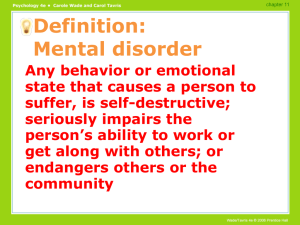
Mental Disorders
... These are disorders related to the heart, the main one being strokes, there are several others such as TIA and disorders related to high blood pressure Trauma induced These are all related to brain injury, hemorrhages and concussions Drug and Alcohol related Intoxication, drug and alcohol withdrawal ...
... These are disorders related to the heart, the main one being strokes, there are several others such as TIA and disorders related to high blood pressure Trauma induced These are all related to brain injury, hemorrhages and concussions Drug and Alcohol related Intoxication, drug and alcohol withdrawal ...
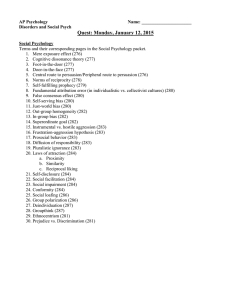
disorders and social psych rv sht
... 2. What are the genetic, biological and environmental causes of schizophrenia and how might they interact? 3. What is the dopamine hypothesis with regard to schizophrenia? 4. Name one side effect of typical anti-psychotic medications? Personality Disorders (p. 596-598 in textbook) Personality Person ...
... 2. What are the genetic, biological and environmental causes of schizophrenia and how might they interact? 3. What is the dopamine hypothesis with regard to schizophrenia? 4. Name one side effect of typical anti-psychotic medications? Personality Disorders (p. 596-598 in textbook) Personality Person ...
Personality Disorders
... Effective psychotherapy treatment for this disorder is limited. Emotions are usually a key aspect of treatment of this disorder. Patients often have had little or no significant emotionally-rewarding relationships in their lives. The therapeutic relationship, therefore, can be one of the firs ...
... Effective psychotherapy treatment for this disorder is limited. Emotions are usually a key aspect of treatment of this disorder. Patients often have had little or no significant emotionally-rewarding relationships in their lives. The therapeutic relationship, therefore, can be one of the firs ...
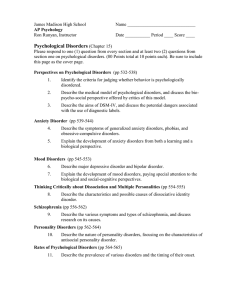
Objectives - RonRunyanEnterprise
... Please respond to one (1) question from every section and at least two (2) questions from section one on psychological disorders. (80 Points total at 10 points each). Be sure to include this page as the cover page. Perspectives on Psychological Disorders (pp 532-538) ...
... Please respond to one (1) question from every section and at least two (2) questions from section one on psychological disorders. (80 Points total at 10 points each). Be sure to include this page as the cover page. Perspectives on Psychological Disorders (pp 532-538) ...
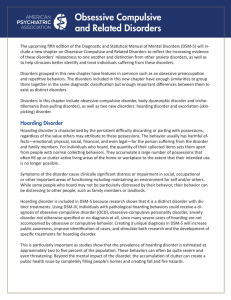
Obsessive Compulsive and Related Disorders
... is no longer possible. Symptoms of the disorder cause clinically significant distress or impairment in social, occupational or other important areas of functioning including maintaining an environment for self and/or others. While some people who hoard may not be particularly distressed by their beh ...
... is no longer possible. Symptoms of the disorder cause clinically significant distress or impairment in social, occupational or other important areas of functioning including maintaining an environment for self and/or others. While some people who hoard may not be particularly distressed by their beh ...

Anorexia Nervosa
... 90% of e.d. folks are adolescent/young women. Anorexia Nervosa—marked by extreme thinness (<85% healthy weight), obsessional thinking, food phobia, poor selfesteem, exercise, dangerous physical effects. Distorted body perception. no treatments are highly successful. Bulimia Nervosa—marked by bin ...
... 90% of e.d. folks are adolescent/young women. Anorexia Nervosa—marked by extreme thinness (<85% healthy weight), obsessional thinking, food phobia, poor selfesteem, exercise, dangerous physical effects. Distorted body perception. no treatments are highly successful. Bulimia Nervosa—marked by bin ...

Name ______ Period_______
... diagnosis treatment options title page (slide), music background, visual with your information ...
... diagnosis treatment options title page (slide), music background, visual with your information ...
Theories of personality
... feels trapped in repetitive, persistent thoughts (obsessions) and repetitive, ritualized behaviors (compulsions) designed to reduce anxiety ...
... feels trapped in repetitive, persistent thoughts (obsessions) and repetitive, ritualized behaviors (compulsions) designed to reduce anxiety ...
1. mood disorders
... Sleep disturbances, weight or appetite changes, fatigue, loss of energy, feelings of worthlessness or excessive guilt, diminishted ability to think of concentrate, indecisiveness, recurrent thoughts of death or suicide ...
... Sleep disturbances, weight or appetite changes, fatigue, loss of energy, feelings of worthlessness or excessive guilt, diminishted ability to think of concentrate, indecisiveness, recurrent thoughts of death or suicide ...

What is an eating disorder?
... • Consumes large amounts of food in short period of time • Purging (eliminates food) through use of laxatives, induced vomiting, diuretics or intense exercise • Fear of being caught. • Symptoms-loss of hair, raspy voice, bruised fingers, sores in corners of mouth, depression ...
... • Consumes large amounts of food in short period of time • Purging (eliminates food) through use of laxatives, induced vomiting, diuretics or intense exercise • Fear of being caught. • Symptoms-loss of hair, raspy voice, bruised fingers, sores in corners of mouth, depression ...
Psychological DisordersClickers
... Brandy, who tends to have a pessimistic explanatory style, learns that she earned a poor grade on her psychology exam. Which attribution is most likely to help her cope without becoming depressed? A. “I’ll always be a poor student.” B. “The teacher gave a particularly hard exam this time.” C. “Of c ...
... Brandy, who tends to have a pessimistic explanatory style, learns that she earned a poor grade on her psychology exam. Which attribution is most likely to help her cope without becoming depressed? A. “I’ll always be a poor student.” B. “The teacher gave a particularly hard exam this time.” C. “Of c ...
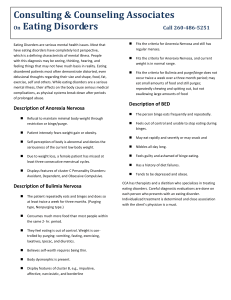
Eating_Disordersas_9..
... Eating Disorders are serious mental health issues. Most that have eating disorders have completely lost perspective, which is a defining characteristic of mental illness. People with this diagnosis may be seeing, thinking, hearing, and feeling things that may not have much basis in reality. Eating d ...
... Eating Disorders are serious mental health issues. Most that have eating disorders have completely lost perspective, which is a defining characteristic of mental illness. People with this diagnosis may be seeing, thinking, hearing, and feeling things that may not have much basis in reality. Eating d ...

Abnormal Psychology - North Cobb High School Class Websites
... • Another theory was to make the body extremely uncomfortable ...
... • Another theory was to make the body extremely uncomfortable ...
Ch12worksheetAPpsyMentalDisorders
... b. Low levels of these three NTs? c. Low self-esteem, faulty ___________________, belief that events in life are uncontrollable _________________ vs _______________ locus of control. d. Lack of development in which parts of the brain? 13. Less severe form of depression is called _______________ ____ ...
... b. Low levels of these three NTs? c. Low self-esteem, faulty ___________________, belief that events in life are uncontrollable _________________ vs _______________ locus of control. d. Lack of development in which parts of the brain? 13. Less severe form of depression is called _______________ ____ ...
Module 50 & 51
... Paranoid Personality Disorders Feel “everyone and everything is out to get them”. - misinterpret situations in line with this paranoia - intensifies under stress - May act on these feelings. Treatment - Cognitive Therapy to increase selfefficacy for dealing with problems. - does not challenge paran ...
... Paranoid Personality Disorders Feel “everyone and everything is out to get them”. - misinterpret situations in line with this paranoia - intensifies under stress - May act on these feelings. Treatment - Cognitive Therapy to increase selfefficacy for dealing with problems. - does not challenge paran ...
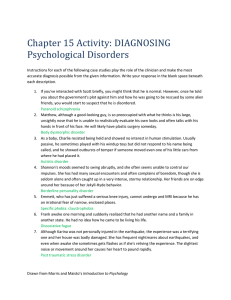
Chapter 15 Activity: DIAGNOSING Psychological Disorders
... one and her house was badly damaged. She has frequent nightmares about earthquakes, and even when awake she sometimes gets flashes as if she's reliving the experience. The slightest noise or movement around her causes her heart to pound rapidly. Post traumatic stress disorder ...
... one and her house was badly damaged. She has frequent nightmares about earthquakes, and even when awake she sometimes gets flashes as if she's reliving the experience. The slightest noise or movement around her causes her heart to pound rapidly. Post traumatic stress disorder ...
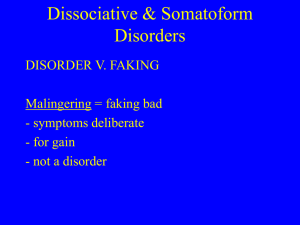
Slides Chapter 6 - Dissociative & Somatoform
... = psychological need to lie - only for psychological gain - symptoms deliberate - a mental disorder ...
... = psychological need to lie - only for psychological gain - symptoms deliberate - a mental disorder ...
Anxiety Disorders
... • Somatization disorder = multiple physical complaints with no physical explanation, onset before age 30 ...
... • Somatization disorder = multiple physical complaints with no physical explanation, onset before age 30 ...
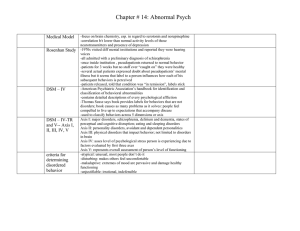
Medical Model - Biloxi Public Schools
... -persistent irrational fears of common events or objects -fear triggered by specific thing or object -intense fear associated w/ public setting -fear of being in open spaces or public places or other places from which escape is perceived to be difficult -anxiety disorder -involuntary, persistent, un ...
... -persistent irrational fears of common events or objects -fear triggered by specific thing or object -intense fear associated w/ public setting -fear of being in open spaces or public places or other places from which escape is perceived to be difficult -anxiety disorder -involuntary, persistent, un ...

No Slide Title
... Obsessive-Compulsive Disorder • Either obsessions or compulsions • At some point during course of disorder, symptoms are recognized as excessive and unreasonable • Symptoms cause marked distress • If Another Axis I Disorder is present, the content of the obsessions or compulsions is not restricted ...
... Obsessive-Compulsive Disorder • Either obsessions or compulsions • At some point during course of disorder, symptoms are recognized as excessive and unreasonable • Symptoms cause marked distress • If Another Axis I Disorder is present, the content of the obsessions or compulsions is not restricted ...
Introduction to Psychology
... Minutes-long episode of intense dread Experience terror & accompanying chest pain, choking, or other frightening sensation ...
... Minutes-long episode of intense dread Experience terror & accompanying chest pain, choking, or other frightening sensation ...
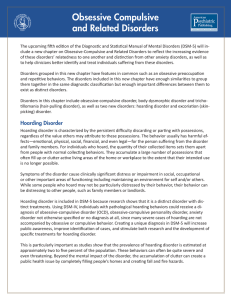
Obsessive Compulsive and Related Disorders - DSM-5
... is no longer possible. Symptoms of the disorder cause clinically significant distress or impairment in social, occupational or other important areas of functioning including maintaining an environment for self and/or others. While some people who hoard may not be particularly distressed by their beh ...
... is no longer possible. Symptoms of the disorder cause clinically significant distress or impairment in social, occupational or other important areas of functioning including maintaining an environment for self and/or others. While some people who hoard may not be particularly distressed by their beh ...

Psychopathology and the DSM
... category of mental disorder is a completely discreet entity with absolute boundaries dividing it from other mental disorders or from no mental disorder.” (p.xxii) ...
... category of mental disorder is a completely discreet entity with absolute boundaries dividing it from other mental disorders or from no mental disorder.” (p.xxii) ...