
AbnormalPsych - WordPress.com
... learning about abnormal psychology. You may find that some of the symptoms we discuss in this chapter sound like something you have experienced. This is normal; happens with medical students, too! Note, though, that all psychological disorders involve exaggerations of normal tendencies. If you can a ...
... learning about abnormal psychology. You may find that some of the symptoms we discuss in this chapter sound like something you have experienced. This is normal; happens with medical students, too! Note, though, that all psychological disorders involve exaggerations of normal tendencies. If you can a ...

Abnormal Psychology
... thinking and behaviors that • deviate significantly from the norm • cause distress to the person or people around him/her • are pervasive and present over time ...
... thinking and behaviors that • deviate significantly from the norm • cause distress to the person or people around him/her • are pervasive and present over time ...
mental disorders intro and anxiety
... It suggests that we have a well-defined concept of normalcy . This can be culture-bound. It also implies that conformity is normal. In some countries, people who disagree with the current political rulers are labeled “abnormal.” ...
... It suggests that we have a well-defined concept of normalcy . This can be culture-bound. It also implies that conformity is normal. In some countries, people who disagree with the current political rulers are labeled “abnormal.” ...
Somatoform Disorders
... somatoform disorder in which a person appears to be, but is not, blind, deaf, paralyzed or insensitive to pain in various parts of the body. – The person will not be able to move their arms, see, feel, etc. but there is no biological cause – The diagnosis of conversion disorder is rare, occurring in ...
... somatoform disorder in which a person appears to be, but is not, blind, deaf, paralyzed or insensitive to pain in various parts of the body. – The person will not be able to move their arms, see, feel, etc. but there is no biological cause – The diagnosis of conversion disorder is rare, occurring in ...

Obsessive-Compulsive Disorder When Unwanted Thoughts Take Over: National Institute of Mental Health
... Examples of obsessions are fear of germs, of being hurt or of hurting others, and troubling religious or sexual thoughts. Examples of compulsions are repeatedly counting things, cleaning things, washing the body or parts of it, or putting things in a certain order, when these actions are not needed, ...
... Examples of obsessions are fear of germs, of being hurt or of hurting others, and troubling religious or sexual thoughts. Examples of compulsions are repeatedly counting things, cleaning things, washing the body or parts of it, or putting things in a certain order, when these actions are not needed, ...
Psychological Disorders notes
... perceptions, and inappropriate emotions and actions. It is a split from reality. Delusions – false beliefs, disturbed perceptions (hallucinations, usually auditory), inappropriate emotions and actions (flat effect, catatonia) Paranoid – preoccupation with delusions or hallucinations Catatonic – immo ...
... perceptions, and inappropriate emotions and actions. It is a split from reality. Delusions – false beliefs, disturbed perceptions (hallucinations, usually auditory), inappropriate emotions and actions (flat effect, catatonia) Paranoid – preoccupation with delusions or hallucinations Catatonic – immo ...

Abnormal Psychology A look at
... Atypical- so different that they violate a norm (what is acceptable in their culture) ...
... Atypical- so different that they violate a norm (what is acceptable in their culture) ...

Abnormal Psychology
... • Paranoia • Psychosis • Very little if any sleep Occurs equally in men and women ...
... • Paranoia • Psychosis • Very little if any sleep Occurs equally in men and women ...
Chapter 9
... -Antisocial Personality Disorder -Borderline Personality Disorder -Histrionic Personality Disorder -Narcissistic Personality Disorder ...
... -Antisocial Personality Disorder -Borderline Personality Disorder -Histrionic Personality Disorder -Narcissistic Personality Disorder ...
Part 2 2011
... keep herself in top physical health. Recently she had some severe dizziness, but her family doctor assured her that is was just a minor ear infection that would clear up in a few days. Laura is concerned because she is sure the ear infection is the sign of something much more serious, such as a brai ...
... keep herself in top physical health. Recently she had some severe dizziness, but her family doctor assured her that is was just a minor ear infection that would clear up in a few days. Laura is concerned because she is sure the ear infection is the sign of something much more serious, such as a brai ...

Anxiety Disorders - Home
... – Develop anxiety, worry, or fear about another attack – Many develop agoraphobia • Prevalence of panic disorder – Affects about 2.7% (in a year) & 4.7% (in a lifetime) of the general population – Onset is often acute, median between 20 and 24 years of age – 75% of individuals with agoraphobia are f ...
... – Develop anxiety, worry, or fear about another attack – Many develop agoraphobia • Prevalence of panic disorder – Affects about 2.7% (in a year) & 4.7% (in a lifetime) of the general population – Onset is often acute, median between 20 and 24 years of age – 75% of individuals with agoraphobia are f ...
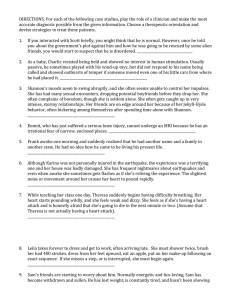
File - Ms. Hines` classroom
... watching himself and his actions from outside of his own body. Because this has happened several times recently, Jack is startled for fear that he will totally lose control of his thoughts and behavior. ____________________________________________________ 22. Kathy took her 6-year old daughter Jenni ...
... watching himself and his actions from outside of his own body. Because this has happened several times recently, Jack is startled for fear that he will totally lose control of his thoughts and behavior. ____________________________________________________ 22. Kathy took her 6-year old daughter Jenni ...

psychology - TeacherWeb
... • Periods of psychotic behavior can alternate with periods of calm and coherence (comes in cycles) • Dopamine – brain chemical that causes speech and thoughts; if too much it can lead to schizophrenia ...
... • Periods of psychotic behavior can alternate with periods of calm and coherence (comes in cycles) • Dopamine – brain chemical that causes speech and thoughts; if too much it can lead to schizophrenia ...
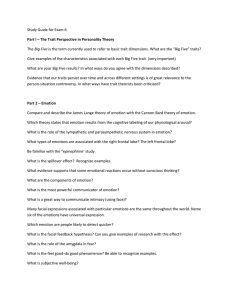
Study Guide for Exam 6 Part I – The Trait Perspective in Personality
... Post traumatic stress disorder (also note pt personal growth) What is a somatoform disorder? Recognize an example of conversion disorder. What are characteristics of dissociative disorders? What is dissociative identity disorder? What evidence suggests that it is ‘more than role-playing’? What are m ...
... Post traumatic stress disorder (also note pt personal growth) What is a somatoform disorder? Recognize an example of conversion disorder. What are characteristics of dissociative disorders? What is dissociative identity disorder? What evidence suggests that it is ‘more than role-playing’? What are m ...
Emotional and Behavioral Disorders
... • a condition that is accompanied by one or more of the following characteristics over a long time and to a marked degree and that adversely affects a child’s educational performance • An inability to learn that cannot be explained by intellectual, sensory, or health factors An inability to build ...
... • a condition that is accompanied by one or more of the following characteristics over a long time and to a marked degree and that adversely affects a child’s educational performance • An inability to learn that cannot be explained by intellectual, sensory, or health factors An inability to build ...
Assessment and Treatment of OCD in the DDMI
... 1. Recurrent and persistent thoughts, impulses, or images that are experienced, at some time during the disturbance, as intrusive and inappropriate and that cause marked anxiety or distress 2. The thoughts, impulses, or images are not simply excessive worries about real-life problems 3. The person a ...
... 1. Recurrent and persistent thoughts, impulses, or images that are experienced, at some time during the disturbance, as intrusive and inappropriate and that cause marked anxiety or distress 2. The thoughts, impulses, or images are not simply excessive worries about real-life problems 3. The person a ...

A mental or emotional condition that makes it difficult for
... Severe disturbances in the behavioral tendencies of an individual, usually involving several areas of a person’s personality ...
... Severe disturbances in the behavioral tendencies of an individual, usually involving several areas of a person’s personality ...
Warm-Up
... a happy, healthful, productive life Each year about 20% of the US population are affected by some form of mental disorder. ...
... a happy, healthful, productive life Each year about 20% of the US population are affected by some form of mental disorder. ...
Shairah Carpio Tory Lamanivong Grant Foster Christine Zhang
... • A person who recognizes the obsessional thoughts, impulses, or images , are a product of his or her own mind (not imposed without as in thought insertion). ...
... • A person who recognizes the obsessional thoughts, impulses, or images , are a product of his or her own mind (not imposed without as in thought insertion). ...

Psychology Study Guide
... While walking to class, Sheila is suddenly overcome by feelings of intense apprehension. For several minutes she has to stand still because her heart is pounding so hard she feels it will burst. Sheila's suffering would most likely be classified as an example of: a. b. c. d. ...
... While walking to class, Sheila is suddenly overcome by feelings of intense apprehension. For several minutes she has to stand still because her heart is pounding so hard she feels it will burst. Sheila's suffering would most likely be classified as an example of: a. b. c. d. ...

Anxiety Disorders - hhsabnormalpsych
... • Both have the same physiological features – increase in respiration, perspiration, muscle tension, etc. ...
... • Both have the same physiological features – increase in respiration, perspiration, muscle tension, etc. ...

Psych 451 -2 - Western Washington University
... Proliferation of diagnostic categories What does this mean? ...
... Proliferation of diagnostic categories What does this mean? ...

Neurotic Disorders - the Peninsula MRCPsych Course
... obsessions, overvalued ideas and always yield to the compulsion Treat with CBT- exposure to stimulus with response prevention, loop tapes. Medication- SSRIs, clomipramine Best is combination- meds + CBT. Psychosurgery in extreme cases ...
... obsessions, overvalued ideas and always yield to the compulsion Treat with CBT- exposure to stimulus with response prevention, loop tapes. Medication- SSRIs, clomipramine Best is combination- meds + CBT. Psychosurgery in extreme cases ...

View Presentation
... Four Types of Anxiety Disorders • Phobic disorder - an anxiety disorder characterized by a persistent, inappropriate fear of an object or situation • Generalized anxiety disorder - a mental disorder that is characterized by a persistent, inappropriate anxiety for which there is no apparent cause • ...
... Four Types of Anxiety Disorders • Phobic disorder - an anxiety disorder characterized by a persistent, inappropriate fear of an object or situation • Generalized anxiety disorder - a mental disorder that is characterized by a persistent, inappropriate anxiety for which there is no apparent cause • ...
Document
... of event, while PTSD requires at least one month of symptoms. Thus, PTSD cannot be diagnosed within one month of traumatic event, but should be considered if symptoms persist beyond one month. ...
... of event, while PTSD requires at least one month of symptoms. Thus, PTSD cannot be diagnosed within one month of traumatic event, but should be considered if symptoms persist beyond one month. ...