Somatoform & Dissociative Disorders
... BUT no physiological basis can be found Emotions Physical Symptoms ...
... BUT no physiological basis can be found Emotions Physical Symptoms ...
Mental Health Unit
... Martians controlling your thoughts Hallucinations — sensing things that don't exist, such as imaginary voices Social isolation ...
... Martians controlling your thoughts Hallucinations — sensing things that don't exist, such as imaginary voices Social isolation ...
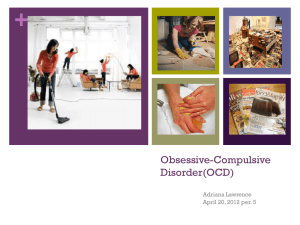
Obsessive-Compulsive Disorder(OCD)
... presence of Body Dysmorphic Disorder; preoccupation with drugs in the presence of a substance Use Disorder; preoccupation with having a serious illness in the presence of Hypochondriasis; preoccupation with sexual urges or fantasies in the presence of a Paraphilia; or guilty ruminations in the prese ...
... presence of Body Dysmorphic Disorder; preoccupation with drugs in the presence of a substance Use Disorder; preoccupation with having a serious illness in the presence of Hypochondriasis; preoccupation with sexual urges or fantasies in the presence of a Paraphilia; or guilty ruminations in the prese ...
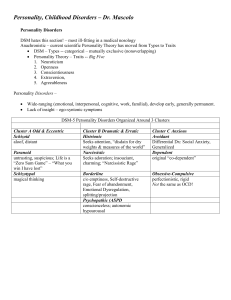
Dr. Mascolo Personality, Childhood Disorders
... Not always a delay. Focus on function, rather than topography of the behavior. Verbal Skills/Insight – weak; Candor -- strong Dx – consequences of a false positive -- but also -- a false negative “Sensitivity” it may be subtle, but the clinician makes the diagnosis “Specificity”– it may seem ...
... Not always a delay. Focus on function, rather than topography of the behavior. Verbal Skills/Insight – weak; Candor -- strong Dx – consequences of a false positive -- but also -- a false negative “Sensitivity” it may be subtle, but the clinician makes the diagnosis “Specificity”– it may seem ...
Obsessive Compulsive Disorder
... door even though you know it is locked, or washing your hands even though they are clean? Most people experience unwanted, even somewhat bizarre or disgusting thoughts, images and impulses from time to time. We don't feel upset by these thoughts and urges, even though they seem pretty unusual for ou ...
... door even though you know it is locked, or washing your hands even though they are clean? Most people experience unwanted, even somewhat bizarre or disgusting thoughts, images and impulses from time to time. We don't feel upset by these thoughts and urges, even though they seem pretty unusual for ou ...
handout 2
... Obsessive Compulsive and Related Disorders • New disorders also have been identified: Hoarding Disorder and Excoriation (skinpicking) Disorder • Similarity among the set of disorders across symptoms, neurobiological networks, genetics, course of illness and treatment response ...
... Obsessive Compulsive and Related Disorders • New disorders also have been identified: Hoarding Disorder and Excoriation (skinpicking) Disorder • Similarity among the set of disorders across symptoms, neurobiological networks, genetics, course of illness and treatment response ...
Section 9: Personality Disorders
... Dependent Personality Disorder • One of most common personality disorders • Excessive dependence on others • Tolerant of abusive treatment • Passive, needy, naive • Different from Borderline P.D. – Respond with submissiveness and monkey bar theory in relationships ...
... Dependent Personality Disorder • One of most common personality disorders • Excessive dependence on others • Tolerant of abusive treatment • Passive, needy, naive • Different from Borderline P.D. – Respond with submissiveness and monkey bar theory in relationships ...

What are Psychological Disorders and How Can We Understand
... • Obsessions: persistent, intrusive thoughts, images and impulses. • Product of own mind (e.g., not hallucinations) • Difficulty ignoring or suppressing obsessions ...
... • Obsessions: persistent, intrusive thoughts, images and impulses. • Product of own mind (e.g., not hallucinations) • Difficulty ignoring or suppressing obsessions ...
OCD
... – The behaviors or mental acts are aimed at preventing or reducing distress or preventing some dreaded event or situation; however, these behaviors or mental acts either are not connected in a realistic way with what they are designed to neutralize or prevent, or are clearly excessive ...
... – The behaviors or mental acts are aimed at preventing or reducing distress or preventing some dreaded event or situation; however, these behaviors or mental acts either are not connected in a realistic way with what they are designed to neutralize or prevent, or are clearly excessive ...
chpt 10
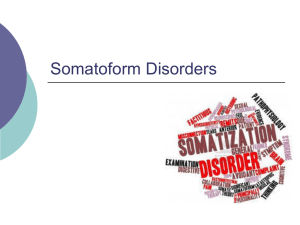
... SOMATOFORM DISORDERS An illness in which a person complains of disease symptoms, but no physical cause can be found. ...
... SOMATOFORM DISORDERS An illness in which a person complains of disease symptoms, but no physical cause can be found. ...
mental illness
... Disorders that are caused by a physical illness or injury that affects the brain. Examples: • Meningitis • Syphilis • Traumatic brain injury ...
... Disorders that are caused by a physical illness or injury that affects the brain. Examples: • Meningitis • Syphilis • Traumatic brain injury ...
Mental Disorders
... people hear things other people don’t hear, think people are reading their minds, controlling their thoughts. People are fearful, withdrawn, and can be extremely ...
... people hear things other people don’t hear, think people are reading their minds, controlling their thoughts. People are fearful, withdrawn, and can be extremely ...

Anxiety Disorders
... – last from days to decades – New identity possibly est. – Escape from conflict ...
... – last from days to decades – New identity possibly est. – Escape from conflict ...
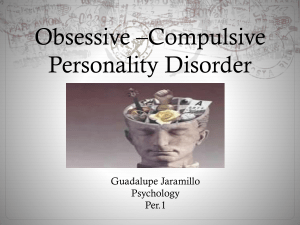
Obsessive Compulsive Personality Disorder
... Psychotherapy a) Psychodynamic techniques b) Cognitive Behavioral therapy c) Training in relaxation techniques d) Help see the emotional side of life ...
... Psychotherapy a) Psychodynamic techniques b) Cognitive Behavioral therapy c) Training in relaxation techniques d) Help see the emotional side of life ...

Did you know that... Psychology works for Obsessive Compulsive
... intrusion called obsessions. Obsessions are recurrent and persistent intrusive thoughts, images or impulses that are unwanted, personally unacceptable and cause significant distress. Even though a person tries very hard to suppress the obsession or cancel out its negative effects, it continues to re ...
... intrusion called obsessions. Obsessions are recurrent and persistent intrusive thoughts, images or impulses that are unwanted, personally unacceptable and cause significant distress. Even though a person tries very hard to suppress the obsession or cancel out its negative effects, it continues to re ...

Document
... - extreme mood changes - high to low for no apparent reason - chemical imbalance in the brain ...
... - extreme mood changes - high to low for no apparent reason - chemical imbalance in the brain ...
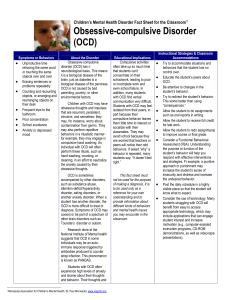
Children`s Mental Health Disorder Fact Sheet for the Classroom
... OCD is not caused by bad parenting, poverty, or other environmental factors. Children with OCD may have obsessive thoughts and impulses that are recurrent, persistent, intrusive, and senseless- they may, for instance, worry about contamination from germs. They may also perform repetitive behaviors i ...
... OCD is not caused by bad parenting, poverty, or other environmental factors. Children with OCD may have obsessive thoughts and impulses that are recurrent, persistent, intrusive, and senseless- they may, for instance, worry about contamination from germs. They may also perform repetitive behaviors i ...

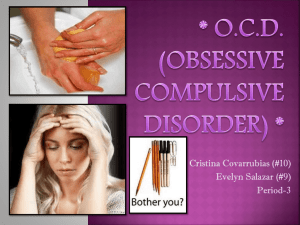
Obsessive-Compulsive Disorder (Word)
... Obsessive-Compulsive Disorder (OCD) has a neurobiological basis. This means it is a biological disease of the brain, just as diabetes is a biological disease of the pancreas. OCD is not caused by bad parenting, poverty, or other environmental factors. Children with OCD may have obsessive thoughts an ...
... Obsessive-Compulsive Disorder (OCD) has a neurobiological basis. This means it is a biological disease of the brain, just as diabetes is a biological disease of the pancreas. OCD is not caused by bad parenting, poverty, or other environmental factors. Children with OCD may have obsessive thoughts an ...
Obsessive-compulsive disorder (OCD)
... Causes, incidence, and risk factors: Obsessive-compulsive disorder (OCD) is more common than was once thought. Most people who develop it show symptoms by age 30. There are several theories about the cause of OCD, but none have been confirmed. Some reports have linked OCD to head injury and infectio ...
... Causes, incidence, and risk factors: Obsessive-compulsive disorder (OCD) is more common than was once thought. Most people who develop it show symptoms by age 30. There are several theories about the cause of OCD, but none have been confirmed. Some reports have linked OCD to head injury and infectio ...
Obsessive-Compulsive Personality Disorder
... Researchers today don’t know what causes obsessive-compulsive personality disorder. There are many theories however some causes may be genetic factors, social factors or psychological factors. ...
... Researchers today don’t know what causes obsessive-compulsive personality disorder. There are many theories however some causes may be genetic factors, social factors or psychological factors. ...