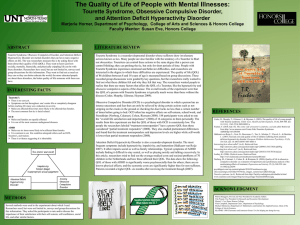
Tourette Syndrome, Obsessive Compulsive
... of times before going to bed. OCD often has negative effects on self-esteem, school/work, and friendships (Norberg, Calamari, Cohen, Riemann 2008). 188 participants were asked to rate the “overall life satisfaction and importance” (2008) of 16 categories to them personally. The results from this exp ...
... of times before going to bed. OCD often has negative effects on self-esteem, school/work, and friendships (Norberg, Calamari, Cohen, Riemann 2008). 188 participants were asked to rate the “overall life satisfaction and importance” (2008) of 16 categories to them personally. The results from this exp ...
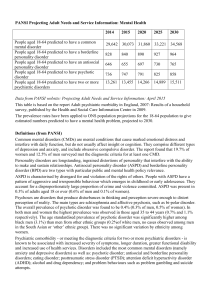
Mental Health Projections: PANSI 2015
... both men and women the highest prevalence was observed in those aged 35 to 44 years (0.7% and 1.1% respectively). The age standardised prevalence of psychotic disorder was significantly higher among black men (3.1%) than men from other ethnic groups (0.2%of white men, no cases observed among men in ...
... both men and women the highest prevalence was observed in those aged 35 to 44 years (0.7% and 1.1% respectively). The age standardised prevalence of psychotic disorder was significantly higher among black men (3.1%) than men from other ethnic groups (0.2%of white men, no cases observed among men in ...
Compulsive Disorder
... Obsessions are recurrent and persistent thoughts, urges, or images that are experienced as intrusive and unwanted. Compulsions are repetitive behaviors or mental acts that the individual feels driven to ...
... Obsessions are recurrent and persistent thoughts, urges, or images that are experienced as intrusive and unwanted. Compulsions are repetitive behaviors or mental acts that the individual feels driven to ...
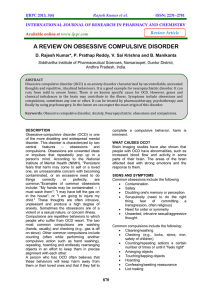
a review on obsessive compulsive disorder
... child." These thoughts are often intrusive, unpleasant and produce a high degree of anxiety. Sometimes the obsessions are of a violent or a sexual nature, or concern illness. Compulsions are repetitive behaviors to which people who suffer from OCD resort. The two most common compulsions are washing ...
... child." These thoughts are often intrusive, unpleasant and produce a high degree of anxiety. Sometimes the obsessions are of a violent or a sexual nature, or concern illness. Compulsions are repetitive behaviors to which people who suffer from OCD resort. The two most common compulsions are washing ...
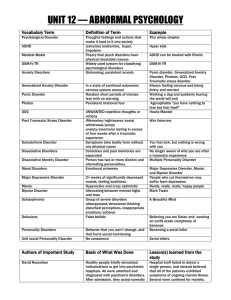
unit 12 — abnormal psychology
... fear with no warning Persistent irrational fear UNWANTED repetitive thoughts or actions (Memories/nightmares/social withdrawal/jumpy anxiety/insomnia) lasting in excess of four weeks after a traumatic experience Symptoms take bodily form without any physical cause Conscious and past memories are sep ...
... fear with no warning Persistent irrational fear UNWANTED repetitive thoughts or actions (Memories/nightmares/social withdrawal/jumpy anxiety/insomnia) lasting in excess of four weeks after a traumatic experience Symptoms take bodily form without any physical cause Conscious and past memories are sep ...

2. Personality Disorders
... when they found he had been stealing money and materials. Andrew feels no remorse over his actions, but he has managed to convince each of his former employers that he is sorry for his actions, and none plan to press any charges. Ellen is self-centered, immature, and excitable. She craves attention, ...
... when they found he had been stealing money and materials. Andrew feels no remorse over his actions, but he has managed to convince each of his former employers that he is sorry for his actions, and none plan to press any charges. Ellen is self-centered, immature, and excitable. She craves attention, ...
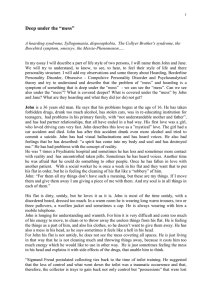
A hoarding syndrome, Syllogomania, disposophobia
... In my essay I will describe a part of life style of two persons, I will name them John and Jane. We will try to understand, to know, to see, to hear, to feel their style of life and there personality structure. I will add my observations and some theory about Hoarding, Borderline Personality Disorde ...
... In my essay I will describe a part of life style of two persons, I will name them John and Jane. We will try to understand, to know, to see, to hear, to feel their style of life and there personality structure. I will add my observations and some theory about Hoarding, Borderline Personality Disorde ...

social phobia - UCT health sciences
... • Pathological or problem gambling, compulsive sexual disorder, problematic internet use • Hoarding concerns hoarding behaviors • Being a meticulous professional or student ...
... • Pathological or problem gambling, compulsive sexual disorder, problematic internet use • Hoarding concerns hoarding behaviors • Being a meticulous professional or student ...
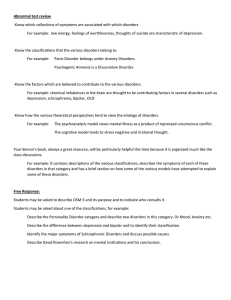
Abnormal test review -Know which collections of symptoms are
... For example: chemical imbalances in the brain are thought to be contributing factors in several disorders such as depression, schizophrenia, bipolar, OCD ...
... For example: chemical imbalances in the brain are thought to be contributing factors in several disorders such as depression, schizophrenia, bipolar, OCD ...
Somatic, Factitious, and Dissociative Disorders
... medical condition, but not explained by medical, substance or another mental disorder ...
... medical condition, but not explained by medical, substance or another mental disorder ...
023_2004_MentalDisorders_Mood_web
... • Dysthymia – less severe symptoms than major depression that last for 2+ years ...
... • Dysthymia – less severe symptoms than major depression that last for 2+ years ...
appsychchapt16
... worrying about anything and everything, even in calm situations. They have difficulty relaxing, falling asleep, and/or concentrating, and tend to be impatient and irritable. ...
... worrying about anything and everything, even in calm situations. They have difficulty relaxing, falling asleep, and/or concentrating, and tend to be impatient and irritable. ...
Module 49 - DID and Personality disorders
... increased in the late 20th century. Also DID has not been found in other countries. Critics Arguments 1. Role-playing by people open to therapist’s suggestion. 2. Learned response that reinforces reductions in anxiety. ...
... increased in the late 20th century. Also DID has not been found in other countries. Critics Arguments 1. Role-playing by people open to therapist’s suggestion. 2. Learned response that reinforces reductions in anxiety. ...
Mental Disorders
... • Commonly occur during the teen years • Puberty, body changes, and media cause some teens to put pressure on themselves to look a certain way • Common among girls but affect boys, too ...
... • Commonly occur during the teen years • Puberty, body changes, and media cause some teens to put pressure on themselves to look a certain way • Common among girls but affect boys, too ...

ap abnormal - HopewellPsychology
... or travel away from their homes or places of work. 2. Cause: linked to severe stress, which might be the result of traumatic events— such as war, abuse, accidents, disasters or extreme violence—that the person has experienced or witnessed. example ...
... or travel away from their homes or places of work. 2. Cause: linked to severe stress, which might be the result of traumatic events— such as war, abuse, accidents, disasters or extreme violence—that the person has experienced or witnessed. example ...
Obsessions
... • The focus of BDD symptoms is limited to one’s appearance • Similar psychological treatments are effective for both conditions. Hoarding • Once considered to be a symptom of OCD, hoarding is now understood as a separate problem. • Hoarding symptoms are no more prevalent in OCD patients than those w ...
... • The focus of BDD symptoms is limited to one’s appearance • Similar psychological treatments are effective for both conditions. Hoarding • Once considered to be a symptom of OCD, hoarding is now understood as a separate problem. • Hoarding symptoms are no more prevalent in OCD patients than those w ...
PSYCHOLOGY (9th Edition) David Myers
... Understanding Antisocial Personality Disorder Like mood disorders and schizophrenia, antisocial personality disorder has biological and psychological reasons. Youngsters, before committing a crime, respond with lower levels of stress hormones than others do at their age. ...
... Understanding Antisocial Personality Disorder Like mood disorders and schizophrenia, antisocial personality disorder has biological and psychological reasons. Youngsters, before committing a crime, respond with lower levels of stress hormones than others do at their age. ...
Obsessive Compulsive Disorder
... DSM -5 OCD Criteria Obsessions • Recurrent & persistent thought, impulses, or images that are experienced, at some time during the disturbance, as intrusive and inappropriate & that cause marked anxiety or distress. • The thoughts, impulses, or images aren’t simply excessive worries about life prob ...
... DSM -5 OCD Criteria Obsessions • Recurrent & persistent thought, impulses, or images that are experienced, at some time during the disturbance, as intrusive and inappropriate & that cause marked anxiety or distress. • The thoughts, impulses, or images aren’t simply excessive worries about life prob ...

AP_Chapter_16_psychological_disorders[1][1]
... 1. Definition: preoccupying fear of having a serious illness 2. Causes: no known causes , but… could be a form of OCD. 3. Faking it??? True hypochondriacs are not faking it. ...
... 1. Definition: preoccupying fear of having a serious illness 2. Causes: no known causes , but… could be a form of OCD. 3. Faking it??? True hypochondriacs are not faking it. ...

PCOM Board Review: Behavioral Medicine
... S5 of the following for at least 2 weeks duration, of which one is Depressed mood or ...
... S5 of the following for at least 2 weeks duration, of which one is Depressed mood or ...
Mental and Emotional Illness
... • Intense and exaggerated fear of a specific situation or object • Examples: fear of animals, heights, flying ...
... • Intense and exaggerated fear of a specific situation or object • Examples: fear of animals, heights, flying ...
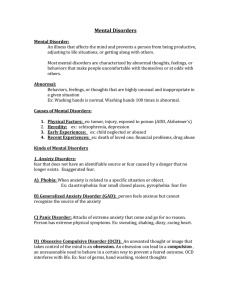
Mental Disorder Notes File
... adjusting to life situations, or getting along with others. Most mental disorders are characterized by abnormal thoughts, feelings, or behaviors that make people uncomfortable with themselves or at odds with others. Abnormal: Behaviors, feelings, or thoughts that are highly unusual and inappropriate ...
... adjusting to life situations, or getting along with others. Most mental disorders are characterized by abnormal thoughts, feelings, or behaviors that make people uncomfortable with themselves or at odds with others. Abnormal: Behaviors, feelings, or thoughts that are highly unusual and inappropriate ...
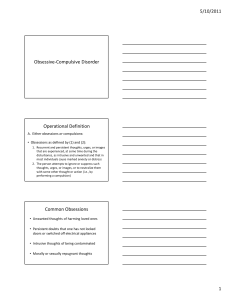
Obsessive-Compulsive Disorder
... • Those with hoarding symptoms appear to respond less well to treatment • May need to add motivational enhancement techniques for those who are reluctant to engage in exposures • Group therapy is as effective as individual Abramowitz et al. (2009) ...
... • Those with hoarding symptoms appear to respond less well to treatment • May need to add motivational enhancement techniques for those who are reluctant to engage in exposures • Group therapy is as effective as individual Abramowitz et al. (2009) ...