PowerPoint Presentation - Waukee Community School District Blogs
... • Avoiding social situations where food is there • Distorted body image • Preoccupied with exercise ...
... • Avoiding social situations where food is there • Distorted body image • Preoccupied with exercise ...

Unit 6: Psychopathology Name: I. Defining Psychological Disorders
... • C. Standards of this harmful behavior … II. Medical Model • A. The idea that diseases have… ...
... • C. Standards of this harmful behavior … II. Medical Model • A. The idea that diseases have… ...
Students with Emotional and Behavioral Disorders
... • An inability to learn that cannot be explained by intellectual, sensory, or health factors An inability to build or maintain satisfactory interpersonal relationships with peers and teachers Inappropriate types of behavior or feelings under normal circumstances A general pervasive mood of unha ...
... • An inability to learn that cannot be explained by intellectual, sensory, or health factors An inability to build or maintain satisfactory interpersonal relationships with peers and teachers Inappropriate types of behavior or feelings under normal circumstances A general pervasive mood of unha ...
Post Traumatic Stress Disorder
... suffer from any type of anxiety disorder. • Over 30% of women experience an anxiety disorder at some time in their life. • Rates of obsessive compulsive disorder are nearly equal for men and women • Females risk of developing PTSD following a trauma is twice that of males. Females are also more like ...
... suffer from any type of anxiety disorder. • Over 30% of women experience an anxiety disorder at some time in their life. • Rates of obsessive compulsive disorder are nearly equal for men and women • Females risk of developing PTSD following a trauma is twice that of males. Females are also more like ...
File
... • Sexual and Gender Identity Disorder: Problems with sexual identity, deviant sexual behavior, or sexual adjustment • Substance Related Disorders: Abuse or dependence on a behavior or moodaltering drug, like alcohol or cocaine – Person cannot stop using the substance and may suffer withdrawal sympto ...
... • Sexual and Gender Identity Disorder: Problems with sexual identity, deviant sexual behavior, or sexual adjustment • Substance Related Disorders: Abuse or dependence on a behavior or moodaltering drug, like alcohol or cocaine – Person cannot stop using the substance and may suffer withdrawal sympto ...

EMOTIONAL DISORDERS - Dublin City Schools
... control, stressed, illness Treatment: support groups, twelve step programs, formal interventions, gradually stopping, cold turkey ...
... control, stressed, illness Treatment: support groups, twelve step programs, formal interventions, gradually stopping, cold turkey ...
Chapter14
... loss of memory for important personal information that is too extensive to be due to normal forgetting. Memory loss may be for a single traumatic event or for an extended time period around the event. identity ...
... loss of memory for important personal information that is too extensive to be due to normal forgetting. Memory loss may be for a single traumatic event or for an extended time period around the event. identity ...
Somatoform and Dissociative Disorders
... Conversion Disorder • Conversion disorder is changing emotional difficulties into a loss of specific body function – No actual physical damage is present – They usually accept the loss with relative calm – They invent physical symptoms to gain freedom from an unbearable conflict ...
... Conversion Disorder • Conversion disorder is changing emotional difficulties into a loss of specific body function – No actual physical damage is present – They usually accept the loss with relative calm – They invent physical symptoms to gain freedom from an unbearable conflict ...
DSM-IV-TR in Action Powerpoint
... Anxiety and Obsessive-Compulsive Spectrum Disorders Will also include trichotillomania and possible other conditions Obsessions to be described as urges rather than impulses Term “impulses” is problematic as how do you distinguish them from impulse control disorders, so will change term ...
... Anxiety and Obsessive-Compulsive Spectrum Disorders Will also include trichotillomania and possible other conditions Obsessions to be described as urges rather than impulses Term “impulses” is problematic as how do you distinguish them from impulse control disorders, so will change term ...

Final Jeopardy
... with anorexia and those with bulimia, the other disorders comorbid with this eating disorder seem to include an underlying need for control. ...
... with anorexia and those with bulimia, the other disorders comorbid with this eating disorder seem to include an underlying need for control. ...
2- obsessive compulsive disorders DSM 5
... Obsessions: • The preoccupation with recurrent and persistent thoughts , urges or images that are experienced- at some time during the disturbance- as being intrusive, senseless and unwanted and cause marked anxiety (obsession). – Not excessive worry about daily life problems. • The individual tries ...
... Obsessions: • The preoccupation with recurrent and persistent thoughts , urges or images that are experienced- at some time during the disturbance- as being intrusive, senseless and unwanted and cause marked anxiety (obsession). – Not excessive worry about daily life problems. • The individual tries ...
Reactive Attachment Disorder (RAD) and Disinhibited Social
... Criterion B: One or more intrusion symptoms Criterion C: Persistent avoidance of stimuli Criterion D: Alterations in cognitive, arousal, mood, reactivity, etc. Duration in both is more than 1 month and causes clinically significant distress. Remaining criteria differ slightly for both groups. ...
... Criterion B: One or more intrusion symptoms Criterion C: Persistent avoidance of stimuli Criterion D: Alterations in cognitive, arousal, mood, reactivity, etc. Duration in both is more than 1 month and causes clinically significant distress. Remaining criteria differ slightly for both groups. ...

023_W2006_Disorder_AnxMood_web
... Obsessions and Compulsions Obsessions • irrational, disturbing thoughts that intrude into consciousness • Examples: dirt & contamination, aggression and violence, religion, bodily functions like bowel movements, need for “Out, damned spot! out, I say!balance and symmetry - One: two: why ….Yet who C ...
... Obsessions and Compulsions Obsessions • irrational, disturbing thoughts that intrude into consciousness • Examples: dirt & contamination, aggression and violence, religion, bodily functions like bowel movements, need for “Out, damned spot! out, I say!balance and symmetry - One: two: why ….Yet who C ...

Learners with Emotional or Behavioral Disorders
... • a need to count or a need for things to be symmetrical, it is just as common for individuals with OCD to suffer most from symptoms that are less well-known, none of which is more common than indecision. • And indecision is always at its worst when the patient is presented with two options that are ...
... • a need to count or a need for things to be symmetrical, it is just as common for individuals with OCD to suffer most from symptoms that are less well-known, none of which is more common than indecision. • And indecision is always at its worst when the patient is presented with two options that are ...
2. Personality Disorders
... when they found he had been stealing money and materials. Andrew feels no remorse over his actions, but he has managed to convince each of his former employers that he is sorry for his actions, and none plan to press any charges. Ellen is has been feeling both depressed and anxious. She would like t ...
... when they found he had been stealing money and materials. Andrew feels no remorse over his actions, but he has managed to convince each of his former employers that he is sorry for his actions, and none plan to press any charges. Ellen is has been feeling both depressed and anxious. She would like t ...
Psychological Disorders
... Psychoanalytic – repressed urges become physical Look for a connection Behavioral – means of escape ...
... Psychoanalytic – repressed urges become physical Look for a connection Behavioral – means of escape ...

The assessment of traumatic brain injury
... Dr Amit Nigam, Dr Joanne Farrow, Dr Ali Al-Allaq, Dr Sanjay Nelson and Professor Naomi A Fineberg ...
... Dr Amit Nigam, Dr Joanne Farrow, Dr Ali Al-Allaq, Dr Sanjay Nelson and Professor Naomi A Fineberg ...

Somatoform and Dissociative Disorders
... Several important changes have been made from previous editions of DSM. The DSM-IV disorders of somatization disorder, hypochondriasis, pain disorder, and undifferentiated somatoform disorder have been removed, and many, but not all, of the individuals diagnosed with one of these disorders could now ...
... Several important changes have been made from previous editions of DSM. The DSM-IV disorders of somatization disorder, hypochondriasis, pain disorder, and undifferentiated somatoform disorder have been removed, and many, but not all, of the individuals diagnosed with one of these disorders could now ...
Psi Chi/ PSA - Michigan State University
... variety of ways, and individuals usually suffer from a combination of symptoms. However, most people with OCD share common difficulties in daily activities, such as tardiness, perfectionism, procrastination, indecision, discouragement and family difficulties. ...
... variety of ways, and individuals usually suffer from a combination of symptoms. However, most people with OCD share common difficulties in daily activities, such as tardiness, perfectionism, procrastination, indecision, discouragement and family difficulties. ...
Unit 12 PowerPoint Notes - Troup County School System
... • Used to be known as Multiple Personality Disorder. • A person has several rather than one integrated personality. • People with DID commonly have a history of childhood abuse or trauma. ...
... • Used to be known as Multiple Personality Disorder. • A person has several rather than one integrated personality. • People with DID commonly have a history of childhood abuse or trauma. ...
Mental Health for Law Enforcement
... - Diagnostic and Statistical Manual of Mental Disorders, Fourth Edition (DSM-IVTR) It’s the big book where we get all the information on mental disorders, substance abuse and other mental health concerns. ...
... - Diagnostic and Statistical Manual of Mental Disorders, Fourth Edition (DSM-IVTR) It’s the big book where we get all the information on mental disorders, substance abuse and other mental health concerns. ...
Child and Adolescent Psychopathology
... Includes OCD and Trichotillomania (TTM) OCD and TTM may be related due to: 1) Presence of repetitive behavior 2) Similar response to pharmacological treatments 3) Higher than expected rates of TTM among relatives of OCD patients and vice versa Relationship between the two disorders is no ...
... Includes OCD and Trichotillomania (TTM) OCD and TTM may be related due to: 1) Presence of repetitive behavior 2) Similar response to pharmacological treatments 3) Higher than expected rates of TTM among relatives of OCD patients and vice versa Relationship between the two disorders is no ...
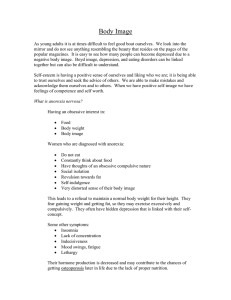
Body Image
... Bulimia may be easier to hide than anorexia because women who have this disorder can keep a normal body weight. Some other symptoms of this disorder: ...
... Bulimia may be easier to hide than anorexia because women who have this disorder can keep a normal body weight. Some other symptoms of this disorder: ...
Abnormal Psychology
... Characterized by what can best be called a “fragmented” mental life. Fragmented thought – cannot maintain coherent thoughts. Jump from one idea to the next. Fragmented attention – easily distracted Withdrawal from social contact – They remove themselves from contact with others and start to li ...
... Characterized by what can best be called a “fragmented” mental life. Fragmented thought – cannot maintain coherent thoughts. Jump from one idea to the next. Fragmented attention – easily distracted Withdrawal from social contact – They remove themselves from contact with others and start to li ...