
Heredity in comorbid bipolar disorder and obsessive
... patient who has the index disease under study”.[1] In Feinstein’s formulation, the implication was that a completely different and independent disease occurred at the same time as another disease. In contrast to this approach, the Diagnostic and Statistical Manual of Mental Disorders (DSM) explicitl ...
... patient who has the index disease under study”.[1] In Feinstein’s formulation, the implication was that a completely different and independent disease occurred at the same time as another disease. In contrast to this approach, the Diagnostic and Statistical Manual of Mental Disorders (DSM) explicitl ...

Continued on next slide
... B. symptoms of the disorder are most dramatic after the patient has begun therapy. C. in some countries, the disorder is nonexistent. D. children who have endured extreme traumas, such as watching a parent’s murder, do not develop the disorder. ...
... B. symptoms of the disorder are most dramatic after the patient has begun therapy. C. in some countries, the disorder is nonexistent. D. children who have endured extreme traumas, such as watching a parent’s murder, do not develop the disorder. ...

Anorexia Nervosa
... -In normal children, neuroplasticity will allow the insula to create a homunculi that represents their new bodies post-puberty. In AN, the insula is dysfunction due to impaired neuroplasticity created through noradrenergic dysregulation. Thus, a major discrepancy between actual body size and the hom ...
... -In normal children, neuroplasticity will allow the insula to create a homunculi that represents their new bodies post-puberty. In AN, the insula is dysfunction due to impaired neuroplasticity created through noradrenergic dysregulation. Thus, a major discrepancy between actual body size and the hom ...
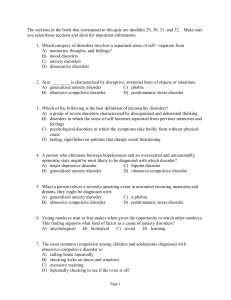
The sections in the book that correspond to this quiz are modules 29
... 17. According to the medical model, psychological disorders are: A) learned habits that need to be extinguished. B) maladaptive responses to a troubling environment. C) purely imaginary symptoms of distress. D) sicknesses that need to be diagnosed and cured. 18. Nonmedical therapy is known as: A) th ...
... 17. According to the medical model, psychological disorders are: A) learned habits that need to be extinguished. B) maladaptive responses to a troubling environment. C) purely imaginary symptoms of distress. D) sicknesses that need to be diagnosed and cured. 18. Nonmedical therapy is known as: A) th ...
mlukulach8
... About one quarter to one third of people who go to weight-loss clinics may have binge eating disorder. ...
... About one quarter to one third of people who go to weight-loss clinics may have binge eating disorder. ...
Eating disorders and body image. PPT
... Perceived body weight and body shape are severely distorted Even when drastically underweight, most individuals with this disorder will see themselves as being overweight ...
... Perceived body weight and body shape are severely distorted Even when drastically underweight, most individuals with this disorder will see themselves as being overweight ...

Day 7
... some situations Unexpected (uncued) panic – Unexpected “out of the blue” without warning Situationally predisposed panic – May or may not occur in some situations ...
... some situations Unexpected (uncued) panic – Unexpected “out of the blue” without warning Situationally predisposed panic – May or may not occur in some situations ...
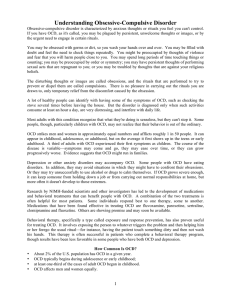
Understanding Obsessive-Compulsive Disorder
... unable to stop themselves. Common forms of this are checking locks, stoves, and lights, or recurrent intrusive thoughts of hurting oneself or one's children. Afflicted individuals usually experience severe anxiety if unable to complete their rituals, though many therapies work by helping the individ ...
... unable to stop themselves. Common forms of this are checking locks, stoves, and lights, or recurrent intrusive thoughts of hurting oneself or one's children. Afflicted individuals usually experience severe anxiety if unable to complete their rituals, though many therapies work by helping the individ ...
Obsessive-compulsive disorder (OCD) is a psychiatric disorder
... most people, even those without OCD. Violence is rare among OCD sufferers, but the disorder is often debilitating and detrimental to their quality of life. Also, the psychological self-awareness of the irrationality of the disorder can be painful. For people with severe OCD, it may take several hour ...
... most people, even those without OCD. Violence is rare among OCD sufferers, but the disorder is often debilitating and detrimental to their quality of life. Also, the psychological self-awareness of the irrationality of the disorder can be painful. For people with severe OCD, it may take several hour ...
Emotional Health
... experiencing hallucinations (hearing or seeing things that are not real) and delusions (irrational beliefs that do not reflect reality). Characteristics of the psychotic also include disorganized thinking and personality changes. Although the above two terms are used quite frequently to describe an ...
... experiencing hallucinations (hearing or seeing things that are not real) and delusions (irrational beliefs that do not reflect reality). Characteristics of the psychotic also include disorganized thinking and personality changes. Although the above two terms are used quite frequently to describe an ...
Psychological Disorders Review Sheet (Chapter 15)
... also known as multiple personality disorder. Person alternates between 2 or more personalities. Has amnesia when personalities change and main personality usually unaware of others. Usually caused by some traumatic (usually sexual abuse) during early life. ...
... also known as multiple personality disorder. Person alternates between 2 or more personalities. Has amnesia when personalities change and main personality usually unaware of others. Usually caused by some traumatic (usually sexual abuse) during early life. ...
PSY101 Powerpoint Chapter 15 Psychological Disorders
... significant distress or disability in social, occupational, or other important activities. An expectable or culturally approved response to a common stressor or loss, such as the death of a loved one, is not a mental disorder. Socially deviant behavior (e.g., political, religious, or sexual) and con ...
... significant distress or disability in social, occupational, or other important activities. An expectable or culturally approved response to a common stressor or loss, such as the death of a loved one, is not a mental disorder. Socially deviant behavior (e.g., political, religious, or sexual) and con ...
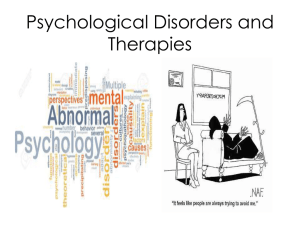
Introduction to Abnormal Psychology and Mental Illness
... at least the last two weeks for that person to be diagnosed with this disorder. • When diagnosing a client the American Psychiatric Association recommends that the clinician use a multiaxial ...
... at least the last two weeks for that person to be diagnosed with this disorder. • When diagnosing a client the American Psychiatric Association recommends that the clinician use a multiaxial ...

MSIV personality disorders v 2012_Dr D Mercer
... reassurance from others unable to disagree with others because fears loss of support, will do things that are unpleasant, degrading to maintain ...
... reassurance from others unable to disagree with others because fears loss of support, will do things that are unpleasant, degrading to maintain ...
Mind the (explanatory) gap - California State University, Fullerton
... • Contrary to expectations, v was parameter lower for OCD+HD less risk averse. ...
... • Contrary to expectations, v was parameter lower for OCD+HD less risk averse. ...

Slide 1
... Agoraphobia - fear of wide open spaces, crowds, or uncontrolled social conditions - Both marked by panic attacks when confronted with phobic situation - 2/3 of all phobias are agoraphobics ...
... Agoraphobia - fear of wide open spaces, crowds, or uncontrolled social conditions - Both marked by panic attacks when confronted with phobic situation - 2/3 of all phobias are agoraphobics ...

a PowerPoint presentation of Module 51
... D. children who have endured extreme traumas, such as watching a parent’s murder, do not develop the disorder. ...
... D. children who have endured extreme traumas, such as watching a parent’s murder, do not develop the disorder. ...
Section III - American Psychiatric Association
... base that warranted their progression into Section II for widespread clinical use, however, other conditions were dropped from the manual altogether failing to have garnered utility or empirical evidence since the prior manual was published. It is anticipated that the conditions included in Section ...
... base that warranted their progression into Section II for widespread clinical use, however, other conditions were dropped from the manual altogether failing to have garnered utility or empirical evidence since the prior manual was published. It is anticipated that the conditions included in Section ...

Abnormal Psychology - Bloomfield Central School
... • Organic amnesia can be retrograde or antrograde. ...
... • Organic amnesia can be retrograde or antrograde. ...
Somatoform & Dissociative Disorders
... something or only thought about it Absorption in TV program or movie Remembering past so vividly you seem to be reliving it Staring into space Talking out loud to yourself when alone Finding evidence of having done things you can’t remember doing ...
... something or only thought about it Absorption in TV program or movie Remembering past so vividly you seem to be reliving it Staring into space Talking out loud to yourself when alone Finding evidence of having done things you can’t remember doing ...
Mental Disorders
... and thinking processes. These people have difficulty thinking rationally and their judgments are impaired. Living their daily life becomes very, very difficult. However, for even the worst of these disorders there is treatment available. The most prevalent symptoms of these diseases are usually delu ...
... and thinking processes. These people have difficulty thinking rationally and their judgments are impaired. Living their daily life becomes very, very difficult. However, for even the worst of these disorders there is treatment available. The most prevalent symptoms of these diseases are usually delu ...
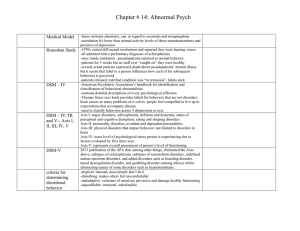
Notes_14 abnormal - Biloxi Public Schools
... - aka: multiple personality disorder -rare condition involving existence of 2+ separate personalities housed in one body -identities may or may not be aware of each other -sufferer is essentially converting psychological stress to physical symptoms -involves a preoccupation with the fear that one ha ...
... - aka: multiple personality disorder -rare condition involving existence of 2+ separate personalities housed in one body -identities may or may not be aware of each other -sufferer is essentially converting psychological stress to physical symptoms -involves a preoccupation with the fear that one ha ...
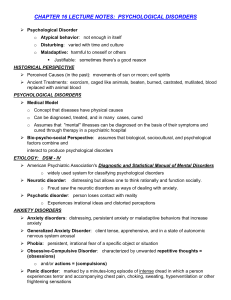
chapter 16 lecture notes: psychological disorders
... o Concept that diseases have physical causes o Can be diagnosed, treated, and in many cases, cured o Assumes that "mental" illnesses can be diagnosed on the basis of their symptoms and cured through therapy in a psychiatric hospital Bio-psycho-social Perspective: assumes that biological, sociocult ...
... o Concept that diseases have physical causes o Can be diagnosed, treated, and in many cases, cured o Assumes that "mental" illnesses can be diagnosed on the basis of their symptoms and cured through therapy in a psychiatric hospital Bio-psycho-social Perspective: assumes that biological, sociocult ...
Disorders - Tipp City Schools
... • Symptoms: trouble communicating; eccentric and repetitive behaviors, unusual preoccupations rituals, communication issues (no eye contact, don’t understand body language); limited interests but obsessed with what they do like; coordination problems; skilled/talented in music and/or math • More com ...
... • Symptoms: trouble communicating; eccentric and repetitive behaviors, unusual preoccupations rituals, communication issues (no eye contact, don’t understand body language); limited interests but obsessed with what they do like; coordination problems; skilled/talented in music and/or math • More com ...
Psychology 11
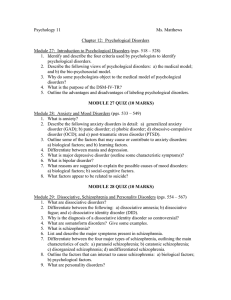
... Module 29: Dissociative, Schizophrenia and Personality Disorders (pgs. 554 – 567) 1. What are dissociative disorders? 2. Differentiate between the following: a) dissociative amnesia; b) dissociative fugue; and c) dissociative identity disorder (DID). 3. Why is the diagnosis of a dissociative identit ...
... Module 29: Dissociative, Schizophrenia and Personality Disorders (pgs. 554 – 567) 1. What are dissociative disorders? 2. Differentiate between the following: a) dissociative amnesia; b) dissociative fugue; and c) dissociative identity disorder (DID). 3. Why is the diagnosis of a dissociative identit ...