DSM Powerpoint - Incoming Student Resources
... Individuals with ASD must show symptoms from early childhood, even if those symptoms are not recognized until later ...
... Individuals with ASD must show symptoms from early childhood, even if those symptoms are not recognized until later ...

Mental Illness for Individuals with IDD
... Note: Any of the above factors alone is likely insufficient evidence of a mental health diagnosis. Adapted from Solutions Building Community Collaborative www.solutionsbuilding.org ...
... Note: Any of the above factors alone is likely insufficient evidence of a mental health diagnosis. Adapted from Solutions Building Community Collaborative www.solutionsbuilding.org ...
Eating Disorders
... • An eating disorder is when a person experiences severe disturbances in eating behavior, such as extreme reduction of food intake or extreme overeating, or feelings of extreme distress or concern about body weight or shape. • A person with an eating disorder may have started out just eating smaller ...
... • An eating disorder is when a person experiences severe disturbances in eating behavior, such as extreme reduction of food intake or extreme overeating, or feelings of extreme distress or concern about body weight or shape. • A person with an eating disorder may have started out just eating smaller ...

Psychological Disorders - Rio Hondo Community College Faculty
... distress. 4- Mental disorder as unjustifiable ...
... distress. 4- Mental disorder as unjustifiable ...

- bYTEBoss
... excessive and unreasonable The obsessions or compulsions cause marked distress, are time consuming,and significantly interfere with normal routine ...
... excessive and unreasonable The obsessions or compulsions cause marked distress, are time consuming,and significantly interfere with normal routine ...

PS1000: Introduction to Abnormal Psychology Mood disorders and
... • Persistent worry – often about minor things • Persistent worry – excessive, uncontrollable, long lasting • Symptoms need to be present for at least 6 months ...
... • Persistent worry – often about minor things • Persistent worry – excessive, uncontrollable, long lasting • Symptoms need to be present for at least 6 months ...
The Therapist`s Corner - The OCD-BDD Clinic of Northern California
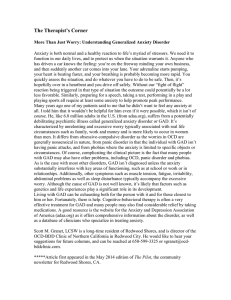
... function in our daily lives, and to protect us when the situation warrants it. Anyone who has driven a car knows the feeling: you’re on the freeway minding your own business, and then suddenly another car comes into your lane. Your adrenaline starts pumping, your heart is beating faster, and your br ...
... function in our daily lives, and to protect us when the situation warrants it. Anyone who has driven a car knows the feeling: you’re on the freeway minding your own business, and then suddenly another car comes into your lane. Your adrenaline starts pumping, your heart is beating faster, and your br ...
Abnormal Psychology cracking Mac
... Panic Disorder Recurring panic attacks Worry of panic attacks ...
... Panic Disorder Recurring panic attacks Worry of panic attacks ...
PSY240H1S Introduction to Abnormal Psychology
... possible evaluation by others • individual fears that he/she may do something humiliating or embarrassing. ...
... possible evaluation by others • individual fears that he/she may do something humiliating or embarrassing. ...

Multi-impulsive Eating Disorders
... adaptation – not so for those who bingepurge, where rapid swings in glu levels act like drug highs and withdrawal Hypoglycemia mimics symptoms of anxiety, and loss of K+ and Mg++ makes people even more nervous and twitchy ...
... adaptation – not so for those who bingepurge, where rapid swings in glu levels act like drug highs and withdrawal Hypoglycemia mimics symptoms of anxiety, and loss of K+ and Mg++ makes people even more nervous and twitchy ...
See More - With Mona Reda
... convenience only and is not meant to suggest that there is any clear distinction between childhood and adult disorders for most ( but not all) DSM-IV disorder, a single criteria set is provided that applies to children and adults . ...
... convenience only and is not meant to suggest that there is any clear distinction between childhood and adult disorders for most ( but not all) DSM-IV disorder, a single criteria set is provided that applies to children and adults . ...

Personality Disorders
... reinforcement in one’s life. Ambivalent individuals = conflicted over whether they should follow what others want them to do or follow their own needs and wishes. “Anxious – fearful” cluster with anxiety & tension prominent symptoms. OCPD: extreme rigidity, preoccupation with details & perfect ...
... reinforcement in one’s life. Ambivalent individuals = conflicted over whether they should follow what others want them to do or follow their own needs and wishes. “Anxious – fearful” cluster with anxiety & tension prominent symptoms. OCPD: extreme rigidity, preoccupation with details & perfect ...

FEEDING AND EATING DISORDERS
... a challenge for many Americans, recurrent binge eating is much less common, far more severe, and is associated with significant physical and psychological problems. ...
... a challenge for many Americans, recurrent binge eating is much less common, far more severe, and is associated with significant physical and psychological problems. ...
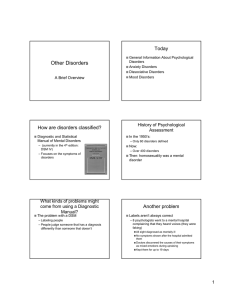
Other Disorders
... How are disorders classified? Diagnostic and Statistical Manual of Mental Disorders – (currently in the 4th edition: DSM IV) – Focuses on the symptoms of disorders ...
... How are disorders classified? Diagnostic and Statistical Manual of Mental Disorders – (currently in the 4th edition: DSM IV) – Focuses on the symptoms of disorders ...
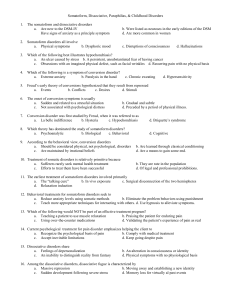
Somatoform and Dissociative Disorders
... 13. Which of the following would NOT be part of an effective treatment program? a. Teaching a patient to use muscle relaxation b. Praising the patient for enduring pain c. Using over-the-counter medications d. Validating the patient’s experience of pain as real 14. Current psychological treatment fo ...
... 13. Which of the following would NOT be part of an effective treatment program? a. Teaching a patient to use muscle relaxation b. Praising the patient for enduring pain c. Using over-the-counter medications d. Validating the patient’s experience of pain as real 14. Current psychological treatment fo ...
Impulse-Control Disorders
... •Aggressive episodes not due to direct effects of a substance, other mental disorder, or general medical condition (Criterion C) ...
... •Aggressive episodes not due to direct effects of a substance, other mental disorder, or general medical condition (Criterion C) ...

BUILDING THE ESSAY DRAFT
... mentally ill either On the other hand… - It is “normal” to have cavities in teeth occasionally, but doesn’t mean that’s healthy / preferred The term “normal” therefore is very problematic ...
... mentally ill either On the other hand… - It is “normal” to have cavities in teeth occasionally, but doesn’t mean that’s healthy / preferred The term “normal” therefore is very problematic ...
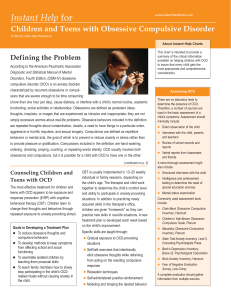
Obsessive Compulsive Disorder
... (more than one hour per day), cause distress, or interfere with a child’s normal routine, academic functioning, social activities or relationships. Obsessions are defined as persistent ideas, thoughts, impulses, or images that are experienced as intrusive and inappropriate; they are not ...
... (more than one hour per day), cause distress, or interfere with a child’s normal routine, academic functioning, social activities or relationships. Obsessions are defined as persistent ideas, thoughts, impulses, or images that are experienced as intrusive and inappropriate; they are not ...

Feeding and Eating Disorders - American Psychiatric Association
... disorder and the common phenomenon of overeating. While overeating is a challenge for many Americans, recurrent binge eating is much less common, far more severe, and is associated with significant physical and psychological problems. ...
... disorder and the common phenomenon of overeating. While overeating is a challenge for many Americans, recurrent binge eating is much less common, far more severe, and is associated with significant physical and psychological problems. ...
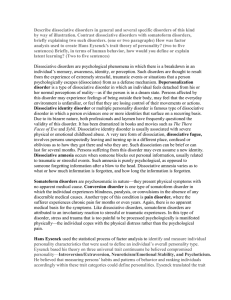
Describe dissociative disorders in general several
... validity of this disorder. It has been dramatized in books and movies such as The There Faces of Eve and Sybil. Dissociative identity disorder is usually associated with severe physical or emotional childhood abuse. A very rare form of dissociation, dissociative fugue, involves persons unexpectedly ...
... validity of this disorder. It has been dramatized in books and movies such as The There Faces of Eve and Sybil. Dissociative identity disorder is usually associated with severe physical or emotional childhood abuse. A very rare form of dissociation, dissociative fugue, involves persons unexpectedly ...
hi low
... possible evaluation by others • individual fears that he/she may do something humiliating or embarrassing. ...
... possible evaluation by others • individual fears that he/she may do something humiliating or embarrassing. ...

Psychological Disorders
... Schizophrenia tends to run in families. The risk of developing the disorder increases with the degree of genetic relatedness between an individual and a family member who has schizophrenia. ...
... Schizophrenia tends to run in families. The risk of developing the disorder increases with the degree of genetic relatedness between an individual and a family member who has schizophrenia. ...
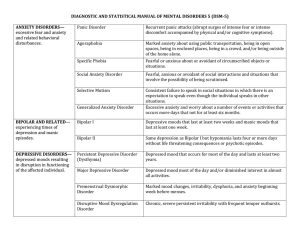
Major Disorders as Defined by DSM-5
... Clinically significant persistent or recurrent experiences of unreality or detachment from one’s mind, self or body and/or experiences of unreality or detachment from one’s surroundings. ...
... Clinically significant persistent or recurrent experiences of unreality or detachment from one’s mind, self or body and/or experiences of unreality or detachment from one’s surroundings. ...