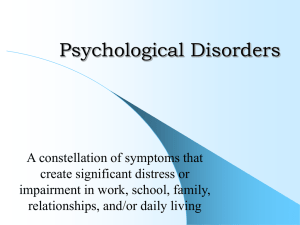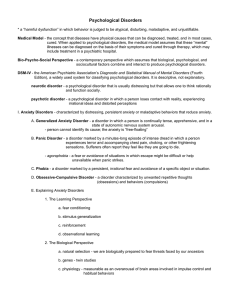
Psychological Disorders
... Medical Model - the concept that diseases have physical causes that can be diagnosed, treated, and in most cases, cured. When applied to psychological disorders, the medical model assumes that these “mental” illnesses can be diagnosed on the basis of their symptoms and cured through therapy, which m ...
... Medical Model - the concept that diseases have physical causes that can be diagnosed, treated, and in most cases, cured. When applied to psychological disorders, the medical model assumes that these “mental” illnesses can be diagnosed on the basis of their symptoms and cured through therapy, which m ...
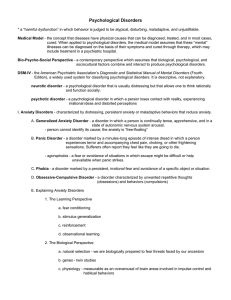
Psych Disorder Notes
... Medical Model - the concept that diseases have physical causes that can be diagnosed, treated, and in most cases, cured. When applied to psychological disorders, the medical model assumes that these “mental” illnesses can be diagnosed on the basis of their symptoms and cured through therapy, which m ...
... Medical Model - the concept that diseases have physical causes that can be diagnosed, treated, and in most cases, cured. When applied to psychological disorders, the medical model assumes that these “mental” illnesses can be diagnosed on the basis of their symptoms and cured through therapy, which m ...
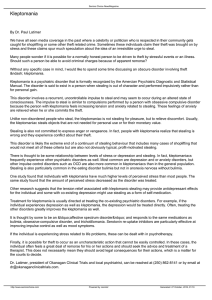
Kleptomania - Seniors Choice
... Unlike non-disordered people who steal, the kleptomaniac is not stealing for pleasure, but to relieve discomfort. Usually, the kleptomaniac steals objects that are not needed for personal use or for their monetary value. Stealing is also not committed to express anger or vengeance. In fact, people w ...
... Unlike non-disordered people who steal, the kleptomaniac is not stealing for pleasure, but to relieve discomfort. Usually, the kleptomaniac steals objects that are not needed for personal use or for their monetary value. Stealing is also not committed to express anger or vengeance. In fact, people w ...

BEHAVIORAL HEALTH PROBLEMS OF FARM PEOPLE DIFFER
... Drawing on the research of Dr. Walter Mischel and other psychology experts, personality is a behavior pattern that is consistent across various situations and over time. For example, some people tend to be gregarious and seemingly “talk all the time” wherever they are and with whomever they interact ...
... Drawing on the research of Dr. Walter Mischel and other psychology experts, personality is a behavior pattern that is consistent across various situations and over time. For example, some people tend to be gregarious and seemingly “talk all the time” wherever they are and with whomever they interact ...

dysfunctionalbehavio..
... DSM-IV: Diagnostic and Statistical Manual of Mental Disorders, fourth edition; the APA’s (American Psychiatric Association) major classification of psychological disorders. Multiaxial system: classifies individuals into 5 dimensions. Axis I: all diagnostic categories except personality disorders and ...
... DSM-IV: Diagnostic and Statistical Manual of Mental Disorders, fourth edition; the APA’s (American Psychiatric Association) major classification of psychological disorders. Multiaxial system: classifies individuals into 5 dimensions. Axis I: all diagnostic categories except personality disorders and ...

Chapter 9 Mood Disorders: Depressive Disorders
... thoughts of death and dying – Somatic complaints are also common – Associated with increased suicide risk ...
... thoughts of death and dying – Somatic complaints are also common – Associated with increased suicide risk ...
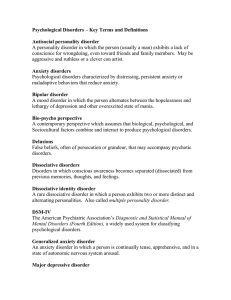
Psychological Disorders
... model assumes that these “mental” illnesses can be diagnosed on the basis of their symptoms and cured through therapy, which may include treatment in a psychiatric hospital. Mood disorders Psychological disorders characterized by emotional extremes. See major depressive disorder, manic episode, and ...
... model assumes that these “mental” illnesses can be diagnosed on the basis of their symptoms and cured through therapy, which may include treatment in a psychiatric hospital. Mood disorders Psychological disorders characterized by emotional extremes. See major depressive disorder, manic episode, and ...

Personality Disorders
... -indulge in self destructive behaviors (drugs, sex) -lack of coherent sense of self -self mutilation (cutting with razor/knife) -suicide attempts -intense fear of abandonment ...
... -indulge in self destructive behaviors (drugs, sex) -lack of coherent sense of self -self mutilation (cutting with razor/knife) -suicide attempts -intense fear of abandonment ...

Abnormal Psychology
... Tries to avoid abandonment (real or imagined) Pattern of unstable & intense relationships Unstable self-image, feelings of empitness ...
... Tries to avoid abandonment (real or imagined) Pattern of unstable & intense relationships Unstable self-image, feelings of empitness ...

Document
... • often no memory of a traumatic experience • traumatic experience may not produce phobia ...
... • often no memory of a traumatic experience • traumatic experience may not produce phobia ...

hi low
... no physical problems but has trouble getting out of bed. She has little appetite and has lost 10 pounds in two weeks. She has no interest in things that she used to enjoy. • Mary masturbates in public on a regular basis. She ...
... no physical problems but has trouble getting out of bed. She has little appetite and has lost 10 pounds in two weeks. She has no interest in things that she used to enjoy. • Mary masturbates in public on a regular basis. She ...
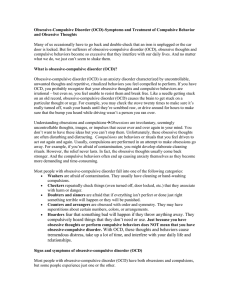
Obsessive-Compulsive Disorder (OCD)
... Accumulating “junk” such as old newspapers or empty food containers. ...
... Accumulating “junk” such as old newspapers or empty food containers. ...


Chapter 10 Lesson 1 - Brimley Area Schools
... • Obsession – consistent, recurrent, unwanted thoughts or ideas that keep people from thinking about other things • Compulsion – urgent, repeated, irresistible behaviors ...
... • Obsession – consistent, recurrent, unwanted thoughts or ideas that keep people from thinking about other things • Compulsion – urgent, repeated, irresistible behaviors ...

Chapter 18---Psychological Disorders new
... patterns or mental process that cause serious personal suffering or interfere with a person’s ability to cope with everyday life. 1/3 of all adults have experienced some type of psychological disorder. ...
... patterns or mental process that cause serious personal suffering or interfere with a person’s ability to cope with everyday life. 1/3 of all adults have experienced some type of psychological disorder. ...
Hypochondria: hypochondriasis
... what he believes they are rather than make him believe they don’t exist. As they progress time during session can be change depending on what the PA Observes. ...
... what he believes they are rather than make him believe they don’t exist. As they progress time during session can be change depending on what the PA Observes. ...

Anxiety, Somatoform, Dissociative Disorders and Stress
... Disorder is a disorder in which one may experience racing pulse or difficulty breathing. Heart rate can accelerate up to 180 beats per minute and can last from a few minutes to an hour. Victims may believe they are going crazy or having a heart attack. –This collection of symptoms is called a ...
... Disorder is a disorder in which one may experience racing pulse or difficulty breathing. Heart rate can accelerate up to 180 beats per minute and can last from a few minutes to an hour. Victims may believe they are going crazy or having a heart attack. –This collection of symptoms is called a ...

Childhood Anxiety Disorders List
... Not every child who experiences or hears about a traumatic event will develop PTSD. It is normal to be fearful, sad, or apprehensive after such events, and many children will recover from these feelings in a short time. Children most at risk for PTSD are those who directly witnessed a traumatic even ...
... Not every child who experiences or hears about a traumatic event will develop PTSD. It is normal to be fearful, sad, or apprehensive after such events, and many children will recover from these feelings in a short time. Children most at risk for PTSD are those who directly witnessed a traumatic even ...
Abnormal Psych2014 - Doral Academy Preparatory
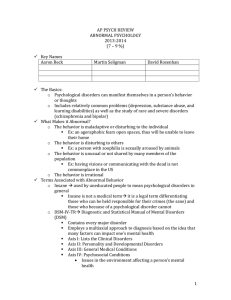
... Marked by distorted thinking but no symptoms of the other forms of schizophrenia o Divisions of schizophrenic symptoms Positive refers to an excess of behavior Ex: neologisms and hallucinations Negative refers to deficits in appropriate behaviors Ex: no emotion or catatonia o Causes of ...
... Marked by distorted thinking but no symptoms of the other forms of schizophrenia o Divisions of schizophrenic symptoms Positive refers to an excess of behavior Ex: neologisms and hallucinations Negative refers to deficits in appropriate behaviors Ex: no emotion or catatonia o Causes of ...
Somatoform and Dissociative Disorders
... • Focus on symptoms instead of what they might mean • Often show little urgency to do anything about symptoms • Symptoms become major part of indentity • Most are unmarried women, lower SES • chronic ...
... • Focus on symptoms instead of what they might mean • Often show little urgency to do anything about symptoms • Symptoms become major part of indentity • Most are unmarried women, lower SES • chronic ...

Panic Disorder
... and psychological symptoms that causes significant personal distress, impairs the ability to function in one or more important areas of daily life or both DSM-IV TR--abbreviation for the Diagnostic and Statistical Manual for Mental Disorders, 4th edition, text revision; the book published by the Ame ...
... and psychological symptoms that causes significant personal distress, impairs the ability to function in one or more important areas of daily life or both DSM-IV TR--abbreviation for the Diagnostic and Statistical Manual for Mental Disorders, 4th edition, text revision; the book published by the Ame ...
View Presentation
... Clinical onset of panic disorder is later. The role of heredity appears to be greater in panic disorder. The ratio of women to men is greater in panic disorder. Alcoholism is more common in people suffering from panic disorder. Depression is more common in panic disorder. ...
... Clinical onset of panic disorder is later. The role of heredity appears to be greater in panic disorder. The ratio of women to men is greater in panic disorder. Alcoholism is more common in people suffering from panic disorder. Depression is more common in panic disorder. ...