

Anxiety Disorders
... » Intrusive, persistent, and uncontrollable thoughts or urges » Experienced as irrational » Most common: –Contamination, sexual & aggressive impulses, body problems Compulsions » Impulse to repeat certain behaviors or mental acts to avoid distress –e.g., cleaning, checking, hoarding, repeating a wor ...
... » Intrusive, persistent, and uncontrollable thoughts or urges » Experienced as irrational » Most common: –Contamination, sexual & aggressive impulses, body problems Compulsions » Impulse to repeat certain behaviors or mental acts to avoid distress –e.g., cleaning, checking, hoarding, repeating a wor ...

Psychological Disorders
... Photos of paintings by Krannert Museum, University of Illinois at Urbana-Champaign ...
... Photos of paintings by Krannert Museum, University of Illinois at Urbana-Champaign ...
OCD - Roger Peele
... • A. Has either compulsions or obsessions • B. Person recognizes that the compulsions or obsessions are unreasonable or excessive (does not apply to children). • C. Compulsions or obsessions are distressing or disabling • D. Compulsions or obsessions are not within another disorder • E. Not direct e ...
... • A. Has either compulsions or obsessions • B. Person recognizes that the compulsions or obsessions are unreasonable or excessive (does not apply to children). • C. Compulsions or obsessions are distressing or disabling • D. Compulsions or obsessions are not within another disorder • E. Not direct e ...

PowerPoint Lecture Notes Presentation Chapter 2 Current
... » Clomipramine for OCD » Medication does not seem to help hoarding ...
... » Clomipramine for OCD » Medication does not seem to help hoarding ...

Working with youth who have ED/BD diagnoses
... Obsessive Compulsive and related disorders OCD: intrusive, recurrent, persistent thoughts, impulses or images (not simply excessive worries about real-life), obsessional thoughts; Compulsion repetitive bxs, aimed at preventing or reducing distress. Over-importance on thoughts – believe having a b ...
... Obsessive Compulsive and related disorders OCD: intrusive, recurrent, persistent thoughts, impulses or images (not simply excessive worries about real-life), obsessional thoughts; Compulsion repetitive bxs, aimed at preventing or reducing distress. Over-importance on thoughts – believe having a b ...
Unit 12 Abnormal Psych Teacher
... Mental Retardation will now be classified as Intellectual Disability New disorders will include: Binge Eating Disorder Hoarding Disorder Hypersexual Disorder Somatoform disorder, hypochondriasis, undifferentiated somatoform disorder and pain disorder combined under Complex Somatic Symptom Dis ...
... Mental Retardation will now be classified as Intellectual Disability New disorders will include: Binge Eating Disorder Hoarding Disorder Hypersexual Disorder Somatoform disorder, hypochondriasis, undifferentiated somatoform disorder and pain disorder combined under Complex Somatic Symptom Dis ...
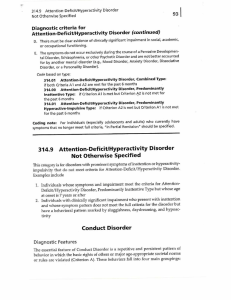
314.9 Attention-Deficit/Hyperactivity Disorder Not
... 1. Individuals whose symptoms and impainnent meet the criteria for AttentionDeficit/Hyperactivity Disorder, Predominantly Inattentive Type but whose age at onset is 7 years or after 2. Individuals with clinically significant impairment who present with inattention and whose symptom pattern does not ...
... 1. Individuals whose symptoms and impainnent meet the criteria for AttentionDeficit/Hyperactivity Disorder, Predominantly Inattentive Type but whose age at onset is 7 years or after 2. Individuals with clinically significant impairment who present with inattention and whose symptom pattern does not ...

Mental Health Nursing II NURS 2310 Unit 12 Personality Disorders
... Mental Health Nursing II NURS 2310 Unit 12 Personality Disorders ...
... Mental Health Nursing II NURS 2310 Unit 12 Personality Disorders ...

Unit I
... suicidal feelings Risk for violence directed toward others R/T homicidal ideation Low-self esteem R/T depression Imbalanced nutrition, less than body requirements R/T lack of interest in food Disturbed sleep pattern R/T depression ...
... suicidal feelings Risk for violence directed toward others R/T homicidal ideation Low-self esteem R/T depression Imbalanced nutrition, less than body requirements R/T lack of interest in food Disturbed sleep pattern R/T depression ...
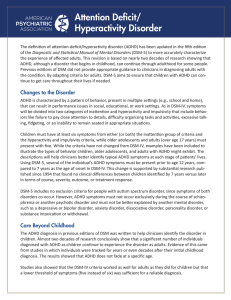
Attention Deficit/ Hyperactivity Disorder
... ensure that they are able to get care when needed. DSM is the manual used by clinicians and researchers to diagnose and classify mental disorders. The American Psychiatric Association (APA) will publish DSM-5 in 2013, culminating a 14-year revision process. APA is a national medical specialty societ ...
... ensure that they are able to get care when needed. DSM is the manual used by clinicians and researchers to diagnose and classify mental disorders. The American Psychiatric Association (APA) will publish DSM-5 in 2013, culminating a 14-year revision process. APA is a national medical specialty societ ...

Ch.16-Psych. Disorders
... What is the effect of labeling psychological disorders? It biases your perception of the patient’s behavior After you know the diagnosis (label) even normal behavior is seen as a symptom of that diagnosis. ...
... What is the effect of labeling psychological disorders? It biases your perception of the patient’s behavior After you know the diagnosis (label) even normal behavior is seen as a symptom of that diagnosis. ...

Ch. 16 - Psychological Disorders
... What is the effect of labeling psychological disorders? It biases your perception of the patient’s behavior After you know the diagnosis (label) even normal behavior is seen as a symptom of that diagnosis. ...
... What is the effect of labeling psychological disorders? It biases your perception of the patient’s behavior After you know the diagnosis (label) even normal behavior is seen as a symptom of that diagnosis. ...

File - Abundance Behavioral Health Services
... Anxiety Disorders Unlike the relatively mild, brief anxiety caused by a stressful event (such as speaking in public or a first date), anxiety disorders last at least 6 months and can get worse if they are not treated. Anxiety disorders commonly occur along with other mental or physical illnesses, in ...
... Anxiety Disorders Unlike the relatively mild, brief anxiety caused by a stressful event (such as speaking in public or a first date), anxiety disorders last at least 6 months and can get worse if they are not treated. Anxiety disorders commonly occur along with other mental or physical illnesses, in ...

Journey to E.M.P.A.T.H.Y
... pattern is manifested in two or more of the following areas: 1) cognition (ways of perceiving and interpreting self, other people, and events.) 2) affectivity (the range, intensity, lability, and appropriateness of emotional response) 3) interpersonal functioning 4) impulse control ...
... pattern is manifested in two or more of the following areas: 1) cognition (ways of perceiving and interpreting self, other people, and events.) 2) affectivity (the range, intensity, lability, and appropriateness of emotional response) 3) interpersonal functioning 4) impulse control ...

Chapter 12: Social Psychology
... Inflexible, maladaptive pattern of thoughts, emotions, behaviors, and interpersonal functioning that are stable over time and across situations, and deviate from the expectations of the individual’s ...
... Inflexible, maladaptive pattern of thoughts, emotions, behaviors, and interpersonal functioning that are stable over time and across situations, and deviate from the expectations of the individual’s ...
Pomerantz chapter 7 ppt
... Criticisms of Recent DSMs • Despite advances (e.g., empiricism, diagnostic criteria), some have criticized recent DSMs: – Breadth of coverage • Too many disorders? Some not actually forms of mental illness? Too many people stigmatized? Concept of mental illness becoming trivialized? ...
... Criticisms of Recent DSMs • Despite advances (e.g., empiricism, diagnostic criteria), some have criticized recent DSMs: – Breadth of coverage • Too many disorders? Some not actually forms of mental illness? Too many people stigmatized? Concept of mental illness becoming trivialized? ...
Personality Disorders - lakshya education hub
... Personality disorder- when personality traits are rigid and self-defeating, they may interfere with functioning and even lead to psychiatric symptoms cause more or less suffering of patient or other persons or both and lead to social maladaptation (relations, family, work...) such personality se ...
... Personality disorder- when personality traits are rigid and self-defeating, they may interfere with functioning and even lead to psychiatric symptoms cause more or less suffering of patient or other persons or both and lead to social maladaptation (relations, family, work...) such personality se ...

Mental Disorders & Suicide - Freeport Area School District
... ___of children & adolescents suffer from emotional and mental disorders Mental illness strikes people as adolescents & young adults ...
... ___of children & adolescents suffer from emotional and mental disorders Mental illness strikes people as adolescents & young adults ...
Somatoform disorders
... • Pain in the absence of adequate physical findings or pathophysiological explanations and in association with psychological factors that seem to play an etiological role ...
... • Pain in the absence of adequate physical findings or pathophysiological explanations and in association with psychological factors that seem to play an etiological role ...
Am J Psychiatry 167:487
... One of the oldest distinctions in psychiatry is that between state and trait—between a transient or time-limited event, such as a panic attack or a depressive episode, and an enduring, even lifelong, condition such as schizophrenia, mental retardation, or a personality disorder. This distinction is ...
... One of the oldest distinctions in psychiatry is that between state and trait—between a transient or time-limited event, such as a panic attack or a depressive episode, and an enduring, even lifelong, condition such as schizophrenia, mental retardation, or a personality disorder. This distinction is ...
Understanding Mental Disorders
... Many people do not seek treatment for mental disorders because they are worried about the stigma associated with mental disorders. Stigma A mark of shame or disapproval that results in an individual being shunned or rejected by others ...
... Many people do not seek treatment for mental disorders because they are worried about the stigma associated with mental disorders. Stigma A mark of shame or disapproval that results in an individual being shunned or rejected by others ...

A Framework for How Personality Disorders Develop
... People with personality disorders and their families will often tell stories of childhood developmental struggles, of profound experiences with shame (or Herculean efforts to avoid shame), with terror or with great sadness, and stories of painful themes of abandonment, disregard, deprivation or othe ...
... People with personality disorders and their families will often tell stories of childhood developmental struggles, of profound experiences with shame (or Herculean efforts to avoid shame), with terror or with great sadness, and stories of painful themes of abandonment, disregard, deprivation or othe ...

There are nine different types of Personality Disorders
... setting Norman openly spoke to his psychiatrist about what he described as serious problems – This was the last time that Norman was cooperative for the better part of 3 years of his 5 year stay – Four months into treatment Norman’s psychiatrist informed him she was going to take a vacation in 2 ...
... setting Norman openly spoke to his psychiatrist about what he described as serious problems – This was the last time that Norman was cooperative for the better part of 3 years of his 5 year stay – Four months into treatment Norman’s psychiatrist informed him she was going to take a vacation in 2 ...