
Classification in Psychiatry
... normality: Sex Paraphilia as an example: recurrent, intensely sexually arousing fantasies, sexual urges or sexual behaviors that involve nonhuman objects, the suffering of self or partner, children or non consenting partner. ...
... normality: Sex Paraphilia as an example: recurrent, intensely sexually arousing fantasies, sexual urges or sexual behaviors that involve nonhuman objects, the suffering of self or partner, children or non consenting partner. ...

Mental Disorders Powerpoint
... The exact cause of GAD is not fully known, but a number of factors -including genetics, brain chemistry and environmental stresses -- appear to contribute to its development. How Common Is GAD? About 4 million adult Americans suffer from GAD during the course of a year. It most often begins in child ...
... The exact cause of GAD is not fully known, but a number of factors -including genetics, brain chemistry and environmental stresses -- appear to contribute to its development. How Common Is GAD? About 4 million adult Americans suffer from GAD during the course of a year. It most often begins in child ...

Treatment of Eating Disorders
... replaced Feeding Disorder of Infancy and Early Childhood and EDNOS which was described in the DSM-IV. While few data on ARFID have been published, it appears that it usually presents in infancy or childhood, but it can also present or persist into adulthood. The course of illness for individuals rel ...
... replaced Feeding Disorder of Infancy and Early Childhood and EDNOS which was described in the DSM-IV. While few data on ARFID have been published, it appears that it usually presents in infancy or childhood, but it can also present or persist into adulthood. The course of illness for individuals rel ...

August 2014
... weight. Although eating disorders are a mental/behavioral health concern, if left untreated, they can have serious physical health consequences. At this point, experts do not know the exact cause of eating disorders, and in fact, there may be many causes that contribute to the development of an eati ...
... weight. Although eating disorders are a mental/behavioral health concern, if left untreated, they can have serious physical health consequences. At this point, experts do not know the exact cause of eating disorders, and in fact, there may be many causes that contribute to the development of an eati ...

Disordered Eating
... – Undue influence of body weight on selfimage or denial of problem – Amenorrhea in women past puberty • Absence of at least three menstrual cycles ...
... – Undue influence of body weight on selfimage or denial of problem – Amenorrhea in women past puberty • Absence of at least three menstrual cycles ...

This assignment is due
... Mary is constantly thinking about germs. She and often a need to perform certain actions to washes her hands at least 100 times a day. try to relieve the anxiety. Anxiety Disorders: Post Traumatic Stress Disorder, Panic Disorder, Generalized Anxiety Disorder, Obsessive-Compulsive Disorder, Phobias M ...
... Mary is constantly thinking about germs. She and often a need to perform certain actions to washes her hands at least 100 times a day. try to relieve the anxiety. Anxiety Disorders: Post Traumatic Stress Disorder, Panic Disorder, Generalized Anxiety Disorder, Obsessive-Compulsive Disorder, Phobias M ...
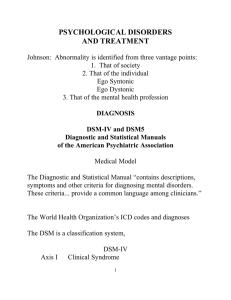
PSYCHOLOGICAL DISORDERS AND TREATMENT
... The DSM-5 has collapsed Axis I, II, and III into one Axis that contains “all psychiatric and general medical diagnoses. “DSM-IV is a categorical classification that divides mental disorders into types based on criteria sets with defining features. The naming of categories is the traditional method o ...
... The DSM-5 has collapsed Axis I, II, and III into one Axis that contains “all psychiatric and general medical diagnoses. “DSM-IV is a categorical classification that divides mental disorders into types based on criteria sets with defining features. The naming of categories is the traditional method o ...
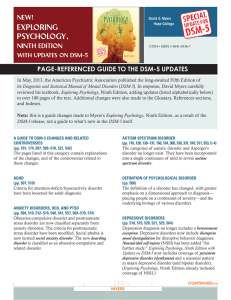
exploring psychology
... The DSM-5 now includes binge-eating disorder along with slightly modified criteria for anorexia nervosa and bulimia nervosa. (Exploring Psychology, Ninth Edition already had this new category included.) INTELLECTUAL DISABILITY (pp. 338, 339, 510, 512) Mental retardation has become intellectual disab ...
... The DSM-5 now includes binge-eating disorder along with slightly modified criteria for anorexia nervosa and bulimia nervosa. (Exploring Psychology, Ninth Edition already had this new category included.) INTELLECTUAL DISABILITY (pp. 338, 339, 510, 512) Mental retardation has become intellectual disab ...
Abnormal Psychology - Solon City Schools
... Dissociative Identity Disorder • Used to be known as Multiple Personality Disorder. • 2 or more distinct personalities control a person’s behavior • Patients commonly have a history of childhood abuse or trauma. ...
... Dissociative Identity Disorder • Used to be known as Multiple Personality Disorder. • 2 or more distinct personalities control a person’s behavior • Patients commonly have a history of childhood abuse or trauma. ...

Psychological Disorders
... The American Psychiatric Association rendered a Diagnostic and Statistical Manual of Mental Disorders (DSM) to describe psychological disorders. The most recent edition, DSM-IV-TR (Text ...
... The American Psychiatric Association rendered a Diagnostic and Statistical Manual of Mental Disorders (DSM) to describe psychological disorders. The most recent edition, DSM-IV-TR (Text ...

Memory
... The American Psychiatric Association rendered a Diagnostic and Statistical Manual of Mental Disorders (DSM) to describe psychological disorders. The most recent edition, DSM-IV-TR (Text ...
... The American Psychiatric Association rendered a Diagnostic and Statistical Manual of Mental Disorders (DSM) to describe psychological disorders. The most recent edition, DSM-IV-TR (Text ...

Mental Disorder Intro-Student - health and physical education
... produce intense fear or horror. Situations that remind them of the event can produce intense anxiety, they begin to avoid those situations. May feel guilty because they survived and others did not. What would be an example of an event that could cause PTSD. ...
... produce intense fear or horror. Situations that remind them of the event can produce intense anxiety, they begin to avoid those situations. May feel guilty because they survived and others did not. What would be an example of an event that could cause PTSD. ...

abnormal PSYCHOLOGY Third Canadian Edition
... • Considerable overlap with conversion disorder • Comorbid with anxiety and mood disorders, substance abuse, & several personality disorders ...
... • Considerable overlap with conversion disorder • Comorbid with anxiety and mood disorders, substance abuse, & several personality disorders ...

Andrew Rosen Early Conceptions of Mental Disorders
... o 4) Antisocial personality disorder (consistent disregard for- and violation of- others’ rights) o 5) Borderline personality disorder (can’t be alone; impulsive behavior and marked instability in relationships, self-concept, and affect) o 6) Histrionic personality disorder (unusual degree of attent ...
... o 4) Antisocial personality disorder (consistent disregard for- and violation of- others’ rights) o 5) Borderline personality disorder (can’t be alone; impulsive behavior and marked instability in relationships, self-concept, and affect) o 6) Histrionic personality disorder (unusual degree of attent ...

Asperger`s Syndrome
... • Inflexible adherence to specific non-functional routines or rituals • Stereotyped and repetitive motor mannerisms. ...
... • Inflexible adherence to specific non-functional routines or rituals • Stereotyped and repetitive motor mannerisms. ...

THE WORLD OF ABNORMAL PSYCHOLOGY
... SCIENCE, RELIGION, SOCIOLOGY, ECONOMICS, ANTHROPOLOGY, EDUCATION, LAW, SOCIOLOGY, BUSINESS.. ...
... SCIENCE, RELIGION, SOCIOLOGY, ECONOMICS, ANTHROPOLOGY, EDUCATION, LAW, SOCIOLOGY, BUSINESS.. ...

Does a clinician`s perspective accurately attest to the effectiveness
... Describe the following personality disorders: ...
... Describe the following personality disorders: ...

Do Now
... two factors. • Restricted behavior is limited in focus, interest, or activity, such as preoccupation with a single television program, toy, or game. • Self Injury: includes movements that injure or can injure the person, such as eye poking, hand biting, and head banging. A 2007 study reported that s ...
... two factors. • Restricted behavior is limited in focus, interest, or activity, such as preoccupation with a single television program, toy, or game. • Self Injury: includes movements that injure or can injure the person, such as eye poking, hand biting, and head banging. A 2007 study reported that s ...

Mental health is… - Pennsylvania Child Welfare Resource Center
... The avoidance, anxious anticipation, or distress in the feared social or performance situation interferes significantly with the person’s normal routine, occupational or social ...
... The avoidance, anxious anticipation, or distress in the feared social or performance situation interferes significantly with the person’s normal routine, occupational or social ...

MRCPsych Course * Across the ages session CAMHS * Prognosis
... History of infant feeding problems Maternal depressive symptoms History of under eating Family History Adverse life events can often precipitate illness childhood sexual abuse - evidence suggests this is likely to predispose to many forms of mental illness and is not specific to anorexia– if this is ...
... History of infant feeding problems Maternal depressive symptoms History of under eating Family History Adverse life events can often precipitate illness childhood sexual abuse - evidence suggests this is likely to predispose to many forms of mental illness and is not specific to anorexia– if this is ...


2. Anxiety Disorders
... – Presence of at least 2 distinct personalities within the same individual – Leads to sudden changes in identity and consciousness – Each personality has its unique style and may unaware of the existence of the other personalities – Often related to severe abuse in early childhood ...
... – Presence of at least 2 distinct personalities within the same individual – Leads to sudden changes in identity and consciousness – Each personality has its unique style and may unaware of the existence of the other personalities – Often related to severe abuse in early childhood ...

