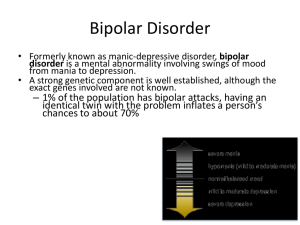
Bipolar Disorder - Long Branch Public Schools
... feelings of anxiety, without any external cause. • May experience times when your worries don't completely consume you, but you still feel rather anxious • May feel on edge about many or all aspects of your life • May have a general sense that something bad is about to happen, even when there's no a ...
... feelings of anxiety, without any external cause. • May experience times when your worries don't completely consume you, but you still feel rather anxious • May feel on edge about many or all aspects of your life • May have a general sense that something bad is about to happen, even when there's no a ...

Anxiety Disorders - Santa Barbara Therapist
... Fear of social or performance situations, and provoke anxiety. Situations are either avoided or endured with extreme distress. Person recognizes the fear is excessive The avoidance or distress impairs functioning ...
... Fear of social or performance situations, and provoke anxiety. Situations are either avoided or endured with extreme distress. Person recognizes the fear is excessive The avoidance or distress impairs functioning ...

Chapter_15 - Blackwell Publishing
... Is the simplest anxiety disorder. B. Is the most complex anxiety disorder. C. Is characterized by short bouts (a few hours) of chronic, uncontrollable worry about numerous things. D. All of the above. ...
... Is the simplest anxiety disorder. B. Is the most complex anxiety disorder. C. Is characterized by short bouts (a few hours) of chronic, uncontrollable worry about numerous things. D. All of the above. ...

Abnormal Psychology
... • 6. Eating Disorders- Characterized by physically and/or psychologically harmful eating patterns – A. Anorexia Nervosa-Refusal to maintain a body weight above the minimum normal weight for one’s age and height, intense fear of becoming obese, body image distortion, absence of at least three menstru ...
... • 6. Eating Disorders- Characterized by physically and/or psychologically harmful eating patterns – A. Anorexia Nervosa-Refusal to maintain a body weight above the minimum normal weight for one’s age and height, intense fear of becoming obese, body image distortion, absence of at least three menstru ...
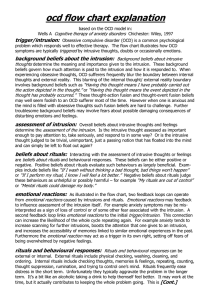
explanation - Good Medicine
... will be really important in any individual case. It is usually necessary to go over the chart carefully with a therapist. Progressively one can build up an understanding of what aspects are personally relevant for making progress. It is then crucial to move increasingly from a simple intellectual un ...
... will be really important in any individual case. It is usually necessary to go over the chart carefully with a therapist. Progressively one can build up an understanding of what aspects are personally relevant for making progress. It is then crucial to move increasingly from a simple intellectual un ...

Psychology Disorders and Treatments
... person, he knows to avoid any situation that may exacerbate the anxieties that he is experiencing. With minimal support from his family and friends, James feels that he is dealing with this all alone and just wants to lead a normal life. Perhaps the stress and strain of becoming a doctor led to Jame ...
... person, he knows to avoid any situation that may exacerbate the anxieties that he is experiencing. With minimal support from his family and friends, James feels that he is dealing with this all alone and just wants to lead a normal life. Perhaps the stress and strain of becoming a doctor led to Jame ...

Eating Disorders - North Idaho College
... purging. During a "binge," the person consumes a large amount of food in a rapid, automatic, and helpless fashion. This may anesthetize hunger, anger, and other feelings, but it eventually creates physical discomfort and anxiety about weight gain. Thus, the person "purges" the food eaten, usually by ...
... purging. During a "binge," the person consumes a large amount of food in a rapid, automatic, and helpless fashion. This may anesthetize hunger, anger, and other feelings, but it eventually creates physical discomfort and anxiety about weight gain. Thus, the person "purges" the food eaten, usually by ...

psychological disorders
... · a disorder in which individuals tend to display no regard for the moral and ethical rules of society or the rights of others * Borderline personality disorder · a disorder in which individuals have difficulty in developing a secure sense of who they are ...
... · a disorder in which individuals tend to display no regard for the moral and ethical rules of society or the rights of others * Borderline personality disorder · a disorder in which individuals have difficulty in developing a secure sense of who they are ...
Mood Disorders
... Maternal viruses during mid-pregnancy: is it the virus, or the medications, etc.? But only 2% seem affected this way… ...
... Maternal viruses during mid-pregnancy: is it the virus, or the medications, etc.? But only 2% seem affected this way… ...
abnormal PSYCHOLOGY Third Canadian Edition
... Agoraphobia- fear of public places Acrophobia- fear of heights. Mysophobia- fear of contamination and dirt ...
... Agoraphobia- fear of public places Acrophobia- fear of heights. Mysophobia- fear of contamination and dirt ...

Psychological disorder
... pattern of behavioral and psychological symptoms that causes significant personal distress, impairs the ability to function in one or more important areas of daily life, or both ...
... pattern of behavioral and psychological symptoms that causes significant personal distress, impairs the ability to function in one or more important areas of daily life, or both ...
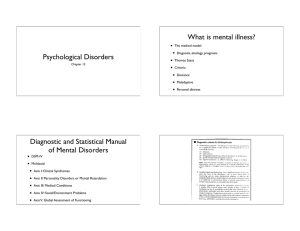
Psychological Disorders What is mental illness? Diagnostic and
... disorder, e.g., the anxiety or worry is not about having a panic attack (as in panic disorder), being embarrassed in public (as in social phobia), being contaminated (as in obsessive-compulsive disorder), being away from home or close relatives (as in Separation Anxiety Disorder), gaining weight (as ...
... disorder, e.g., the anxiety or worry is not about having a panic attack (as in panic disorder), being embarrassed in public (as in social phobia), being contaminated (as in obsessive-compulsive disorder), being away from home or close relatives (as in Separation Anxiety Disorder), gaining weight (as ...
Dissociative Disorders
... personality disorder) is a rare, dramatic, and controversial disorder characterized by the existence of two or more distinct personalities within one person. a. The original personality is unaware of other personalities, but they are conscious of the original personality and often of each other. ...
... personality disorder) is a rare, dramatic, and controversial disorder characterized by the existence of two or more distinct personalities within one person. a. The original personality is unaware of other personalities, but they are conscious of the original personality and often of each other. ...

Personality Disorder
... a set of learned behavior that has become maladaptive— bad habits learned early on in life. Biological explanations look at the lower than normal stress hormones in antisocial personality disordered persons as responsible for their low responsiveness to threatening stimuli. Other possible causes ...
... a set of learned behavior that has become maladaptive— bad habits learned early on in life. Biological explanations look at the lower than normal stress hormones in antisocial personality disordered persons as responsible for their low responsiveness to threatening stimuli. Other possible causes ...
Psychological Disorders
... Antibodies found in blood of schizophrenics, but not others Schizophrenics more likely to have been born in spring, meaning that they were in their 2nd trimester during flu season In late-splitting identical twins that shared the same plancenta, the ...
... Antibodies found in blood of schizophrenics, but not others Schizophrenics more likely to have been born in spring, meaning that they were in their 2nd trimester during flu season In late-splitting identical twins that shared the same plancenta, the ...
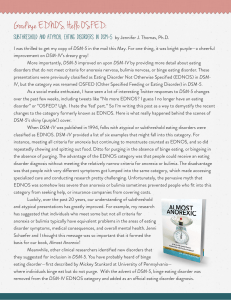
Just click here.
... DSM-5 also includes a category called Unspecified Feeding or Eating Disorder (UFED) that is reserved for folks who don’t fit into any of these five categories, or for whom there is not enough information to make a specific OSFED diagnosis. In our study of DSM-5 changes at the Klarman Eating Disorder ...
... DSM-5 also includes a category called Unspecified Feeding or Eating Disorder (UFED) that is reserved for folks who don’t fit into any of these five categories, or for whom there is not enough information to make a specific OSFED diagnosis. In our study of DSM-5 changes at the Klarman Eating Disorder ...

A Psychological disorder is
... Obsessions are intense, unwanted worries, ideas, and images that repeatedly pop up in the mind. A compulsion is a repeatedly strong feeling of “needing” to carry out an action, even though it doesn’t feel like it makes sense. When is it a “disorder”? Distress: when you are deeply frustrated ...
... Obsessions are intense, unwanted worries, ideas, and images that repeatedly pop up in the mind. A compulsion is a repeatedly strong feeling of “needing” to carry out an action, even though it doesn’t feel like it makes sense. When is it a “disorder”? Distress: when you are deeply frustrated ...

Chapter Summary/Lecture Organizer I. STUDYING
... (dissociative identity disorder DID or multiple personality disorder). There is considerable ...
... (dissociative identity disorder DID or multiple personality disorder). There is considerable ...

Diagnostic and Statistical Manual
... – Intellectual, emotional, social and physical disorders that begin at or before adolescence • E.g., separation anxiety disorder, attention deficit/hyperactivity disorder, learning disorders ...
... – Intellectual, emotional, social and physical disorders that begin at or before adolescence • E.g., separation anxiety disorder, attention deficit/hyperactivity disorder, learning disorders ...

Ch 14 Objectives
... 2. Explain the most commonly used criteria of abnormality. 3. List three stereotypes of people with psychological disorders. 4. List the five diagnostic axes of DSM-IV. 5. Discuss estimates of the prevalence of psychological disorders. 6. List five types of anxiety disorders and describe the symptom ...
... 2. Explain the most commonly used criteria of abnormality. 3. List three stereotypes of people with psychological disorders. 4. List the five diagnostic axes of DSM-IV. 5. Discuss estimates of the prevalence of psychological disorders. 6. List five types of anxiety disorders and describe the symptom ...
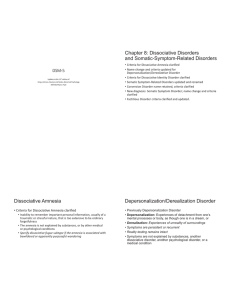
Chapter 8: Dissociative Disorders and Somatic-Symptom
... disruption may be observed by others or reported by the patient • B. Recurrent gaps in recalling events or important personal information that are beyond ordinary forgetting • C. Symptoms are not part of a broadly accepted cultural or religious practice, and are not due to drugs or a medical conditi ...
... disruption may be observed by others or reported by the patient • B. Recurrent gaps in recalling events or important personal information that are beyond ordinary forgetting • C. Symptoms are not part of a broadly accepted cultural or religious practice, and are not due to drugs or a medical conditi ...
Specify dissociative fugue subtype if the amnesia is
... Behavior is not explained by another mental disorder In Factitious Disorder Imposed on Self, the person presents himself or herself to others as ill, impaired, or injured • In Factitious Disorder Imposed on Another, the person fabricates symptoms in another person and then presents that person to ot ...
... Behavior is not explained by another mental disorder In Factitious Disorder Imposed on Self, the person presents himself or herself to others as ill, impaired, or injured • In Factitious Disorder Imposed on Another, the person fabricates symptoms in another person and then presents that person to ot ...

psychological disorders Psych
... The American Psychiatric Association rendered a Diagnostic and Statistical Manual of Mental Disorders (DSM) to classify, and describe psychological symptoms of the disorders. It does not explain causes or possible cures. ...
... The American Psychiatric Association rendered a Diagnostic and Statistical Manual of Mental Disorders (DSM) to classify, and describe psychological symptoms of the disorders. It does not explain causes or possible cures. ...

Unit I - Faculty Sites
... often performed with the hope of preventing obsessive thoughts or making them go away hand washing, counting, checking, cleaning provides only temporary relief not performing rituals results in marked increase in anxiety ...
... often performed with the hope of preventing obsessive thoughts or making them go away hand washing, counting, checking, cleaning provides only temporary relief not performing rituals results in marked increase in anxiety ...

Psychiatric Issues and the Criminal Justice System
... other psychiatric conditions As a result it is thought these disorders reside on a continuum with one another For example, schizotypal personality disorder is found more often in families of individuals with schizophrenia than in the general population ...
... other psychiatric conditions As a result it is thought these disorders reside on a continuum with one another For example, schizotypal personality disorder is found more often in families of individuals with schizophrenia than in the general population ...