
Psych Disorders Review Sheet
... Perspectives of Psychological Disorders Defining Psychological Disorders: Between normality and abnormality there is not a gulf but a somewhat arbitrary line. Where we draw this line depends on how atypical, disturbing, maladaptive, and unjustifiable a person’s behavior is. Understanding Psychologic ...
... Perspectives of Psychological Disorders Defining Psychological Disorders: Between normality and abnormality there is not a gulf but a somewhat arbitrary line. Where we draw this line depends on how atypical, disturbing, maladaptive, and unjustifiable a person’s behavior is. Understanding Psychologic ...

What is a psychological disorder
... Anxiety Disorders: • Agoraphobia involves intense fear and anxiety of any place or situation where escape might be difficult, leading to avoidance of situations such as being alone outside of the home; traveling in a car, bus, or airplane; or being in a crowded area • Obsessive-Compulsive Disorder ...
... Anxiety Disorders: • Agoraphobia involves intense fear and anxiety of any place or situation where escape might be difficult, leading to avoidance of situations such as being alone outside of the home; traveling in a car, bus, or airplane; or being in a crowded area • Obsessive-Compulsive Disorder ...

Review Unit 12 Disorders 2014-2015
... – Explanatory style (how one explains events in one’s life) view (Seligman-dog research) ...
... – Explanatory style (how one explains events in one’s life) view (Seligman-dog research) ...

Introduction to Psychology
... Personality Disorders Dependent Personality Disorder Behave in clingy, submissive ways and displays a strong need to have others take care of them Paranoid Personality Disorder Shows deep distrust of other people, which gets in the way of personal relationships Different than paranoid sch ...
... Personality Disorders Dependent Personality Disorder Behave in clingy, submissive ways and displays a strong need to have others take care of them Paranoid Personality Disorder Shows deep distrust of other people, which gets in the way of personal relationships Different than paranoid sch ...
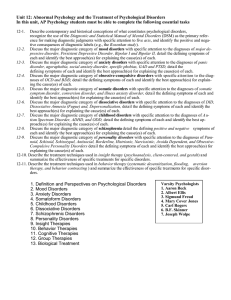
Unit 12: Abnormal Psychology and the Treatment of Psychological
... recognize the use of the Diagnostic and Statistical Manual of Mental Disorders (DSM) as the primary reference for making diagnostic judgments with specific attention to five axis, and identify the positive and negative consequences of diagnostic labels (e.g., the Rosenhan study). 12-2. Discuss the m ...
... recognize the use of the Diagnostic and Statistical Manual of Mental Disorders (DSM) as the primary reference for making diagnostic judgments with specific attention to five axis, and identify the positive and negative consequences of diagnostic labels (e.g., the Rosenhan study). 12-2. Discuss the m ...
What is Dissociation? - University of Delaware
... Suicidality common Focused on self and defect (similar to social anxiety) Can significantly disrupt life ...
... Suicidality common Focused on self and defect (similar to social anxiety) Can significantly disrupt life ...

Impulse Control Disorders Not Elsewhere Classified
... B. Persistent discomfort with his or her sex or sense of inappropriateness in the gender role of that sex In children, the disturbance is manifested by any of the following: in boys, assertion that his penis or testes are disgusting or will disappear or assertion that it would be better to not have ...
... B. Persistent discomfort with his or her sex or sense of inappropriateness in the gender role of that sex In children, the disturbance is manifested by any of the following: in boys, assertion that his penis or testes are disgusting or will disappear or assertion that it would be better to not have ...
Psychological Disorders
... only small parts of events that took place in a defined period of time. For example, an abuse victim may recall only some parts of the series of events around the abuse. • Generalized amnesia is diagnosed when a person's amnesia encompasses his or her entire life. • Systematized amnesia is character ...
... only small parts of events that took place in a defined period of time. For example, an abuse victim may recall only some parts of the series of events around the abuse. • Generalized amnesia is diagnosed when a person's amnesia encompasses his or her entire life. • Systematized amnesia is character ...

CH 16 Abnormal Psychology/Psychological Disorders Main Idea
... • In 1952 the American Psychiatric Association agreed upon a system for classifying abnormal symptoms, which it published in the Diagnostic and Statistical Manual of Mental Disorders, or DSM. • It has been revised five times. ...
... • In 1952 the American Psychiatric Association agreed upon a system for classifying abnormal symptoms, which it published in the Diagnostic and Statistical Manual of Mental Disorders, or DSM. • It has been revised five times. ...

Personality Disorder
... • PD is included in 2003 Mental Health Act, but people with PD often not thought to meet criteria for compulsory measures • Requires that – “person has a mental disorder which causes their ability to make decisions about treatment to be significantly impaired” – ? Impaired decision making ...
... • PD is included in 2003 Mental Health Act, but people with PD often not thought to meet criteria for compulsory measures • Requires that – “person has a mental disorder which causes their ability to make decisions about treatment to be significantly impaired” – ? Impaired decision making ...

psychotic - s3.amazonaws.com
... underlying mental functioning. Mental disorders are usually associated with significant distress or disability in social, occupational, or other important activities. An expectable or culturally approved response to a common stressor or loss, such as the death of a loved one, is not a mental disorde ...
... underlying mental functioning. Mental disorders are usually associated with significant distress or disability in social, occupational, or other important activities. An expectable or culturally approved response to a common stressor or loss, such as the death of a loved one, is not a mental disorde ...
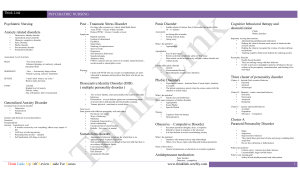
PSychiatric NurSing - Think Link
... Two or more identity, alters personalities that control individual behaviour Dissociation – act as a defense against an overwhelming sense of anxiety that is both painful and emotionally traumatic. Trauma: physical , emotional or sexual abuse ...
... Two or more identity, alters personalities that control individual behaviour Dissociation – act as a defense against an overwhelming sense of anxiety that is both painful and emotionally traumatic. Trauma: physical , emotional or sexual abuse ...
Generalized Anxiety Disorder
... • Therapy based on this model is “clientcentered” and focuses on creating an accepting environment where clients can “experience” themselves • Although case reports have been positive, controlled studies have only sometimes found client-centered therapy to be more effective than placebo or no therap ...
... • Therapy based on this model is “clientcentered” and focuses on creating an accepting environment where clients can “experience” themselves • Although case reports have been positive, controlled studies have only sometimes found client-centered therapy to be more effective than placebo or no therap ...

Psychological Disorders
... moderate depression responded far better to aerobics than other treatments. ...
... moderate depression responded far better to aerobics than other treatments. ...
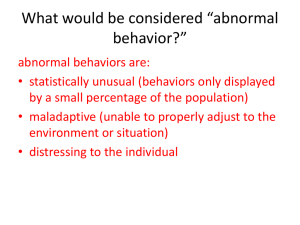
What would be considered “abnormal behavior?”
... • An anxiety disorder in which a person is continuously tense, apprehensive and in a state of autonomic nervous system arousal. • The patient is constantly tense and worried, feels inadequate, is oversensitive, can’t concentrate and often suffers from insomnia. ...
... • An anxiety disorder in which a person is continuously tense, apprehensive and in a state of autonomic nervous system arousal. • The patient is constantly tense and worried, feels inadequate, is oversensitive, can’t concentrate and often suffers from insomnia. ...

Eating Disorders - Personal.psu.edu
... recognize or admit that they are ill. As a result they may strongly resist getting and staying in ...
... recognize or admit that they are ill. As a result they may strongly resist getting and staying in ...

Risk factors
... Depression, body image, post traumatic experiences, emotional upheaval, OCD Common symptoms: ...
... Depression, body image, post traumatic experiences, emotional upheaval, OCD Common symptoms: ...
Communicating
... A 1. Must exhibit 6 or more symptoms of inattention, persisting for minimum of 6 months: from list of 9 items, a through i. A 2. Must exhibit 6 or more symptoms of hyperactivity-impulsivity, persisting for minimum of 6 months, from list of 9 items, a through i. ...
... A 1. Must exhibit 6 or more symptoms of inattention, persisting for minimum of 6 months: from list of 9 items, a through i. A 2. Must exhibit 6 or more symptoms of hyperactivity-impulsivity, persisting for minimum of 6 months, from list of 9 items, a through i. ...
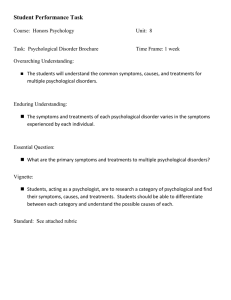
Performance Task: Survival Guide Pamphlet
... Directions: The following project will allow each of you to explore an area of psychology unbeknownst to most. Did you know that in your lifetime you are more likely to be stricken with a psychological disorder than any form of cancer? Psychopathology is the study of the causes, processes, and manif ...
... Directions: The following project will allow each of you to explore an area of psychology unbeknownst to most. Did you know that in your lifetime you are more likely to be stricken with a psychological disorder than any form of cancer? Psychopathology is the study of the causes, processes, and manif ...
Illness Summaries from DSM 5
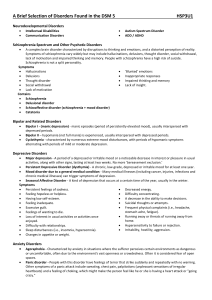
... Long-term, pervasive, inflexible patterns of thoughts and behaviors that are not well adapted or do not fit within the range of behaviour considered normal. Cluster A – Odd and Eccentric Paranoid Personality Disorder – Characterized by paranoia and a pervasive, long-standing suspiciousness and gen ...
... Long-term, pervasive, inflexible patterns of thoughts and behaviors that are not well adapted or do not fit within the range of behaviour considered normal. Cluster A – Odd and Eccentric Paranoid Personality Disorder – Characterized by paranoia and a pervasive, long-standing suspiciousness and gen ...
Obsessive–compulsive disorder
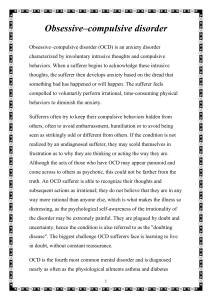
... behaviors or mental acts are not actually connected to the issue, or they are excessive. In addition to these criteria, at some point during the course of the disorder, the individual must realize that his/her obsessions or compulsions are unreasonable or excessive. Moreover, the obsessions or compu ...
... behaviors or mental acts are not actually connected to the issue, or they are excessive. In addition to these criteria, at some point during the course of the disorder, the individual must realize that his/her obsessions or compulsions are unreasonable or excessive. Moreover, the obsessions or compu ...

Ind Psychiatry J1
... The Institutional Review Board of the institute approved the protocol. The sample consisted of a total of 13 patients, who gave informed consent for participation in the study. All subjects had at least moderately severe symptoms of OCD with Yale-Brown Obsessive-Compulsive Scale (YBOCS)[9] scores ab ...
... The Institutional Review Board of the institute approved the protocol. The sample consisted of a total of 13 patients, who gave informed consent for participation in the study. All subjects had at least moderately severe symptoms of OCD with Yale-Brown Obsessive-Compulsive Scale (YBOCS)[9] scores ab ...
here! - Eichlin`s AP psychology
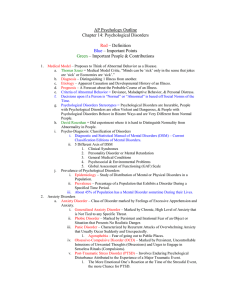
... 3. High Stress often Precipitates onset of Anxiety Disorders. Somatoform Disorders a. Somatoform Disorders – Physical Ailments that Cannot be Fully Explained by Organic Conditions and are Largely due to Psychological Factors. b. Somatization Disorder – Marked by a History of Diverse Physical Complai ...
... 3. High Stress often Precipitates onset of Anxiety Disorders. Somatoform Disorders a. Somatoform Disorders – Physical Ailments that Cannot be Fully Explained by Organic Conditions and are Largely due to Psychological Factors. b. Somatization Disorder – Marked by a History of Diverse Physical Complai ...
Taking a look at the DSM V
... Removal of Axis V System • Implications for PSR and other programs based on Global Assessment of Functioning (GAF) scores ...
... Removal of Axis V System • Implications for PSR and other programs based on Global Assessment of Functioning (GAF) scores ...

DBS FOR OBSESSIVE-COMPULSIVE DISORDER, ROBERT
... has, so the obsession is different than an average worry. So if you worry about something all the time that's very different than what an obsession is. And this actually comes into play later on when I show you some functional MRI research that's been done. Obsessions feel as if they are imposed on ...
... has, so the obsession is different than an average worry. So if you worry about something all the time that's very different than what an obsession is. And this actually comes into play later on when I show you some functional MRI research that's been done. Obsessions feel as if they are imposed on ...