
Chapter 4: Anxiety Disorders
... – Delayed onset PTSD - Onset of symptoms 6 months or more post trauma – Acute stress disorder - Diagnosis of PTSD immediately post-trauma • Causes of PTSD – Intensity of the trauma and one's reaction to it (i.e., true trauma) – Uncontrollability and unpredictability – Extent of social support, or la ...
... – Delayed onset PTSD - Onset of symptoms 6 months or more post trauma – Acute stress disorder - Diagnosis of PTSD immediately post-trauma • Causes of PTSD – Intensity of the trauma and one's reaction to it (i.e., true trauma) – Uncontrollability and unpredictability – Extent of social support, or la ...

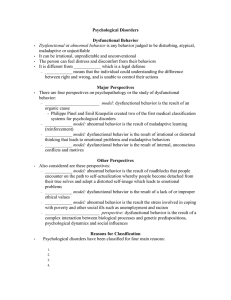
Psychological Disorders
... There are four perspectives on psychopathology or the study of dysfunctional ...
... There are four perspectives on psychopathology or the study of dysfunctional ...

Psychological Disorders
... • unlimited hopes but little motivation to act on them • Can sometimes become aggressive and hostile toward others as their self confidence grows ...
... • unlimited hopes but little motivation to act on them • Can sometimes become aggressive and hostile toward others as their self confidence grows ...
Personality Disorders
... The patient is a 37 year old female. Between the ages of four and twelve, she reportedly was the victim of severe, repetitive abuse by her grandfather, both physical and sexual including insertion of sharp, painful objects (e.g., knives), and hanging her from pulleys. According to the patient, phy ...
... The patient is a 37 year old female. Between the ages of four and twelve, she reportedly was the victim of severe, repetitive abuse by her grandfather, both physical and sexual including insertion of sharp, painful objects (e.g., knives), and hanging her from pulleys. According to the patient, phy ...

Psych8_Lecture_Ch16
... This includes knowing someone’s history, and a concise summary of their experiences with social, cultural, ...
... This includes knowing someone’s history, and a concise summary of their experiences with social, cultural, ...


What is an Eating Disorder?
... 3) Binging and purging occur more than two times per week for at least three months. 4) In relation to body image, self-evaluation and self-esteem are overly influenced by weight and shape. Many people in our culture are concerned with how they look, what they weigh or how to change the body parts t ...
... 3) Binging and purging occur more than two times per week for at least three months. 4) In relation to body image, self-evaluation and self-esteem are overly influenced by weight and shape. Many people in our culture are concerned with how they look, what they weigh or how to change the body parts t ...
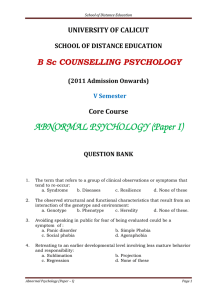
Abnormal Psychology (Paper I)
... a. Diminishing hallucinations and delusions b. Hysteria c. Treating depression d. Alleviating phobias and mania 14. Disorders caused by known and verifiable organic pathology a. substance abuse b. organic mental c. substance abuse d. PTSD 15. What does DSM stand for : a. Diagnostic and statistical m ...
... a. Diminishing hallucinations and delusions b. Hysteria c. Treating depression d. Alleviating phobias and mania 14. Disorders caused by known and verifiable organic pathology a. substance abuse b. organic mental c. substance abuse d. PTSD 15. What does DSM stand for : a. Diagnostic and statistical m ...

Psychological Disorders
... tendency to explain cause of negative uncontrollable events as one’s own stable personal qualities affecting all aspects of life Associated with health problems and premature death ...
... tendency to explain cause of negative uncontrollable events as one’s own stable personal qualities affecting all aspects of life Associated with health problems and premature death ...
Dissociative Disorders - kyle
... • Someone loses their memory of a painful experience (rape, child abuse etc) • Lose memory of identity! ...
... • Someone loses their memory of a painful experience (rape, child abuse etc) • Lose memory of identity! ...

Abnormal Psychology - Rutgers Psychology
... Symptom picture – describe the symptoms commonly seen in the disorder you have chosen to research. ...
... Symptom picture – describe the symptoms commonly seen in the disorder you have chosen to research. ...

Mental Health in Children and Adolescents
... American Psychiatric Association’s Diagnostic and Manual of Mental Disorders. The disability is generally evident before three years of age and significantly affects verbal, nonverbal, or pragmatic communication and social interaction skills and results in an adverse effect on the student’s educatio ...
... American Psychiatric Association’s Diagnostic and Manual of Mental Disorders. The disability is generally evident before three years of age and significantly affects verbal, nonverbal, or pragmatic communication and social interaction skills and results in an adverse effect on the student’s educatio ...

Eating Disorders
... skin, and brittle hair. Another sad effect of anorexia occurs when the person’s weight drops to below 70% of the ideal. At that point the body’s hormonal functions revert back to what they were before puberty, pausing the menstrual periods. There is yet another chemical imbalance present in anorexic ...
... skin, and brittle hair. Another sad effect of anorexia occurs when the person’s weight drops to below 70% of the ideal. At that point the body’s hormonal functions revert back to what they were before puberty, pausing the menstrual periods. There is yet another chemical imbalance present in anorexic ...

medications for anxiety - Austin Community College
... clinic for years, with frequent minor physical complaints, and tells the nurse she worries about her family and home so much that she cannot sleep at night. She can not specifically name anything that is a significant problem with family or home, denies marital problems except, “my husband says I wo ...
... clinic for years, with frequent minor physical complaints, and tells the nurse she worries about her family and home so much that she cannot sleep at night. She can not specifically name anything that is a significant problem with family or home, denies marital problems except, “my husband says I wo ...
Personality Disorders - DSM-5
... no longer exists: Certain disorders, like personality disorders, received inadequate clinical and research focus. As a consequence, these disorders were designated to Axis II to ensure they received greater attention. However, the axis system was seen by some clinicians as burdensome and time consum ...
... no longer exists: Certain disorders, like personality disorders, received inadequate clinical and research focus. As a consequence, these disorders were designated to Axis II to ensure they received greater attention. However, the axis system was seen by some clinicians as burdensome and time consum ...
anxiety disorders - Psychology for you and me
... • The emotional disorder that often arises after a trauma such as war, assault, natural disaster, or death of a loved one is posttraumatic stress disorder(PTSD). According to the DSM-IV-TR, a person with • PTSD must have been exposed to some event during which he/she feels fear, helplessness, or ho ...
... • The emotional disorder that often arises after a trauma such as war, assault, natural disaster, or death of a loved one is posttraumatic stress disorder(PTSD). According to the DSM-IV-TR, a person with • PTSD must have been exposed to some event during which he/she feels fear, helplessness, or ho ...

psych 2 - Huber Heights City Schools
... a. Delusions. In paranoid schizophrenia, a common delusion is that you're being singled out for harm. For instance, you may believe that the government is monitoring every move you make. You may also have delusions of grandeur — the belief that you can fly, that you're famous or that you have a rela ...
... a. Delusions. In paranoid schizophrenia, a common delusion is that you're being singled out for harm. For instance, you may believe that the government is monitoring every move you make. You may also have delusions of grandeur — the belief that you can fly, that you're famous or that you have a rela ...

Psychological Disorders
... Mood Disorders and Depressive Disorders • Mood disorders: mental disorders that have mood disturbances as their predominant feature • Major depressive disorder: a disorder characterized by a severely depressed mood that lasts 2 wks. or more and is accompanied by feelings of worthlessness and lack o ...
... Mood Disorders and Depressive Disorders • Mood disorders: mental disorders that have mood disturbances as their predominant feature • Major depressive disorder: a disorder characterized by a severely depressed mood that lasts 2 wks. or more and is accompanied by feelings of worthlessness and lack o ...
Integrating psychodynamic and cognitive approaches to obsessive
... Shaver, 1998). The first dimension, attachment anxiety, reflects the degree to which a person worries that a partner will not be available or adequately responsive in times of need. The second dimension, avoidance, reflects the extent to which he or she distrusts relationship partners’ goodwill and ...
... Shaver, 1998). The first dimension, attachment anxiety, reflects the degree to which a person worries that a partner will not be available or adequately responsive in times of need. The second dimension, avoidance, reflects the extent to which he or she distrusts relationship partners’ goodwill and ...

Ch 12
... Unpredictability: behave erratically and inconsistently at different times or from one situation to another Unconventionality and undesirable behavior: behave in ways that are statistically rare and violate social norms of what is legally or morally acceptable or desirable ...
... Unpredictability: behave erratically and inconsistently at different times or from one situation to another Unconventionality and undesirable behavior: behave in ways that are statistically rare and violate social norms of what is legally or morally acceptable or desirable ...

CH 13 study guide
... 4. Insanity is primarily a legal term, not a mental health term. 5. Estimates of the prevalence of mental disorders are likely to be inaccurate. 6. Disorders may be divided into two general categories: major mental disorders and personality disorders. 7. The DSM-5 categorizes and subdivides disorder ...
... 4. Insanity is primarily a legal term, not a mental health term. 5. Estimates of the prevalence of mental disorders are likely to be inaccurate. 6. Disorders may be divided into two general categories: major mental disorders and personality disorders. 7. The DSM-5 categorizes and subdivides disorder ...
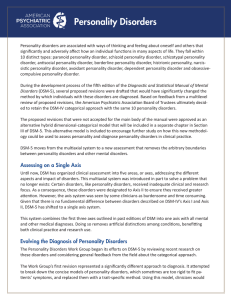
Personality Disorders - American Psychiatric Association
... no longer exists: Certain disorders, like personality disorders, received inadequate clinical and research focus. As a consequence, these disorders were designated to Axis II to ensure they received greater attention. However, the axis system was seen by some clinicians as burdensome and time consum ...
... no longer exists: Certain disorders, like personality disorders, received inadequate clinical and research focus. As a consequence, these disorders were designated to Axis II to ensure they received greater attention. However, the axis system was seen by some clinicians as burdensome and time consum ...
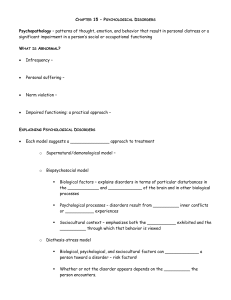
Explaining Psychological Disorders
... Social Phobia – intense and irrational fear of __________ evaluations by others or acting in a way that is ___________ ...
... Social Phobia – intense and irrational fear of __________ evaluations by others or acting in a way that is ___________ ...

Jeopardy - Stritch School of Medicine
... Excessive fear that leads to clinging or shadowing behavior towards the attachment figure (usually a parent) is this ...
... Excessive fear that leads to clinging or shadowing behavior towards the attachment figure (usually a parent) is this ...