
Borderline personality disorder
... Intense but short episodes of anxiety or depression Inappropriate anger, sometimes escalating into physical confrontations Difficulty controlling emotions or impulses Fear of being alone ...
... Intense but short episodes of anxiety or depression Inappropriate anger, sometimes escalating into physical confrontations Difficulty controlling emotions or impulses Fear of being alone ...
chapter 13
... 18. Describe the following conditions: a. agoraphobia b. specific phobia c. social phobia d. obsessive-compulsive disorder e. stress disorders i. post-traumatic stress disorder ii. acute stress disorder f. dissociative disorders i. dissociative amnesia ii. dissociative fugue iii. dissociative identi ...
... 18. Describe the following conditions: a. agoraphobia b. specific phobia c. social phobia d. obsessive-compulsive disorder e. stress disorders i. post-traumatic stress disorder ii. acute stress disorder f. dissociative disorders i. dissociative amnesia ii. dissociative fugue iii. dissociative identi ...

dsm-v review
... The threshold is set at 2 or more criteria vs. 1 or more for abuse and 3 or more for dependence in the DSM-IV. ...
... The threshold is set at 2 or more criteria vs. 1 or more for abuse and 3 or more for dependence in the DSM-IV. ...


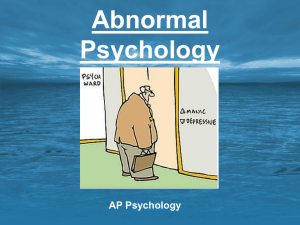
Unit 1 Notes: Psychological Disorders
... DSM-IV In the United States, the DSM-IV (or Diagnostic and Statistical Manual for Mental Disorders, 4th edition) is considered the authoritative source on diagnosing and treating psychological disorders The DSM-IV distinguishes between: – neurotic disorders which are affective (or emotional) disorde ...
... DSM-IV In the United States, the DSM-IV (or Diagnostic and Statistical Manual for Mental Disorders, 4th edition) is considered the authoritative source on diagnosing and treating psychological disorders The DSM-IV distinguishes between: – neurotic disorders which are affective (or emotional) disorde ...

open stax chapter 15 psychological disordersuse
... Depressed individuals react to negative emotional stimuli, such as sad faces, with greater amygdala activation than do non-depressed individuals. (credit: Ian Munroe) ...
... Depressed individuals react to negative emotional stimuli, such as sad faces, with greater amygdala activation than do non-depressed individuals. (credit: Ian Munroe) ...

Anxiety Disorder
... 3. maladaptive- harmful; causes suffering 4. unjustifiable- sometimes there’s a good reason ...
... 3. maladaptive- harmful; causes suffering 4. unjustifiable- sometimes there’s a good reason ...
Anxiety Disorders - Psychology with Mr.Salacki
... • Is this a psychological disorder? – Remember the requirements of “abnormal”! ...
... • Is this a psychological disorder? – Remember the requirements of “abnormal”! ...
Chapter 9 (Personality Disorders)
... • Treatment -- little research, must make sure client does not become dependent on therapist! ...
... • Treatment -- little research, must make sure client does not become dependent on therapist! ...
Obsessive Compulsive Related Disorders
... OCD participants, 45 BDD participants, and 40 comorbid OCD/BDD participants. A comparison of subjects’ characteristics showed OCD and BDD did not significantly differ in regard to demographic traits such as age, race, gender, age of onset, illness duration, most functioning measures, and most comorb ...
... OCD participants, 45 BDD participants, and 40 comorbid OCD/BDD participants. A comparison of subjects’ characteristics showed OCD and BDD did not significantly differ in regard to demographic traits such as age, race, gender, age of onset, illness duration, most functioning measures, and most comorb ...

Psychometric Properties of the Obsessive- Compulsive Inventory-Child Version (OCI-CV)
... The Obsessive Compulsive Inventory-Child Version (OCI-CV) [11] is an approaching wellestablished assessment self-report, with special interest for the assessment of the dimensionality of OCD. Other self-reports, such as the Children´s Florida Obsessive-Compulsive Inventory [12], the Child Saving Inv ...
... The Obsessive Compulsive Inventory-Child Version (OCI-CV) [11] is an approaching wellestablished assessment self-report, with special interest for the assessment of the dimensionality of OCD. Other self-reports, such as the Children´s Florida Obsessive-Compulsive Inventory [12], the Child Saving Inv ...
learning objectives chapter 12
... Discuss the interrater reliability and validity of diagnostic labels. Describe the problems associated with diagnosis. Discuss the research examining diagnostic biases. (see “Evaluating the Diagnostic System” and “Thinking Critically: Is Psychological Diagnosis Biased?”) ...
... Discuss the interrater reliability and validity of diagnostic labels. Describe the problems associated with diagnosis. Discuss the research examining diagnostic biases. (see “Evaluating the Diagnostic System” and “Thinking Critically: Is Psychological Diagnosis Biased?”) ...

Anxiety Disorders
... into consciousness • Compulsions—repetitive actions performed to alleviate obsessions – Overt physical behaviors, such as repeatedly checking or washing your hands – Covert mental behaviors, such as counting or reciting certain phrases to yourself ...
... into consciousness • Compulsions—repetitive actions performed to alleviate obsessions – Overt physical behaviors, such as repeatedly checking or washing your hands – Covert mental behaviors, such as counting or reciting certain phrases to yourself ...

Chapter 18 - PsychChapter18Psych
... • Self-injury or attempted suicide • Strong feelings of anger, anxiety, or depression that last for several hours • Impulsive behavior • Drug or alcohol abuse • Feelings of low self-worth • Unstable relationships with friends, family, and boyfriends/girlfriends ...
... • Self-injury or attempted suicide • Strong feelings of anger, anxiety, or depression that last for several hours • Impulsive behavior • Drug or alcohol abuse • Feelings of low self-worth • Unstable relationships with friends, family, and boyfriends/girlfriends ...

Psychological Disorders
... 1,000 mental patients 1 year after they were discharged from psychiatric facilities Monitored Group #2 (Control Group) Non-mental patients living in same neighborhood as the 1000 former mental patients Findings Former mental patients did not have a high rate of violence then the comparison gro ...
... 1,000 mental patients 1 year after they were discharged from psychiatric facilities Monitored Group #2 (Control Group) Non-mental patients living in same neighborhood as the 1000 former mental patients Findings Former mental patients did not have a high rate of violence then the comparison gro ...

disorder - Cloudfront.net
... Obsessions are intense, unwanted worries, ideas, and images that repeatedly pop up in the mind. A compulsion is a repeatedly strong feeling of “needing” to carry out an action, even though it doesn’t feel like it makes sense. When is it a “disorder”? Distress: when you are deeply frustrated ...
... Obsessions are intense, unwanted worries, ideas, and images that repeatedly pop up in the mind. A compulsion is a repeatedly strong feeling of “needing” to carry out an action, even though it doesn’t feel like it makes sense. When is it a “disorder”? Distress: when you are deeply frustrated ...

2006_08_31-DaSilva-Affective_and_personality_disorders
... – Comorbid medical problems can deteriorate because of poor compliance – Reckless behaviors can increase risk of STD and injury – ETOH and drug abuse frequently complicate manic episodes – Eating disorders – Anxiety disorders – ADHD ...
... – Comorbid medical problems can deteriorate because of poor compliance – Reckless behaviors can increase risk of STD and injury – ETOH and drug abuse frequently complicate manic episodes – Eating disorders – Anxiety disorders – ADHD ...
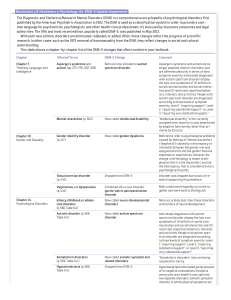
The Diagnostic and Statistical Manual of Mental Disorders (DSM) is
... Feeding and eating disorders is a new diagnostic class that includes anorexia nervosa, bulimia nervosa, a new disorder called binge-eating disorder, and feeding/ eating disorders of infancy and childhood, such as pica (eating nonfood substances). ...
... Feeding and eating disorders is a new diagnostic class that includes anorexia nervosa, bulimia nervosa, a new disorder called binge-eating disorder, and feeding/ eating disorders of infancy and childhood, such as pica (eating nonfood substances). ...

Anxiety Disorders
... of Panic Disorder • Sufferers tend to misinterpret the physical signs of arousal as catastrophic and dangerous • This interpretation leads to further physical arousal, tending toward a vicious cycle • After their first panic attack, they become even more attuned to physical changes, increasing the l ...
... of Panic Disorder • Sufferers tend to misinterpret the physical signs of arousal as catastrophic and dangerous • This interpretation leads to further physical arousal, tending toward a vicious cycle • After their first panic attack, they become even more attuned to physical changes, increasing the l ...

2. Misconceptions about Psychological Disorders
... Non-mental patients living in same neighborhood as the 1000 former mental patients Findings Former mental patients did not have a high rate of violence then the comparison group Stronger predictors of violence are… 1. Living in impoverished neighborhoods 2. Drug and alcohol abuse ...
... Non-mental patients living in same neighborhood as the 1000 former mental patients Findings Former mental patients did not have a high rate of violence then the comparison group Stronger predictors of violence are… 1. Living in impoverished neighborhoods 2. Drug and alcohol abuse ...

Anxiety Disorders FACT SHEET
... be distressed and to feel “on edge” for some time after this experience. Some people who experience traumatic events have severe symptoms such as nightmares, flashbacks, being very easily startled or scared, or feeling numb/angry/irritable, that last for weeks or even months after the event and are ...
... be distressed and to feel “on edge” for some time after this experience. Some people who experience traumatic events have severe symptoms such as nightmares, flashbacks, being very easily startled or scared, or feeling numb/angry/irritable, that last for weeks or even months after the event and are ...

Psychological Disorders - Purdue - Psychological Sciences
... • Depressive state evolved as alerting mechanism when at risk of social exclusion, necessary since Pleistocene period, because social exclusion would equal death. • Mechanism works to minimize social exclusion by changing social perception and social behavior in response to others’ behavior ...
... • Depressive state evolved as alerting mechanism when at risk of social exclusion, necessary since Pleistocene period, because social exclusion would equal death. • Mechanism works to minimize social exclusion by changing social perception and social behavior in response to others’ behavior ...