5 Depression, bipolar disorder and anxiety
... of first onset is typically in the mid-twenties, and most people experience more than one episode in their lifetimes. A depressive episode is distinguished from normal grieving after events such as the death of a loved one by fulfilling certain criteria, such as length of depression, types of symptoms ...
... of first onset is typically in the mid-twenties, and most people experience more than one episode in their lifetimes. A depressive episode is distinguished from normal grieving after events such as the death of a loved one by fulfilling certain criteria, such as length of depression, types of symptoms ...

Chapter 5: Somatoform and Dissociative Disorders
... – Substantial impairment in social or occupational functioning – Concerned over the symptoms themselves, not what they might mean – Symptoms become the person’s identity • Statistics – Rare condition – Onset usually in adolescence – Mostly affects unmarried, low SES women – Runs a chronic course Som ...
... – Substantial impairment in social or occupational functioning – Concerned over the symptoms themselves, not what they might mean – Symptoms become the person’s identity • Statistics – Rare condition – Onset usually in adolescence – Mostly affects unmarried, low SES women – Runs a chronic course Som ...

Anxiety_Disorders
... Clark and Watson’s Model of Anxiety and Depression general distress: depressed people and anxious people both experience high levels of negative affect they are distinguished on the basis of positive affect depressed people are low on positive affect (e.g., loss of interest; fatigue; anhedoni ...
... Clark and Watson’s Model of Anxiety and Depression general distress: depressed people and anxious people both experience high levels of negative affect they are distinguished on the basis of positive affect depressed people are low on positive affect (e.g., loss of interest; fatigue; anhedoni ...

Risk Factors in the Individual
... • Relationship to other conditions – is an “at-risk” condition in and of itself – contributes to intensity of other “at-risk” conditions ...
... • Relationship to other conditions – is an “at-risk” condition in and of itself – contributes to intensity of other “at-risk” conditions ...
7C Anxiety and Mood Disorders
... • Often associated with physical symptoms like choking sensations or shortness of breath • Panic attacks may happen several times a day ...
... • Often associated with physical symptoms like choking sensations or shortness of breath • Panic attacks may happen several times a day ...
DSM IV Article
... unique portion to the variance even when other factors were forced into the regression equation first. Clearly, this is an additional stressor that could lead to certain disorders more often than others, or require coping with certain skills that might also increase resistance to some disorders but ...
... unique portion to the variance even when other factors were forced into the regression equation first. Clearly, this is an additional stressor that could lead to certain disorders more often than others, or require coping with certain skills that might also increase resistance to some disorders but ...
chapter 15 - Cengage Learning
... loss and the assumption of a new identity in a new locale. In dissociative amnesia, a person has sudden memory loss without leaving home and creating a new identity. The most dramatic and least common dissociative disorder is dissociative identity disorder (DID), formerly known as multiple personali ...
... loss and the assumption of a new identity in a new locale. In dissociative amnesia, a person has sudden memory loss without leaving home and creating a new identity. The most dramatic and least common dissociative disorder is dissociative identity disorder (DID), formerly known as multiple personali ...
Indicate the answer choice that best completes the statement or
... vomiting, wild climbing or running, or fainting. c. People affected by phobias recognize that their fears are unreasonable. d. Fear of closed spaces is the most common specific phobia of Americans. 49. Women who are independent, aggressive, and unemotional may be considered "unhealthy," while women ...
... vomiting, wild climbing or running, or fainting. c. People affected by phobias recognize that their fears are unreasonable. d. Fear of closed spaces is the most common specific phobia of Americans. 49. Women who are independent, aggressive, and unemotional may be considered "unhealthy," while women ...
Psychological Disorders Dysfunctional Behavior
... path to self-‐actualization whereby people become detached from their true selves and adopt a distorted self-‐image which leads to emotional problems – ethical model: dysfunctional behavior is the result of ...
... path to self-‐actualization whereby people become detached from their true selves and adopt a distorted self-‐image which leads to emotional problems – ethical model: dysfunctional behavior is the result of ...
DSM-5 Understanding and Interpreting
... Autistic Disorder, Asperger’s Disorder, and Pervasive Developmental Disorder were consolidated into one group known as Autism Spectrum Disorder. Symptoms of these disorders represent a single continuum of mild to severe impairments in the two domains of social communication and restrictive repet ...
... Autistic Disorder, Asperger’s Disorder, and Pervasive Developmental Disorder were consolidated into one group known as Autism Spectrum Disorder. Symptoms of these disorders represent a single continuum of mild to severe impairments in the two domains of social communication and restrictive repet ...

Anxiety Disorders
... • Do you try to block out thoughts or feelings related to the [ ]? • Since the trauma have you… – .. had problems sleeping? – …been more irritable? – ….been on the alert? – …..easily startled? ...
... • Do you try to block out thoughts or feelings related to the [ ]? • Since the trauma have you… – .. had problems sleeping? – …been more irritable? – ….been on the alert? – …..easily startled? ...

PowerPoint 12
... o Eating pathology in mothers produce premature birth and small gestational size because of malnourishment • Premorbid neuroticism • Low weight and high dietary restraint at age 13 • Pressure to be thin (peers, family, media),low parental and peer support do not predict onset of anorexia nervosa ...
... o Eating pathology in mothers produce premature birth and small gestational size because of malnourishment • Premorbid neuroticism • Low weight and high dietary restraint at age 13 • Pressure to be thin (peers, family, media),low parental and peer support do not predict onset of anorexia nervosa ...
15PsychologicalDisorders
... 3. Do you think psychologists should concentrate more on helping people to increase their strengths (e.g. love or courage) or reduce their emotional disorders (e.g. depression), or do they go together? ...
... 3. Do you think psychologists should concentrate more on helping people to increase their strengths (e.g. love or courage) or reduce their emotional disorders (e.g. depression), or do they go together? ...

Common Mental Health Diagnoses of Children
... have lived through or witnessed a traumatic event to which they responded with intense fear, horror, or helplessness, and are currently experiencing 3 or more of the following DISSOCIATIVE symptoms: ...
... have lived through or witnessed a traumatic event to which they responded with intense fear, horror, or helplessness, and are currently experiencing 3 or more of the following DISSOCIATIVE symptoms: ...
Pica for 36 Years with Mild Obsessive
... There are now increasing amount of cases about at least some of the pica may also belong to obsessive-compulsive spectrum disorders but there is no clinical trial about the psychiatric symptoms among pica ...
... There are now increasing amount of cases about at least some of the pica may also belong to obsessive-compulsive spectrum disorders but there is no clinical trial about the psychiatric symptoms among pica ...

PDF - ijcnmh
... and autonomic anxiety, tics are usually preceded by shortlived sensory symptoms and feelings of incompleteness. This difference in how RB are experienced by patients has led to their subdivision into two categories: “OCD-like”, or OCD-related compulsions and “Tic-like”, or TS-related impulsions [12, ...
... and autonomic anxiety, tics are usually preceded by shortlived sensory symptoms and feelings of incompleteness. This difference in how RB are experienced by patients has led to their subdivision into two categories: “OCD-like”, or OCD-related compulsions and “Tic-like”, or TS-related impulsions [12, ...
Review Questions Psychosomatic, Somatoform, Dissociative Disorders
... • How do therapists help people with dissociative amnesia and fugue? – The leading treatments for these disorders are psychodynamic therapy, hypnotic therapy, and drug therapy • Psychodynamic therapists ask patients to free associate and search their unconscious • In hypnotic therapy, patients are h ...
... • How do therapists help people with dissociative amnesia and fugue? – The leading treatments for these disorders are psychodynamic therapy, hypnotic therapy, and drug therapy • Psychodynamic therapists ask patients to free associate and search their unconscious • In hypnotic therapy, patients are h ...
Dissociative Disorders
... interruption of a person's fundamental aspects of waking consciousness (such as one's personal identity, one's personal history, etc.). Dissociative disorders come in many forms, the most famous of which is dissociative identity disorder (formerly known as multiple personality disorder). All of the ...
... interruption of a person's fundamental aspects of waking consciousness (such as one's personal identity, one's personal history, etc.). Dissociative disorders come in many forms, the most famous of which is dissociative identity disorder (formerly known as multiple personality disorder). All of the ...
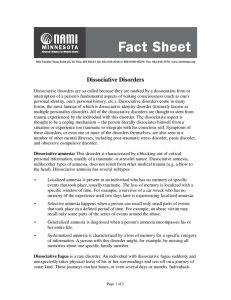
Dissociative Disorders - NAMI
... interruption of a person's fundamental aspects of waking consciousness (such as one's personal identity, one's personal history, etc.). Dissociative disorders come in many forms, the most famous of which is dissociative identity disorder (formerly known as multiple personality disorder). All of the ...
... interruption of a person's fundamental aspects of waking consciousness (such as one's personal identity, one's personal history, etc.). Dissociative disorders come in many forms, the most famous of which is dissociative identity disorder (formerly known as multiple personality disorder). All of the ...

somatoform disorders
... factitious disorder imposed on self according to the criteria in DSM-5, which require each of the following: • ●Falsification of physical or psychological signs or symptoms, or induction of injury or disease, associated with identified deception • ●The individual presents himself or herself to other ...
... factitious disorder imposed on self according to the criteria in DSM-5, which require each of the following: • ●Falsification of physical or psychological signs or symptoms, or induction of injury or disease, associated with identified deception • ●The individual presents himself or herself to other ...

Psychological Disorders
... Five Axes of DSM-IV-TR (guidelines for making decisions about symptoms) ...
... Five Axes of DSM-IV-TR (guidelines for making decisions about symptoms) ...


Unit 12 Abnormal Reading Guide 2017 - Bullis Haiku
... 1. Define mood disorders, and contrast major depressive disorder and bipolar disorder. 2. Describe how the biological and social-cognitive perspectives explain mood disorders. 3. Discuss the factors that affect suicide and self-injury, and identify the important warning signs to watch for in suicide ...
... 1. Define mood disorders, and contrast major depressive disorder and bipolar disorder. 2. Describe how the biological and social-cognitive perspectives explain mood disorders. 3. Discuss the factors that affect suicide and self-injury, and identify the important warning signs to watch for in suicide ...
Borderline Personality Disorder
... image, and affects, and marked impulsivity beginning by early adulthood and present in a variety of contexts, as indicated by 5 (or more) of the following: ...
... image, and affects, and marked impulsivity beginning by early adulthood and present in a variety of contexts, as indicated by 5 (or more) of the following: ...