Prevalence of eating disorders among young Hungarian women
... Research into eating disorders has drawn increasing attention in the last two or three decades. There are two tendencies in the research: one is the ever more precise description of various sub-types and associated comparative studies, and the other is work towards integration, concentrating on comm ...
... Research into eating disorders has drawn increasing attention in the last two or three decades. There are two tendencies in the research: one is the ever more precise description of various sub-types and associated comparative studies, and the other is work towards integration, concentrating on comm ...
Psychological Disorders
... Stress is so extreme that the individual blocks out part of their memory to reduce their anxiety The causes of dissociative disorders may involve an attempt to disconnect from consciousness to avoid awareness of traumatic or painful experiences It may be an attempt to protect the self from this trau ...
... Stress is so extreme that the individual blocks out part of their memory to reduce their anxiety The causes of dissociative disorders may involve an attempt to disconnect from consciousness to avoid awareness of traumatic or painful experiences It may be an attempt to protect the self from this trau ...

Psychological Disorder
... (ii) Maladaptiveness – engaging in bahaviour or thought pattern which makes it more difficult to lead one’s life. (iii) Irrationality – unable to communicate in a reasonable manner with others. (iv) Unpredictability – acting in ways which are entirely unexpected. (v) Vividness and intensity– experie ...
... (ii) Maladaptiveness – engaging in bahaviour or thought pattern which makes it more difficult to lead one’s life. (iii) Irrationality – unable to communicate in a reasonable manner with others. (iv) Unpredictability – acting in ways which are entirely unexpected. (v) Vividness and intensity– experie ...

WC-Hyd-M021 - WordPress.com
... reactivity’s role is still far from clear-cut. Twenty percent of infants are highly reactive, but less than 10 percent go on to develop social phobias. ...
... reactivity’s role is still far from clear-cut. Twenty percent of infants are highly reactive, but less than 10 percent go on to develop social phobias. ...
chapter 15 - Cengage Learning
... 14. Define dissociative disorder. Compare and contrast dissociative fugue and dissociative amnesia. Describe dissociative identity disorder. (see “Dissociative Disorders”) 15. State the causes, according to the various theoretical models, of dissociative disorders. (see “Dissociative Disorders”) 16 ...
... 14. Define dissociative disorder. Compare and contrast dissociative fugue and dissociative amnesia. Describe dissociative identity disorder. (see “Dissociative Disorders”) 15. State the causes, according to the various theoretical models, of dissociative disorders. (see “Dissociative Disorders”) 16 ...

Unit XII Textbook PowerPoint questions and answers
... 5. Xavier, who has a negative explanatory style, is most likely to get depressed after failing a math test is he believes that he failed because a. He is not good at math and never will be. b. His teacher made it impossible to learn the material. c. He was sick on the day he took the test. d. His pa ...
... 5. Xavier, who has a negative explanatory style, is most likely to get depressed after failing a math test is he believes that he failed because a. He is not good at math and never will be. b. His teacher made it impossible to learn the material. c. He was sick on the day he took the test. d. His pa ...
Personality Disorders
... DSM-IV Personality Disorders General Criteria B. The pattern is inflexible and pervasive across a broad range of personal and social situations. C. Clinically significant distress or impairment (occupational, social). D. The pattern is stable and of long duration and its onset can be traced back at ...
... DSM-IV Personality Disorders General Criteria B. The pattern is inflexible and pervasive across a broad range of personal and social situations. C. Clinically significant distress or impairment (occupational, social). D. The pattern is stable and of long duration and its onset can be traced back at ...
Integrative Approaches to Eating Disorders
... 2. Eating much more rapidly than normal 3. Eating alone because you are embarrassed by how much you're eating 4. Feeling disgusted, depressed, or guilty after overeating 5. Marked distress regarding binge eating is present ...
... 2. Eating much more rapidly than normal 3. Eating alone because you are embarrassed by how much you're eating 4. Feeling disgusted, depressed, or guilty after overeating 5. Marked distress regarding binge eating is present ...
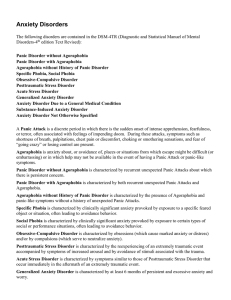
Anxiety Disorders - Joseph Berger MD, R. Ph.
... Agoraphobia without History of Panic Disorder is characterized by the presence of Agoraphobia and panic-like symptoms without a history of unexpected Panic Attacks. Specific Phobia is characterized by clinically significant anxiety provoked by exposure to a specific feared object or situation, often ...
... Agoraphobia without History of Panic Disorder is characterized by the presence of Agoraphobia and panic-like symptoms without a history of unexpected Panic Attacks. Specific Phobia is characterized by clinically significant anxiety provoked by exposure to a specific feared object or situation, often ...
obsession subtypes: relationships with obsessive
... with contamination, mistakes or accidents, associated with overt actions taken to prevent the occurrence of negative outcomes, that can be conceptualised as obsessions plus compulsions (O-C). In this study, the differences between PO and O-C in 39 Obsessive-Compulsive Disordered (OCD) outpatients ar ...
... with contamination, mistakes or accidents, associated with overt actions taken to prevent the occurrence of negative outcomes, that can be conceptualised as obsessions plus compulsions (O-C). In this study, the differences between PO and O-C in 39 Obsessive-Compulsive Disordered (OCD) outpatients ar ...

What is a Personality Disorder?
... to every detail, making it difficult for them to make decisions and complete tasks. When their feelings are not under strict control, events are unpredictable, or they must rely on others, compulsive personalities often feel a sense of isolation and helplessness. ...
... to every detail, making it difficult for them to make decisions and complete tasks. When their feelings are not under strict control, events are unpredictable, or they must rely on others, compulsive personalities often feel a sense of isolation and helplessness. ...

File - SSHS AP Psychology
... Various personalities don’t know they inhabit the same body. Sometimes they know of the other people and make disparaging comments about them. They usually are very different as if the various aspects of the person are represented by various personalities. Almost always one of the personalit ...
... Various personalities don’t know they inhabit the same body. Sometimes they know of the other people and make disparaging comments about them. They usually are very different as if the various aspects of the person are represented by various personalities. Almost always one of the personalit ...
Eating and Sexual Disorders
... • Restricting type; lose weight primarily through dieting, fasting, or excessive exercising • Binge-eating/Purging type. engage regularly in binge eating followed by purging. Binge eating means consuming a large amount of food (far greater than most people eat at one time) in a discrete period of us ...
... • Restricting type; lose weight primarily through dieting, fasting, or excessive exercising • Binge-eating/Purging type. engage regularly in binge eating followed by purging. Binge eating means consuming a large amount of food (far greater than most people eat at one time) in a discrete period of us ...
Unit IV: Anxiety Disorders and Crises
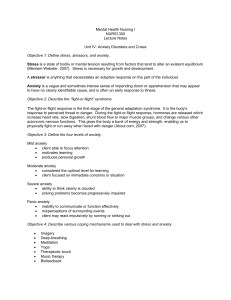
... to seek medical attention. The discomfort and sense of danger accompanying an attack is often so intense that clients with panic disorder often believe they are having a heart attack or other lifethreatening illness (MedlinePlus, 2007). A phobia is an irrational, persistent fear of certain situation ...
... to seek medical attention. The discomfort and sense of danger accompanying an attack is often so intense that clients with panic disorder often believe they are having a heart attack or other lifethreatening illness (MedlinePlus, 2007). A phobia is an irrational, persistent fear of certain situation ...
Document
... c. People who need help can be very inefficient. 1) They are unable to perform their life roles properly. a) An alcoholic who refuses to accept that there is a problem. b) A person who does nothing while his or her family life is falling apart. c) A parent at home with children who cannot even cope ...
... c. People who need help can be very inefficient. 1) They are unable to perform their life roles properly. a) An alcoholic who refuses to accept that there is a problem. b) A person who does nothing while his or her family life is falling apart. c) A parent at home with children who cannot even cope ...

Bulimia Nervosa - Cloudfront.net
... laxatives, diuretics, enemas, or other medications; fasting, or excessive exercise. C. The binge eating and inappropriate compensatory behaviors occur, on average, at least twice a week for three months. D. Self-evaluation is unduly influenced by body shape and weight. E. The disturbance does not oc ...
... laxatives, diuretics, enemas, or other medications; fasting, or excessive exercise. C. The binge eating and inappropriate compensatory behaviors occur, on average, at least twice a week for three months. D. Self-evaluation is unduly influenced by body shape and weight. E. The disturbance does not oc ...

PPN Seeing Your First Child with PANDAS PANS
... Diagnosing OCD in children can be complex because compulsions may resemble oppositional behaviors when children become upset and act out when their compulsions are thwarted. Many compulsions are either mental rituals (and therefore difficult to observe) or appear as extremes of an acceptable behavio ...
... Diagnosing OCD in children can be complex because compulsions may resemble oppositional behaviors when children become upset and act out when their compulsions are thwarted. Many compulsions are either mental rituals (and therefore difficult to observe) or appear as extremes of an acceptable behavio ...
Anxiety Disorders in the Elderly
... Unfortunately, much is made of the ‘reasonableness’ of some of these fears in the elderly, particularly those who live in run-down areas of inner cities, and clinically important fears may be dismissed as rational. In fact, the evidence from fear of crime surveys indicates that an individual’s perce ...
... Unfortunately, much is made of the ‘reasonableness’ of some of these fears in the elderly, particularly those who live in run-down areas of inner cities, and clinically important fears may be dismissed as rational. In fact, the evidence from fear of crime surveys indicates that an individual’s perce ...

Memory - Psychological Associates of South Florida
... http://www.youtube.com/watch?v=KnoTwOUb0aQ&feature=SeriesPlayList&p=A387002AB2C83C39 ...
... http://www.youtube.com/watch?v=KnoTwOUb0aQ&feature=SeriesPlayList&p=A387002AB2C83C39 ...


Eric Erikson`s Psychosocial Theory
... “no more violent than is someone suffering from cancer or any other serious disease” ...
... “no more violent than is someone suffering from cancer or any other serious disease” ...

Depressive and Bipolar Disorders
... • Typically lose interest in activities & relationships and take pleasure in nothing • Despite best efforts, everything from conversation to bathing is an unbearable, exhausting effort • Often exaggerated feelings of inadequacy, worthlessness, hopelessness, or guilt ...
... • Typically lose interest in activities & relationships and take pleasure in nothing • Despite best efforts, everything from conversation to bathing is an unbearable, exhausting effort • Often exaggerated feelings of inadequacy, worthlessness, hopelessness, or guilt ...
Personality Disorders (PD)
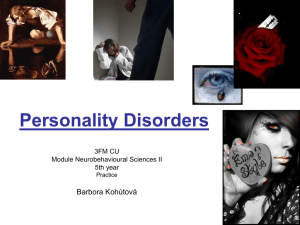
... individual's culture. This pattern is manifested in two (or more) of the following areas: – Cognition (i.e., ways of perceiving and interpreting self, other people and events) – Affectivity (i.e., the range, intensity, liability, and appropriateness of emotional response) ...
... individual's culture. This pattern is manifested in two (or more) of the following areas: – Cognition (i.e., ways of perceiving and interpreting self, other people and events) – Affectivity (i.e., the range, intensity, liability, and appropriateness of emotional response) ...