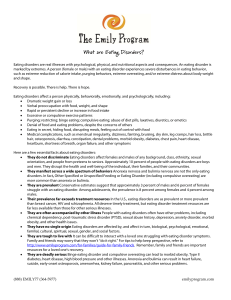
What are Eating Disorders?
... chemical dependency, post-traumatic stress disorder (PTSD), sexual abuse history, depression, anxiety disorder, morbid obesity, and other health issues. They have no single origin Eating disorders are affected by, and affect in turn, biological, psychological, emotional, familial, cultural, spirit ...
... chemical dependency, post-traumatic stress disorder (PTSD), sexual abuse history, depression, anxiety disorder, morbid obesity, and other health issues. They have no single origin Eating disorders are affected by, and affect in turn, biological, psychological, emotional, familial, cultural, spirit ...

Disorders
... The genetically identical Genain sisters suffer from schizophrenia. Two more than others, thus there are contributing environmental factors. ...
... The genetically identical Genain sisters suffer from schizophrenia. Two more than others, thus there are contributing environmental factors. ...

Eating disorders
... and body image lead to unhealthy patterns of eating and/or exercising. This can interfere with their life and relationships with others. Eating disorders often begin in adolescence and early adulthood and they are more common in females but can also affect young males. Mortality rates are two to six ...
... and body image lead to unhealthy patterns of eating and/or exercising. This can interfere with their life and relationships with others. Eating disorders often begin in adolescence and early adulthood and they are more common in females but can also affect young males. Mortality rates are two to six ...

EATING DISORDERS: DR. BERGER The Eating
... purge their bodies of excess calories. Therefore, many with the disorder tend to be overweight. Eating and Weight: Issues are problem areas for a great many men and women. The main types of eating problems are obesity and excess weight, anorexia nervosa, bulimia nervosa, and binge-eating. Most often ...
... purge their bodies of excess calories. Therefore, many with the disorder tend to be overweight. Eating and Weight: Issues are problem areas for a great many men and women. The main types of eating problems are obesity and excess weight, anorexia nervosa, bulimia nervosa, and binge-eating. Most often ...

Memory
... depression… trapped in depressed mood; also exhibit anxiety or substance abuse. 2. Women are nearly twice as vulnerable to depression. Men tend to be more external. 3. Most major depressive episodes self-terminate. 4. Stressful events related to work, marriage, and close relationships often precede ...
... depression… trapped in depressed mood; also exhibit anxiety or substance abuse. 2. Women are nearly twice as vulnerable to depression. Men tend to be more external. 3. Most major depressive episodes self-terminate. 4. Stressful events related to work, marriage, and close relationships often precede ...

chapter 23 mental health
... – Intense apprehension, fear, or terror, often associated with feelings of impending doom ...
... – Intense apprehension, fear, or terror, often associated with feelings of impending doom ...

Chapter 13 - Bakersfield College
... The genetically identical Genain sisters suffer from schizophrenia. Two more than others, thus there are contributing environmental factors. ...
... The genetically identical Genain sisters suffer from schizophrenia. Two more than others, thus there are contributing environmental factors. ...

myersand fun Chapter 16 (2)
... disorders as persistently harmful thoughts, feelings, and actions. When behavior is deviant, distressful, and dysfunctional psychiatrists and psychologists label it as disordered (Comer, 2004). ...
... disorders as persistently harmful thoughts, feelings, and actions. When behavior is deviant, distressful, and dysfunctional psychiatrists and psychologists label it as disordered (Comer, 2004). ...

What medications are used to treat anxiety disorders
... document you will see two names for medications—the generic name and in parenthesis, the trade name. An example is fluoxetine (Prozac). ...
... document you will see two names for medications—the generic name and in parenthesis, the trade name. An example is fluoxetine (Prozac). ...
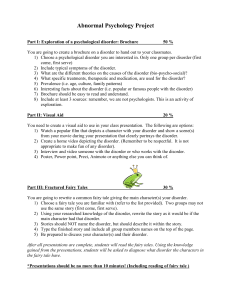
Abnormal Psychology Project
... 2. Mood Disorders – disturbances of emotions a. Depression b. Bipolar 3. Anxiety Disorder – unexplained feelings of apprehensions and tenseness a. Obsessive Compulsive Disorder b. Post-traumatic Stress Disorder c. Panic 4. Dissociative Disorder – person’s sense of self separates from the individual’ ...
... 2. Mood Disorders – disturbances of emotions a. Depression b. Bipolar 3. Anxiety Disorder – unexplained feelings of apprehensions and tenseness a. Obsessive Compulsive Disorder b. Post-traumatic Stress Disorder c. Panic 4. Dissociative Disorder – person’s sense of self separates from the individual’ ...
abnormal anxiety and mood disorders
... actions • Obsessions – repetitive thoughts • Compulsions – repetitive actions • The obsessions/compulsions begin to take control of the person’s life. ...
... actions • Obsessions – repetitive thoughts • Compulsions – repetitive actions • The obsessions/compulsions begin to take control of the person’s life. ...
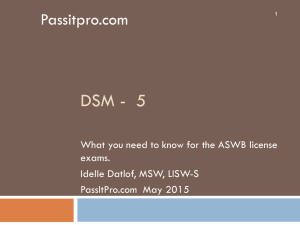
DSM 5
... Recurrent episodes of binge-eating: overeating, inability to control amounts of food ingested. Eating faster than normal until uncomfortable, eating large quantity of food when not hungry. Experiencing distress during and after these events and not being able to refrain from repeated episodes. Occur ...
... Recurrent episodes of binge-eating: overeating, inability to control amounts of food ingested. Eating faster than normal until uncomfortable, eating large quantity of food when not hungry. Experiencing distress during and after these events and not being able to refrain from repeated episodes. Occur ...
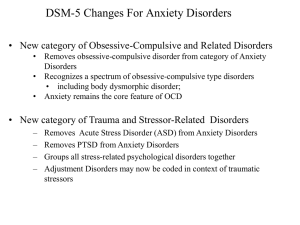
Epidemiology of Anxiety
... • Marked and persistent fear of one or more social or performance situations in which a person is exposed to unfamiliar people or possible scrutiny by others • Exposed to the feared social situation invariably provokes anxiety • The person realizes that the fear is excessive or unreasonable • The fe ...
... • Marked and persistent fear of one or more social or performance situations in which a person is exposed to unfamiliar people or possible scrutiny by others • Exposed to the feared social situation invariably provokes anxiety • The person realizes that the fear is excessive or unreasonable • The fe ...

Eating Disorders Study Guide
... Depression, Anxiety, Anger and Loneliness Troubled family and personal relationships Difficulty expressing emotions and feelings History of being teased or ridiculed based on size or weight History of physical or sexual abuse Cultural pressures that glorify “thinness” and place value on obtaining th ...
... Depression, Anxiety, Anger and Loneliness Troubled family and personal relationships Difficulty expressing emotions and feelings History of being teased or ridiculed based on size or weight History of physical or sexual abuse Cultural pressures that glorify “thinness” and place value on obtaining th ...


Coping with The Emotional Lives of Children
... • Anxiety disorders affect approximately 13% of American children and adolescents. • Anxiety disorders are the greatest predictors of mood disorders and alcohol abuse in adulthood. • More than 40 million adults in the US (18%) have reported disabling anxiety that negatively impacts their lives. ...
... • Anxiety disorders affect approximately 13% of American children and adolescents. • Anxiety disorders are the greatest predictors of mood disorders and alcohol abuse in adulthood. • More than 40 million adults in the US (18%) have reported disabling anxiety that negatively impacts their lives. ...
File - Logan Class of December 2011
... Recurrent episodes of binge eating. An episode is characterized by both of the following: - Eating, in a discrete period of time (any 2 hour period) an amount of food that is definitely larger than most people would eat during a similar period of time and under similar circumstance. - A sense of l ...
... Recurrent episodes of binge eating. An episode is characterized by both of the following: - Eating, in a discrete period of time (any 2 hour period) an amount of food that is definitely larger than most people would eat during a similar period of time and under similar circumstance. - A sense of l ...

Personality Disorders - Psychclerk
... A pervasive distrust and suspiciousness of others such that their motives are interpreted as malevolent, beginning by early adulthood and present in a variety of contexts, as indicated by four (or more) of the following: 1) Suspects, without sufficient basis, that others are exploiting, harming, or ...
... A pervasive distrust and suspiciousness of others such that their motives are interpreted as malevolent, beginning by early adulthood and present in a variety of contexts, as indicated by four (or more) of the following: 1) Suspects, without sufficient basis, that others are exploiting, harming, or ...

psk0503_ing_the assessment.indd
... At present, there are various instruments developed to assess the content and severity of obsessive-compulsive symptoms both in clinical and non-clinical studies. The Yale-Brown Obsession Compulsion Scale (YBOCS) is the most commonly used instrument and considered as the “golden standard” for measur ...
... At present, there are various instruments developed to assess the content and severity of obsessive-compulsive symptoms both in clinical and non-clinical studies. The Yale-Brown Obsession Compulsion Scale (YBOCS) is the most commonly used instrument and considered as the “golden standard” for measur ...
Unit 12 - Our Lady of Lourdes High School
... Specific phobias – fear of certain animals, insects, blood, things Social phobias – extreme shyness and avoidance of others. Fear of being judged by others Afraid of the fear, so avoidance of all things ...
... Specific phobias – fear of certain animals, insects, blood, things Social phobias – extreme shyness and avoidance of others. Fear of being judged by others Afraid of the fear, so avoidance of all things ...

Exploring 9e
... the DSM. the DSM may contain the information to correct inaccurate perceptions of mental illness. ...
... the DSM. the DSM may contain the information to correct inaccurate perceptions of mental illness. ...

Anxiety Disorders
... persistent, and excessive or unreasonable fear when in the presence of, or when anticipating an encounter with, a specific object or situation • Specific phobias frequently occur concurrently with other anxiety disorders, but are rarely the focus of clinical attention in these situations • Treatment ...
... persistent, and excessive or unreasonable fear when in the presence of, or when anticipating an encounter with, a specific object or situation • Specific phobias frequently occur concurrently with other anxiety disorders, but are rarely the focus of clinical attention in these situations • Treatment ...
Unit Eleven
... People suffering from anxiety disorders feel anxiety, but not just normal anxiety. They suffer from anxiety that is out of proportion to the situation that is provoking it. This intense anxiety may interfere with the normal functioning of everyday life. Anxiety disorders are the most common mental d ...
... People suffering from anxiety disorders feel anxiety, but not just normal anxiety. They suffer from anxiety that is out of proportion to the situation that is provoking it. This intense anxiety may interfere with the normal functioning of everyday life. Anxiety disorders are the most common mental d ...

Lecture 4
... – Compulsions - Thoughts or actions to suppress the thoughts and provide relief – Most persons with OCD present with cleaning and washing or checking rituals Obsessive-Compulsive Disorder (OCD): Causes and Associated Features ...
... – Compulsions - Thoughts or actions to suppress the thoughts and provide relief – Most persons with OCD present with cleaning and washing or checking rituals Obsessive-Compulsive Disorder (OCD): Causes and Associated Features ...