
A mood disorder - Mater Academy Lakes High School
... sudden bouts of intense, unexplained anxiety, • often associated with physical symptoms like choking sensations or shortness of breath. • Panic attacks may happen several times a day ...
... sudden bouts of intense, unexplained anxiety, • often associated with physical symptoms like choking sensations or shortness of breath. • Panic attacks may happen several times a day ...

Powerpoint 31 - Mater Academy Lakes High School
... sudden bouts of intense, unexplained anxiety, • often associated with physical symptoms like choking sensations or shortness of breath. • Panic attacks may happen several times a day ...
... sudden bouts of intense, unexplained anxiety, • often associated with physical symptoms like choking sensations or shortness of breath. • Panic attacks may happen several times a day ...

TAP3_LecturePowerPointSlides_Module31
... sudden bouts of intense, unexplained anxiety, • often associated with physical symptoms like choking sensations or shortness of breath. • Panic attacks may happen several times a day ...
... sudden bouts of intense, unexplained anxiety, • often associated with physical symptoms like choking sensations or shortness of breath. • Panic attacks may happen several times a day ...

Psychological Disorders
... 1. Identify the criteria for judging whether behavior is psychologically disordered. Psychological disorders consist of deviant, distressful, and dysfunctional behavior patterns. Mental health workers view psychological disorders as persistently harmful thoughts, feelings, and actions. Standards of ...
... 1. Identify the criteria for judging whether behavior is psychologically disordered. Psychological disorders consist of deviant, distressful, and dysfunctional behavior patterns. Mental health workers view psychological disorders as persistently harmful thoughts, feelings, and actions. Standards of ...

Cluster B – Borderline
... Cluster B: Antisocial personality disorder is 3 times more prevalent in men than in women. Borderline personality disorder is 3 times more common in women than in men. Of patients with narcissistic personality disorder, 50-75% are male. Cluster C: Obsessive-compulsive personality disorder is dia ...
... Cluster B: Antisocial personality disorder is 3 times more prevalent in men than in women. Borderline personality disorder is 3 times more common in women than in men. Of patients with narcissistic personality disorder, 50-75% are male. Cluster C: Obsessive-compulsive personality disorder is dia ...
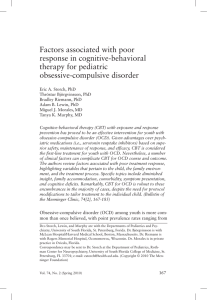
Factors associated with poor response in cognitive
... pediatric OCD patients. Marked improvements were found within both CBFT conditions (which did not differ) on symptom severity and diagnostic status change. Furthermore, results were maintained at 6 months: 65% of individual and 87% of group CBGT participants were OCD diagnosis free. De Haan, Hoogdui ...
... pediatric OCD patients. Marked improvements were found within both CBFT conditions (which did not differ) on symptom severity and diagnostic status change. Furthermore, results were maintained at 6 months: 65% of individual and 87% of group CBGT participants were OCD diagnosis free. De Haan, Hoogdui ...
Slide 1
... Rule-out Schizoaffective and Mood Disorder with Psychosis: 1. No significant mood symptoms during active phase 2. If mood symptoms present during active phase, their duration is brief relative to active and residual phases Not due to a medical condition or a substance ...
... Rule-out Schizoaffective and Mood Disorder with Psychosis: 1. No significant mood symptoms during active phase 2. If mood symptoms present during active phase, their duration is brief relative to active and residual phases Not due to a medical condition or a substance ...
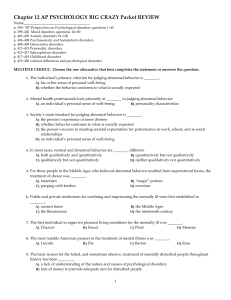
Ch 12 Big Review backup.tst
... does not deserve to have any friends. He spends his nights alone and has not gone out with anyone in two years. His low opinion of himself is probably the result of a(n) ________ disorder. A) anxiety B) mood C) dissociative D) somatoform 48. The DSM-IV-TR distinguishes between ________ forms of depr ...
... does not deserve to have any friends. He spends his nights alone and has not gone out with anyone in two years. His low opinion of himself is probably the result of a(n) ________ disorder. A) anxiety B) mood C) dissociative D) somatoform 48. The DSM-IV-TR distinguishes between ________ forms of depr ...
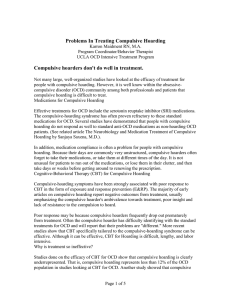
Hoarding Treatment Problems
... of how much the hoarding and clutter have impacted their lives. Poor insight also contributes to low motivation for treatment. Despite significant pressure from loved ones or the authorities to get help for their problem, many hoarders are not convinced they truly have a psychiatric disorder. Theref ...
... of how much the hoarding and clutter have impacted their lives. Poor insight also contributes to low motivation for treatment. Despite significant pressure from loved ones or the authorities to get help for their problem, many hoarders are not convinced they truly have a psychiatric disorder. Theref ...
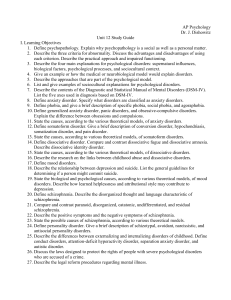
Unit 12 Study Guide
... 15. A therapist suggests that Mr. Broshi continues to bite his fingernails because this behavior often reduced his feelings of anxiety in the past. The therapist's suggestion most clearly reflects a ________ perspective. A) biological B) humanistic C) psychoanalytic D) learning E) cognitive 16. Res ...
... 15. A therapist suggests that Mr. Broshi continues to bite his fingernails because this behavior often reduced his feelings of anxiety in the past. The therapist's suggestion most clearly reflects a ________ perspective. A) biological B) humanistic C) psychoanalytic D) learning E) cognitive 16. Res ...


Mental Disorders - University of Alberta
... in higher social strata) is in love with them Fregoli’s syndrome: someone known to you has changed identities, and is out to get you Folie a Deux: shared delusions; one person with genuine delusional disorder, and a second person (usually less intelligent) who has become convinced of the validity of ...
... in higher social strata) is in love with them Fregoli’s syndrome: someone known to you has changed identities, and is out to get you Folie a Deux: shared delusions; one person with genuine delusional disorder, and a second person (usually less intelligent) who has become convinced of the validity of ...

Basic Statistics for the Behavioral Sciences
... Associated Features and Treatment • Treatment of GAD: Generally weak – Benzodiazapines – often prescribed – Antidepressents (may be more effective than benzos) – Psychological interventions – cognitive-behavioral therapy – Meditation therapy ...
... Associated Features and Treatment • Treatment of GAD: Generally weak – Benzodiazapines – often prescribed – Antidepressents (may be more effective than benzos) – Psychological interventions – cognitive-behavioral therapy – Meditation therapy ...

Generalized Anxiety Disorder
... Patients with generalized anxiety disorder (GAD) have persistent, excessive, and/or unrealistic worry associated with other signs and symptoms, which commonly include muscle tension, impaired concentration, autonomic arousal, feeling "on edge" or restless, and insomnia. Onset is usually before age 2 ...
... Patients with generalized anxiety disorder (GAD) have persistent, excessive, and/or unrealistic worry associated with other signs and symptoms, which commonly include muscle tension, impaired concentration, autonomic arousal, feeling "on edge" or restless, and insomnia. Onset is usually before age 2 ...
Pseudo-obsessive symptoms in the endogenous psychoses:
... in the beginning often appear unspecific, so-called accessoric symptoms (epiphenomena), e.g. depressive or euphorie mood swings, short-time delusional symptoms or hallucinations, which disappear and are replaced by the developing characteristic residual syndrome clinically sharply distinguished symp ...
... in the beginning often appear unspecific, so-called accessoric symptoms (epiphenomena), e.g. depressive or euphorie mood swings, short-time delusional symptoms or hallucinations, which disappear and are replaced by the developing characteristic residual syndrome clinically sharply distinguished symp ...

Anxiety Disorders
... The font for the question & answer slides is “Enchanted;” a copy of this font in located in the “REAL Jeopardy Template” folder or included in the “jeopardy_pc.zip” file. (This font will need to be installed in the C:/WINDOWS/FONTS folder of the computer running the show.) In order to keep all of th ...
... The font for the question & answer slides is “Enchanted;” a copy of this font in located in the “REAL Jeopardy Template” folder or included in the “jeopardy_pc.zip” file. (This font will need to be installed in the C:/WINDOWS/FONTS folder of the computer running the show.) In order to keep all of th ...
Study Guide Final 12-13-2005 - Logan Class of December 2011
... Adolescent-onset type is defined by the absence of any criterion characteristic of CD before an individual is aged 10 years. These individuals tend to be less aggressive and have more normative peer relationships. They often display their conduct behaviors in the company of a peer group engaged in t ...
... Adolescent-onset type is defined by the absence of any criterion characteristic of CD before an individual is aged 10 years. These individuals tend to be less aggressive and have more normative peer relationships. They often display their conduct behaviors in the company of a peer group engaged in t ...

Clinical_CV 1211
... Post-baccalaureate work in Psychology coursework and research Massachusetts Institute of Technology, Cambridge, MA, 1987-1992 S.B.: Major: Electrical Engineering / Biomedical Technology, Minor: Writing ...
... Post-baccalaureate work in Psychology coursework and research Massachusetts Institute of Technology, Cambridge, MA, 1987-1992 S.B.: Major: Electrical Engineering / Biomedical Technology, Minor: Writing ...

Defining Psychological Disorders
... disadvantaged ethnic groups. People with psychological disorders are stigmatized by the people around them. ...
... disadvantaged ethnic groups. People with psychological disorders are stigmatized by the people around them. ...
Review Session 11 5/5/08
... • reinforcing positive behavior by awarding "tokens" for meeting positive behavioral goals • tokens are accumulated and "spent" in order to obtain a reinforcer ...
... • reinforcing positive behavior by awarding "tokens" for meeting positive behavioral goals • tokens are accumulated and "spent" in order to obtain a reinforcer ...

Eating disorders - Tufts Health Plan
... Main Types of Eating Disorders Anorexia: People with anorexia demonstrate an excessive effort to lose weight and an extreme fear of gaining weight. People with anorexia are often very thin and their bodies do not always have the nutrients necessary to function normally. Symptoms of anorexia include ...
... Main Types of Eating Disorders Anorexia: People with anorexia demonstrate an excessive effort to lose weight and an extreme fear of gaining weight. People with anorexia are often very thin and their bodies do not always have the nutrients necessary to function normally. Symptoms of anorexia include ...
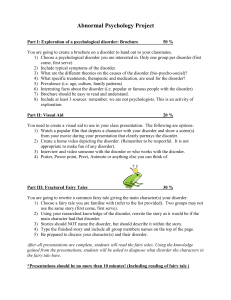
Abnormal Psychology Project
... You are going to rewrite a common fairy tale giving the main character(s) your disorder. 1) Choose a fairy tale you are familiar with (refer to the list provided). Two groups may not use the same story (first come, first serve). 2) Using your researched knowledge of the disorder, rewrite the story a ...
... You are going to rewrite a common fairy tale giving the main character(s) your disorder. 1) Choose a fairy tale you are familiar with (refer to the list provided). Two groups may not use the same story (first come, first serve). 2) Using your researched knowledge of the disorder, rewrite the story a ...

The Bipolar Child - VA Association of Visiting Teachers
... hypothesis that the symptoms of bipolar disorder in children are different than those seen in adults. ...
... hypothesis that the symptoms of bipolar disorder in children are different than those seen in adults. ...
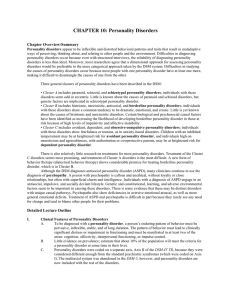
CHAPTER 10: Personality Disorders
... personality disorders occur because even with structured interviews, the reliability of diagnosing personality disorders is less than ideal. Moreover, most researchers agree that a dimensional approach for assessing personality disorders would be preferable to the more categorical approach taken by ...
... personality disorders occur because even with structured interviews, the reliability of diagnosing personality disorders is less than ideal. Moreover, most researchers agree that a dimensional approach for assessing personality disorders would be preferable to the more categorical approach taken by ...

DSM-5 Released: The Big Changes
... for this change: “(1) Opportunity for early detection. The earlier the better for patients with these symptoms. (2) It also encourages an early effective treatment plan, ” before dementia sets in. Other New & Notable Disorders Both binge eating disorder and premenstrual dysphoric disorder and now of ...
... for this change: “(1) Opportunity for early detection. The earlier the better for patients with these symptoms. (2) It also encourages an early effective treatment plan, ” before dementia sets in. Other New & Notable Disorders Both binge eating disorder and premenstrual dysphoric disorder and now of ...