Disordered Eating
... 2. What are the early warning signs and symptoms of disordered eating? 3. What is the role of the coach when disordered eating is suspected? Disordered Eating and Eating Disorders There are many hypotheses regarding what causes disordered eating or eating disorders and why athletes appear to be pred ...
... 2. What are the early warning signs and symptoms of disordered eating? 3. What is the role of the coach when disordered eating is suspected? Disordered Eating and Eating Disorders There are many hypotheses regarding what causes disordered eating or eating disorders and why athletes appear to be pred ...
Document
... with borderline, obsessive-compulsive, avoidant, or schizotypal personality disorders no longer had the disorder after two years. • However, most of the patients still had residual problems, often impairment in social relationships. ...
... with borderline, obsessive-compulsive, avoidant, or schizotypal personality disorders no longer had the disorder after two years. • However, most of the patients still had residual problems, often impairment in social relationships. ...
Child and Adolescent Anxiety Disorders
... psychophysiological response to a real, external, demonstrable threat to safety and life. Anxiety produces the same responses as fear, but the danger is symbolic rather than actual and is associated with unresolved problems and conflicts that are often unconscious. In 1869, anxiety was referred to a ...
... psychophysiological response to a real, external, demonstrable threat to safety and life. Anxiety produces the same responses as fear, but the danger is symbolic rather than actual and is associated with unresolved problems and conflicts that are often unconscious. In 1869, anxiety was referred to a ...
continued - Human Kinetics
... of those with disordered eating: compulsions and rituals, rigid diets, perfectionism, and control over the body ...
... of those with disordered eating: compulsions and rituals, rigid diets, perfectionism, and control over the body ...

OCD Chicago Ten Things You Need To Know To
... It has always been a favorite saying of mine that, “Getting well is 50 percent of the job, and staying well is the other 50 percent.” We have actually come full-circle back to Point #1, which tells us that OCD is chronic. This tells us that although there is no cure, you can successfully recover and ...
... It has always been a favorite saying of mine that, “Getting well is 50 percent of the job, and staying well is the other 50 percent.” We have actually come full-circle back to Point #1, which tells us that OCD is chronic. This tells us that although there is no cure, you can successfully recover and ...
Neurodevelopmental disorders
... bears some resemblance to the "reason of insanity" defense (in that both examine the mental competence of the defendant), there are important differences. The most fundamental of these is that, while "reason of insanity" is a full defense to a crime -- that is, pleading "reason of insanity" is the e ...
... bears some resemblance to the "reason of insanity" defense (in that both examine the mental competence of the defendant), there are important differences. The most fundamental of these is that, while "reason of insanity" is a full defense to a crime -- that is, pleading "reason of insanity" is the e ...

Psych Disorders
... something I'd never done before. I was a good girl — I never skipped school. And as I was walking, the houses got very ominous and foreboding, and I started to think that ...
... something I'd never done before. I was a good girl — I never skipped school. And as I was walking, the houses got very ominous and foreboding, and I started to think that ...
Chapter Preview
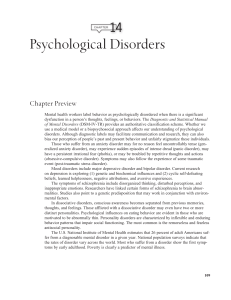
... Mental health workers label behavior as psychologically disordered when there is a significant dysfunction in a person’s thoughts, feelings, or behaviors. The Diagnostic and Statistical Manual of Mental Disorders (DSM-IV-TR) provides an authoritative classification scheme. Whether we use a medical m ...
... Mental health workers label behavior as psychologically disordered when there is a significant dysfunction in a person’s thoughts, feelings, or behaviors. The Diagnostic and Statistical Manual of Mental Disorders (DSM-IV-TR) provides an authoritative classification scheme. Whether we use a medical m ...
Purple curves design template
... • Anorexia Nervosa - self-starvation, excessive weight loss, and refusal to maintain a weight which is normal for one’s height and age. These individuals often perceive themselves as being fat even though they are extremely thin. • Bulimia Nervosa: a cycle of bingeing and compensatory behaviors suc ...
... • Anorexia Nervosa - self-starvation, excessive weight loss, and refusal to maintain a weight which is normal for one’s height and age. These individuals often perceive themselves as being fat even though they are extremely thin. • Bulimia Nervosa: a cycle of bingeing and compensatory behaviors suc ...
- Bepress
... – Making diagnoses requires clinical judgment, not just checking off the symptoms in the criteria. – The client’s cultural and social context must be considered. – The DSM-5 does not include all possible mental disorders. ...
... – Making diagnoses requires clinical judgment, not just checking off the symptoms in the criteria. – The client’s cultural and social context must be considered. – The DSM-5 does not include all possible mental disorders. ...

Anxiety Disorder - West African Rescue Association Ghana
... trials show that CBT is as effective, if not more effective as medication in treating anxiety. The relapse rate is lower once the treatment has ended and there are no side effects as experienced with medication. The down side of CBT is that commitment to the therapy is essential, which means a signi ...
... trials show that CBT is as effective, if not more effective as medication in treating anxiety. The relapse rate is lower once the treatment has ended and there are no side effects as experienced with medication. The down side of CBT is that commitment to the therapy is essential, which means a signi ...

Anxiety Disorders
... When are obsessions and compulsions harmful? When they begin to take control with some people, what could have been helpful tendencies become obsessivecompulsive disorder. If sufferers are prevented from engaging in their ritual behavior, ___________ and __________ rapidly build. ...
... When are obsessions and compulsions harmful? When they begin to take control with some people, what could have been helpful tendencies become obsessivecompulsive disorder. If sufferers are prevented from engaging in their ritual behavior, ___________ and __________ rapidly build. ...

2008 Unit 12 Disorders - TJ
... Disorders outlined by DSM-IV are reliable. Therefore, diagnoses by different professionals are similar. Others criticize DSM-IV for “putting any kind of behavior within the compass of psychiatry.”(un-DSM-Seligman-postive psychology text pg 648) + Ryff resources pg ...
... Disorders outlined by DSM-IV are reliable. Therefore, diagnoses by different professionals are similar. Others criticize DSM-IV for “putting any kind of behavior within the compass of psychiatry.”(un-DSM-Seligman-postive psychology text pg 648) + Ryff resources pg ...

Personality disorders - Faribault Area Learning Center
... • Stressful events related to work, marriage and close relationships often precede depression • With each new generation, depression is striking earlier and affecting more people ...
... • Stressful events related to work, marriage and close relationships often precede depression • With each new generation, depression is striking earlier and affecting more people ...
disorder
... views of mental illness, and not from the DSM. the DSM may contain the information to correct inaccurate perceptions of mental illness. ...
... views of mental illness, and not from the DSM. the DSM may contain the information to correct inaccurate perceptions of mental illness. ...

EXPLORING PSYCHOLOGY (7th Edition in Modules) David Myers
... Philippe Pinel (1745-1826) from France, insisted that madness was not due to demonic possession, but an ailment of the mind. George Wesley Bellows, Dancer in a Madhouse, 1907. © 1997 The Art Institute of Chicago ...
... Philippe Pinel (1745-1826) from France, insisted that madness was not due to demonic possession, but an ailment of the mind. George Wesley Bellows, Dancer in a Madhouse, 1907. © 1997 The Art Institute of Chicago ...

Describe symptoms and prevalence of two disorders (anxiety
... • Fairburn and Beglin (1990) found that bulimia nervosa affected between 1 and 2 % of young women in the USA and the UK. • APA (2000) estimated 1– 3% of young adult females to have Bulimia. • The disorder occurs much less frequently in men. Describe symptoms and prevalence of two disorders ...
... • Fairburn and Beglin (1990) found that bulimia nervosa affected between 1 and 2 % of young women in the USA and the UK. • APA (2000) estimated 1– 3% of young adult females to have Bulimia. • The disorder occurs much less frequently in men. Describe symptoms and prevalence of two disorders ...

Somatoform Disorders
... physical damage is present. Conversion disorders are rare, accounting for only about 2% of diagnoses. ...
... physical damage is present. Conversion disorders are rare, accounting for only about 2% of diagnoses. ...
Assessment and Treatment of Aggressive, Sexual, and Religious
... disorder characterized by obsessions and/or compulsive behaviors. Obsessions are intrusive thoughts, images, or impulses associated with significant anxiety or distress, and compulsions are behaviors or mental acts that a person with OCD performs to reduce anxiety. Approximately 1-2% of youth are es ...
... disorder characterized by obsessions and/or compulsive behaviors. Obsessions are intrusive thoughts, images, or impulses associated with significant anxiety or distress, and compulsions are behaviors or mental acts that a person with OCD performs to reduce anxiety. Approximately 1-2% of youth are es ...
Abnormal Psychology
... Paranoid Personality Disorder and Schizoid Personality Disorder are different from schizophrenia only by a matter of degree. While people with schizophrenia experience psychotic episodes when they lose touch with reality, people with these personality disorders do not have these ...
... Paranoid Personality Disorder and Schizoid Personality Disorder are different from schizophrenia only by a matter of degree. While people with schizophrenia experience psychotic episodes when they lose touch with reality, people with these personality disorders do not have these ...
Chapter Outline - Cengage Learning
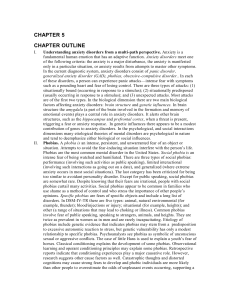
... focused on the relationship between types of worry and GAD. In the social and sociocultural dimensions stressful conditions such as poverty, poor housing, prejudice, and discrimination can also contribute to GAD. Treatments include Benzodiazepines which have been successful in treating GAD, but beca ...
... focused on the relationship between types of worry and GAD. In the social and sociocultural dimensions stressful conditions such as poverty, poor housing, prejudice, and discrimination can also contribute to GAD. Treatments include Benzodiazepines which have been successful in treating GAD, but beca ...
