
Lighten your Load. Lose the OCD!
... similar, and some of the symptoms may look the same on the outside. But these disorders are very different. People with OCPD are generally preoccupied with orderliness, perfectionism, and control in virtually every part of their lives. Someone who wants to keep his dorm room and car spotlessly clean ...
... similar, and some of the symptoms may look the same on the outside. But these disorders are very different. People with OCPD are generally preoccupied with orderliness, perfectionism, and control in virtually every part of their lives. Someone who wants to keep his dorm room and car spotlessly clean ...

Anxiety and Children
... Anxiety disorders are among the most common Psychiatric disorders affecting children and adolescents Anxiety disorders tend to have an early onset in childhood and adolescents and run a chronic course well into adulthood Anxiety symptoms may worsen over time (kindling, Physiological effects and lear ...
... Anxiety disorders are among the most common Psychiatric disorders affecting children and adolescents Anxiety disorders tend to have an early onset in childhood and adolescents and run a chronic course well into adulthood Anxiety symptoms may worsen over time (kindling, Physiological effects and lear ...

Phobias are intense fears about specific places, situations or things
... not enjoy the situation, but they will not show a phobic response (Lisa Fritscher, 2009). E. The differences between specific phobia and bipolar disorder Bipolar disorder is more complex, because there are many specific symptoms, but those symptoms are not with phobia or other anxiety disorder. F. T ...
... not enjoy the situation, but they will not show a phobic response (Lisa Fritscher, 2009). E. The differences between specific phobia and bipolar disorder Bipolar disorder is more complex, because there are many specific symptoms, but those symptoms are not with phobia or other anxiety disorder. F. T ...
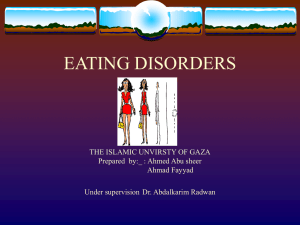
EATING DISORDERS
... If one identical twin has anorexia, the other has more than a 50% chance of also developing it. Research suggests that a genetic predisposition to anorexia may run in families.. Family studies have shown that the prevalence of anorexia nervosa is 7 to 12 times higher among relatives of AN than ...
... If one identical twin has anorexia, the other has more than a 50% chance of also developing it. Research suggests that a genetic predisposition to anorexia may run in families.. Family studies have shown that the prevalence of anorexia nervosa is 7 to 12 times higher among relatives of AN than ...
Huffman PowerPoint Slides - HomePage Server for UT Psychology
... – Depersonalization disorder involves an alteration of a person’s self-experience – Dissociative amnesia is the inability to recall important personal information – Dissociative fugue involves extensive memory loss – Dissociative trance disorder involves a sudden change in personality / “possession ...
... – Depersonalization disorder involves an alteration of a person’s self-experience – Dissociative amnesia is the inability to recall important personal information – Dissociative fugue involves extensive memory loss – Dissociative trance disorder involves a sudden change in personality / “possession ...

Chapter 16
... Phobias In contrast to the normal fears we all experience, phobias can be so severe that they are incapacitating. For example, social anxiety disorder, an intense fear of being scrutinized by others, is shyness taken to an extreme. ...
... Phobias In contrast to the normal fears we all experience, phobias can be so severe that they are incapacitating. For example, social anxiety disorder, an intense fear of being scrutinized by others, is shyness taken to an extreme. ...

Psychology
... • An anxiety disorder characterized by disruptive levels of persistent, unexplained feelings of apprehension and tenseness – Until pharmaceutical companies began a hardsell TV ad campaign for drugs to combat it, many people had never heard of it. – Most of us have the symptoms they identify – Effexo ...
... • An anxiety disorder characterized by disruptive levels of persistent, unexplained feelings of apprehension and tenseness – Until pharmaceutical companies began a hardsell TV ad campaign for drugs to combat it, many people had never heard of it. – Most of us have the symptoms they identify – Effexo ...
Ch5
... Comprised of two components: • Obsessions • Persistent thoughts, ideas, impulses, or images that seem to invade a person’s consciousness ...
... Comprised of two components: • Obsessions • Persistent thoughts, ideas, impulses, or images that seem to invade a person’s consciousness ...

Hoarding Fact Sheet - International OCD Foundation
... traumatic event or serious loss, such as the death of a spouse or parent, may lead to a worsening of hoarding behavior. Can compulsive hoarding be treated? Yes, compulsive hoarding can be treated. Unfortunately it has not responded well to the usual treatments that work for OCD. Strategies to treat ...
... traumatic event or serious loss, such as the death of a spouse or parent, may lead to a worsening of hoarding behavior. Can compulsive hoarding be treated? Yes, compulsive hoarding can be treated. Unfortunately it has not responded well to the usual treatments that work for OCD. Strategies to treat ...
The major symptom dimensions of obsessive
... anisotropy (a measure of WM connectivity) in the anterior cingulate region and the internal capsule (Szeszko et al., 2005; Cannistraro et al., 2007; Yoo et al., 2007), are consistent with the current model. In summary, VBM studies in OCD have shown frontal-striatal and limbic GM alterations, althoug ...
... anisotropy (a measure of WM connectivity) in the anterior cingulate region and the internal capsule (Szeszko et al., 2005; Cannistraro et al., 2007; Yoo et al., 2007), are consistent with the current model. In summary, VBM studies in OCD have shown frontal-striatal and limbic GM alterations, althoug ...
Psychology 16.3 - Somatoform and Dissociative Disorders
... an inability to recall important personal events or information; is usually associated with stressful events ...
... an inability to recall important personal events or information; is usually associated with stressful events ...
The Surprising History of Passive
... “deeply ingrained maladaptive patterns of behavior,” which according to DSMII were usually “life-long” and “determined primarily by malfunctioning of the brain” (APA, 1968, pp. 41–42, code 301). The APA was at this point close to saying that passive-aggression and all other mental disorders were per ...
... “deeply ingrained maladaptive patterns of behavior,” which according to DSMII were usually “life-long” and “determined primarily by malfunctioning of the brain” (APA, 1968, pp. 41–42, code 301). The APA was at this point close to saying that passive-aggression and all other mental disorders were per ...
Classification of eating disorders: comparison of relative prevalence
... Consistent with previous research,5–7 compared with DSM-IV, the DSM-5 criteria produced a reduction in EDNOS diagnoses from 46% to 29% (combined OSFED and UFED diagnoses), an increase in anorexia nervosa from 35% to 47%, the same number of bulimia nervosa diagnoses and a 5% rate of binge eating diso ...
... Consistent with previous research,5–7 compared with DSM-IV, the DSM-5 criteria produced a reduction in EDNOS diagnoses from 46% to 29% (combined OSFED and UFED diagnoses), an increase in anorexia nervosa from 35% to 47%, the same number of bulimia nervosa diagnoses and a 5% rate of binge eating diso ...
Research On Borderline Personality Disorder
... with personality disorders and patients with major depressive disorder without personality disorder. METHOD: Semistructured interviews were used to assess diagnosis and treatment history of 664 patients in four representative personality disorder groups-schizotypal, borderline, avoidant, and obsessi ...
... with personality disorders and patients with major depressive disorder without personality disorder. METHOD: Semistructured interviews were used to assess diagnosis and treatment history of 664 patients in four representative personality disorder groups-schizotypal, borderline, avoidant, and obsessi ...
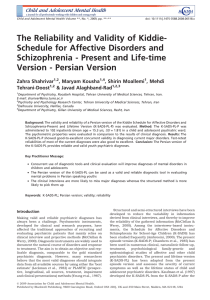
The Reliability and Validity of Kiddie
... diagnosis and symptoms, and does not include a broad assessment of symptom severity (Ambrosini, 2000). The K-SADS-PL has excellent inter-rater reliability and results comparable to semi-structured and fully structured child diagnostic interviews (Kaufman et al., 1997). The test-retest reliability ka ...
... diagnosis and symptoms, and does not include a broad assessment of symptom severity (Ambrosini, 2000). The K-SADS-PL has excellent inter-rater reliability and results comparable to semi-structured and fully structured child diagnostic interviews (Kaufman et al., 1997). The test-retest reliability ka ...
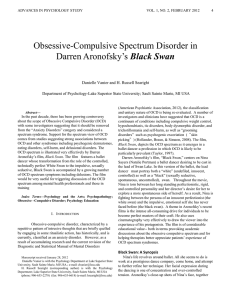
Obsessive-Compulsive Spectrum Disorder in Darren Aronofsky`s
... `The dancers are presented with a surprise audition by Thomas, the director (Vincent Cassel) who is seeking a lead dancer who must be able to transcend between the innocent white swan and the sexually seductive black swan. Initially, Nina’s audition did not go over well because Thomas believed she w ...
... `The dancers are presented with a surprise audition by Thomas, the director (Vincent Cassel) who is seeking a lead dancer who must be able to transcend between the innocent white swan and the sexually seductive black swan. Initially, Nina’s audition did not go over well because Thomas believed she w ...

Diagnosing Using DSM 5 - The media library @ uofthenet.info
... “All drugs that are taken in excess have in common direct activation of the brain reward system…. Individuals with lower levels of self-control, which may reflect impairments of brain inhibitory mechanisms, may be particularly predisposed to develop substance use disorders, suggesting that the roots ...
... “All drugs that are taken in excess have in common direct activation of the brain reward system…. Individuals with lower levels of self-control, which may reflect impairments of brain inhibitory mechanisms, may be particularly predisposed to develop substance use disorders, suggesting that the roots ...
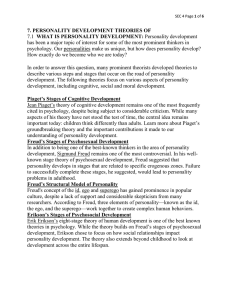
7. PERSONALITY DEVELOPMENT THEORIES OF 7.1 WHAT IS
... In order to answer this question, many prominent theorists developed theories to describe various steps and stages that occur on the road of personality development. The following theories focus on various aspects of personality development, including cognitive, social and moral development. Piaget’ ...
... In order to answer this question, many prominent theorists developed theories to describe various steps and stages that occur on the road of personality development. The following theories focus on various aspects of personality development, including cognitive, social and moral development. Piaget’ ...
National Eating Disorders Awareness Month
... Levine, M. P. & Harrison, K. (2004). The role of mass media in the perpetuation and prevention of negative body image and disordered eating. In J. K. Thompson (Ed.), Handbook of eating disorders & obesity (pp. 695-717). New York: Wiley. Levine, M. P., & Murnen, S. K. (2009). Everybody knows that mas ...
... Levine, M. P. & Harrison, K. (2004). The role of mass media in the perpetuation and prevention of negative body image and disordered eating. In J. K. Thompson (Ed.), Handbook of eating disorders & obesity (pp. 695-717). New York: Wiley. Levine, M. P., & Murnen, S. K. (2009). Everybody knows that mas ...
National Eating Disorder Awareness Week (PPT)
... Levine, M. P. & Harrison, K. (2004). The role of mass media in the perpetuation and prevention of negative body image and disordered eating. In J. K. Thompson (Ed.), Handbook of eating disorders & obesity (pp. 695-717). New York: Wiley. Levine, M. P., & Murnen, S. K. (2009). Everybody knows that mas ...
... Levine, M. P. & Harrison, K. (2004). The role of mass media in the perpetuation and prevention of negative body image and disordered eating. In J. K. Thompson (Ed.), Handbook of eating disorders & obesity (pp. 695-717). New York: Wiley. Levine, M. P., & Murnen, S. K. (2009). Everybody knows that mas ...
National Eating Disorders Awareness Month
... Levine, M. P. & Harrison, K. (2004). The role of mass media in the perpetuation and prevention of negative body image and disordered eating. In J. K. Thompson (Ed.), Handbook of eating disorders & obesity (pp. 695-717). New York: Wiley. Levine, M. P., & Murnen, S. K. (2009). Everybody knows that mas ...
... Levine, M. P. & Harrison, K. (2004). The role of mass media in the perpetuation and prevention of negative body image and disordered eating. In J. K. Thompson (Ed.), Handbook of eating disorders & obesity (pp. 695-717). New York: Wiley. Levine, M. P., & Murnen, S. K. (2009). Everybody knows that mas ...
rajiv gandhi university of health sciences
... DIAGNOSTIC CRITERIA:According to the World Health Organization ICD-10, Avoidant Personality Disorder as –(F.60.6), ANXIOUS (avoidant) PERSONALITY DISORDER, should be characterized by at least four of the following:a) Persistent and pervasive feeling of tension and apprehension. b) Belief that one i ...
... DIAGNOSTIC CRITERIA:According to the World Health Organization ICD-10, Avoidant Personality Disorder as –(F.60.6), ANXIOUS (avoidant) PERSONALITY DISORDER, should be characterized by at least four of the following:a) Persistent and pervasive feeling of tension and apprehension. b) Belief that one i ...
MBBS Psychiatry - Newcastle University Blogging Service
... This has the strongest evidence for a biological aetiology for any of the anxiety disorders. There is a strong link with Gilles de la Tourette syndrome. Neuroimaging studies show abnormality in the basal ganglia, anterior cingulate cortex and orbitofrontal cortex. 33% of those with OCD do not have p ...
... This has the strongest evidence for a biological aetiology for any of the anxiety disorders. There is a strong link with Gilles de la Tourette syndrome. Neuroimaging studies show abnormality in the basal ganglia, anterior cingulate cortex and orbitofrontal cortex. 33% of those with OCD do not have p ...


Introduction to Psychology
... not all patients recognize or accurately describe how they feel therapists and patients who come from different cultural backgrounds may have difficulty agreeing that the problem is depression the symptoms vary from patient to patient: one patient may be slowed down & crying; another will smile & de ...
... not all patients recognize or accurately describe how they feel therapists and patients who come from different cultural backgrounds may have difficulty agreeing that the problem is depression the symptoms vary from patient to patient: one patient may be slowed down & crying; another will smile & de ...