Module 30 Power Point
... disruptive, irrational fears of specific objects or situations • The fear must be both irrational and disruptive. ...
... disruptive, irrational fears of specific objects or situations • The fear must be both irrational and disruptive. ...

Memory
... – A disorder in which a person exhibits two or more personality states, each with its own patterns of thought and behavior – Previously known as “Multiple Personality Disorder” – A person may have anywhere from 2 to 100 different distinct personalities – The transition from one personality to anothe ...
... – A disorder in which a person exhibits two or more personality states, each with its own patterns of thought and behavior – Previously known as “Multiple Personality Disorder” – A person may have anywhere from 2 to 100 different distinct personalities – The transition from one personality to anothe ...
Psychology - HGunnWikiMHS
... without effort. I see myself as being able to accomplish a great deal for my family & others. I feel pleasure, a sense of euphoria or elation. I want it to last forever. I don’t seem to need much sleep. I’ve lost weight and feel healthy, and I like myself. I would like to help people with problems s ...
... without effort. I see myself as being able to accomplish a great deal for my family & others. I feel pleasure, a sense of euphoria or elation. I want it to last forever. I don’t seem to need much sleep. I’ve lost weight and feel healthy, and I like myself. I would like to help people with problems s ...
Module 28
... disruptive, irrational fears of specific objects or situations • The fear must be both irrational and disruptive. ...
... disruptive, irrational fears of specific objects or situations • The fear must be both irrational and disruptive. ...
Blair_Module28
... disruptive, irrational fears of specific objects or situations • The fear must be both irrational and disruptive. ...
... disruptive, irrational fears of specific objects or situations • The fear must be both irrational and disruptive. ...

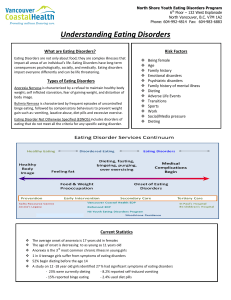
Eating Disorders 1 Eating Disorders in Adolescent Females: Signs
... nature, there is a greater capacity for judgmental behavior. It is important to keep in mind that an anorexic’s world is based on body size. People who are heavier are considered less valuable than those who are thin. It should also be kept in mind that anorexics view themselves as fat, and therefor ...
... nature, there is a greater capacity for judgmental behavior. It is important to keep in mind that an anorexic’s world is based on body size. People who are heavier are considered less valuable than those who are thin. It should also be kept in mind that anorexics view themselves as fat, and therefor ...
Psychology
... disruptive, irrational fears of specific objects or situations • The fear must be both irrational and disruptive. ...
... disruptive, irrational fears of specific objects or situations • The fear must be both irrational and disruptive. ...

Pervasive Developmental Disorders
... – IFSP: family is central focus of service – Services to be provided in “natural environment” ...
... – IFSP: family is central focus of service – Services to be provided in “natural environment” ...
Chapter 12 - Psychological Disorders
... temporarily relieves anxiety, so it is strengthened by negative reinforcement. But such actions do not eliminate the obsessive thoughts, which later return and again elicit the compulsive behaviors, resulting in repetitive, vicious cycle of anxiety. B. Phobias may result when a once-neutral stimulus ...
... temporarily relieves anxiety, so it is strengthened by negative reinforcement. But such actions do not eliminate the obsessive thoughts, which later return and again elicit the compulsive behaviors, resulting in repetitive, vicious cycle of anxiety. B. Phobias may result when a once-neutral stimulus ...
The Psychological Treatment of Obsessive
... practise leaving home after rapidly closing and locking the front door. The individual would also practise imagining being held responsible for harming others or causing a burglary because of these exposure tasks. Refraining from compulsive rituals (response prevention) is a vital component of treat ...
... practise leaving home after rapidly closing and locking the front door. The individual would also practise imagining being held responsible for harming others or causing a burglary because of these exposure tasks. Refraining from compulsive rituals (response prevention) is a vital component of treat ...

Hoarding - National Initiative for the Care of the Elderly
... • May be precipitated by loss or deprivation – Hartl et al, 2005: hoarders reported greater frequency of traumatic events than controls • Having something taken by force • Rough physical handling • Forced to engage in sexual activity ...
... • May be precipitated by loss or deprivation – Hartl et al, 2005: hoarders reported greater frequency of traumatic events than controls • Having something taken by force • Rough physical handling • Forced to engage in sexual activity ...
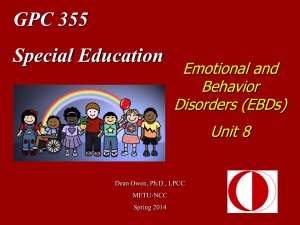
Emotional and Behavior Disorders
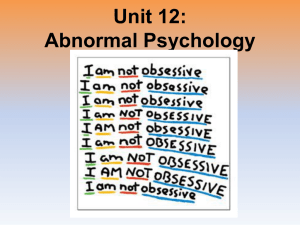
... Obsessive-Compulsive Disorders Symptoms Obsessive-compulsive disorder symptoms usually include both obsessions and compulsions. But it's also possible to have only obsession symptoms or only compulsion symptoms. About one-third of people with OCD also have a disorder that includes sudden, brief, in ...
... Obsessive-Compulsive Disorders Symptoms Obsessive-compulsive disorder symptoms usually include both obsessions and compulsions. But it's also possible to have only obsession symptoms or only compulsion symptoms. About one-third of people with OCD also have a disorder that includes sudden, brief, in ...
Signs and Symptoms of Mental Illness
... 1. Behaviors which are associated with a classification are seen but there is uncertainty regarding the diagnostic category due to the fact that The client presents some symptoms of the category but a complete clinical impression is not clear The client responds to external stimuli with symptoms ...
... 1. Behaviors which are associated with a classification are seen but there is uncertainty regarding the diagnostic category due to the fact that The client presents some symptoms of the category but a complete clinical impression is not clear The client responds to external stimuli with symptoms ...
Anxiety
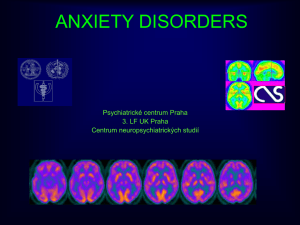
... door closes and I feel trapped. My heart pounds and I sweat bullets. If somebody starts talking to me, I get very stiff and preoccupied. When the airplane starts to ascend, it just reinforces that feeling that I can't get out. I picture myself losing control, freaking out, climbing the walls, but of ...
... door closes and I feel trapped. My heart pounds and I sweat bullets. If somebody starts talking to me, I get very stiff and preoccupied. When the airplane starts to ascend, it just reinforces that feeling that I can't get out. I picture myself losing control, freaking out, climbing the walls, but of ...

Buried in Treasures
... C. The symptoms cause clinically significant distress or impairment in social, occupational, or other important areas of functioning (including maintaining a safe environment for self and others). D. The hoarding symptoms are not due to a general medical condition (e.g., brain injury, cerebrovascula ...
... C. The symptoms cause clinically significant distress or impairment in social, occupational, or other important areas of functioning (including maintaining a safe environment for self and others). D. The hoarding symptoms are not due to a general medical condition (e.g., brain injury, cerebrovascula ...
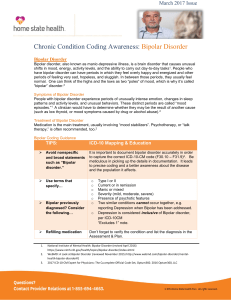
Chronic Condition Coding Awareness: Bipolar
... periods of feeling very sad, hopeless, and sluggish. In between those periods, they usually feel normal. One can think of the highs and the lows as two “poles” of mood, which is why it’s called “bipolar” disorder.2 Symptoms of Bipolar Disorder People with bipolar disorder experience periods of unusu ...
... periods of feeling very sad, hopeless, and sluggish. In between those periods, they usually feel normal. One can think of the highs and the lows as two “poles” of mood, which is why it’s called “bipolar” disorder.2 Symptoms of Bipolar Disorder People with bipolar disorder experience periods of unusu ...

Psychology and You
... classifying abnormal symptoms, which it published in the Diagnostic and Statistical Manual of Mental Disorders, or DSM. – It has been revised five times. ...
... classifying abnormal symptoms, which it published in the Diagnostic and Statistical Manual of Mental Disorders, or DSM. – It has been revised five times. ...
Anxiety disorders:Diagnosis and Treatment
... months he noted depressed mood, anhedonia, irritability, poor concentration, difficulty with sleep, guilt feelings, hopelessness and on the day PTA SI with a plan. He has a recent lapse of one day on heroin and cocaine. What should we ...
... months he noted depressed mood, anhedonia, irritability, poor concentration, difficulty with sleep, guilt feelings, hopelessness and on the day PTA SI with a plan. He has a recent lapse of one day on heroin and cocaine. What should we ...
Huffman PowerPoint Slides - HomePage Server for UT Psychology
... • Psychological treatments emphasize exposure to stimuli that accompany panic – Barlow’s therapy includes a combination of breathing re-training, cognitive interventions, and exposure to the internal cues that elicit panic. Patient learns to relax and reinterpret these sensations as nonthreatening a ...
... • Psychological treatments emphasize exposure to stimuli that accompany panic – Barlow’s therapy includes a combination of breathing re-training, cognitive interventions, and exposure to the internal cues that elicit panic. Patient learns to relax and reinterpret these sensations as nonthreatening a ...

A young lady who eat a lot - Centre on Behavioral Health
... One day, her chance of “recovery” came! (in fact, it should be remission). What was it? ...
... One day, her chance of “recovery” came! (in fact, it should be remission). What was it? ...
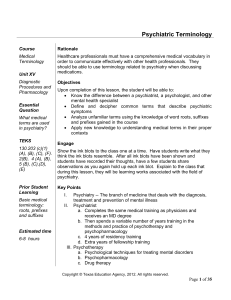
Psychiatric Terminology
... identification with the opposite sex 2. Preference for cross-dressings and cross-gender roles 3. Persistent fantasies about being the other sex XXVI. Somatoform Disorders a. Patient’s mental conflicts are expressed as physical symptoms b. Conversion disorder: loss of physical functioning that sugges ...
... identification with the opposite sex 2. Preference for cross-dressings and cross-gender roles 3. Persistent fantasies about being the other sex XXVI. Somatoform Disorders a. Patient’s mental conflicts are expressed as physical symptoms b. Conversion disorder: loss of physical functioning that sugges ...
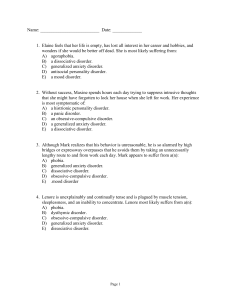
Name: Date: ______ 1. Elaine feels that her life is empty, has lost all
... His deceit often endangers the safety and well-being of those around him, but he is indifferent to any suffering they might experience as a result of his actions. His behavior best illustrates: A) obsessive-compulsive disorder. B) bipolar disorder. C) schizophrenia. D) an antisocial personality diso ...
... His deceit often endangers the safety and well-being of those around him, but he is indifferent to any suffering they might experience as a result of his actions. His behavior best illustrates: A) obsessive-compulsive disorder. B) bipolar disorder. C) schizophrenia. D) an antisocial personality diso ...

Disorders and Treatment
... What is Abnormal? After each of the descriptions below place an “A” (for abnormal) or an “N” (for normal) based on your analysis of each person. 1. Terry has been having terrible nightmares at least three times a week from which he wakes up shaking and sweating. ______ 2. Vanda has visions and hall ...
... What is Abnormal? After each of the descriptions below place an “A” (for abnormal) or an “N” (for normal) based on your analysis of each person. 1. Terry has been having terrible nightmares at least three times a week from which he wakes up shaking and sweating. ______ 2. Vanda has visions and hall ...