
Prevention of an Eating Disorder and Ways to Spread Awareness
... The core diagnostic criteria for anorexia nervosa are conceptually unchanged from DSM-IV with one exception: the requirement for amenorrhea has been eliminated. As in DSM-IV, individuals with this disorder are required by Criterion A to be at a significantly low body weight for their development ...
... The core diagnostic criteria for anorexia nervosa are conceptually unchanged from DSM-IV with one exception: the requirement for amenorrhea has been eliminated. As in DSM-IV, individuals with this disorder are required by Criterion A to be at a significantly low body weight for their development ...
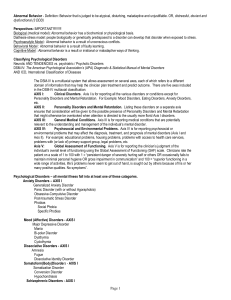
Tripken Abnoraml 16 Review geuide and study guid [Type text
... B. During the period of mood disturbance, three (or more) of the following symptoms have persisted (four if the mood is only irritable) and have been present to a significant degree: 1. inflated self-esteem or grandiosity 2. decreased need for sleep (e.g., feels rested after only 3 hours of sleep) 3 ...
... B. During the period of mood disturbance, three (or more) of the following symptoms have persisted (four if the mood is only irritable) and have been present to a significant degree: 1. inflated self-esteem or grandiosity 2. decreased need for sleep (e.g., feels rested after only 3 hours of sleep) 3 ...
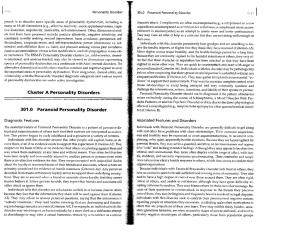
Cluster A Personality Disorders 301.0 Paranoid Personality Disorder
... Paranoid Personality Disorder must be distinguished from Personality Change Due to a General Medical Condition, in which the traits emerge due to the direct effects of a general medical condition on the central nervous system. It must also be distinguished from symptoms that may develop in associati ...
... Paranoid Personality Disorder must be distinguished from Personality Change Due to a General Medical Condition, in which the traits emerge due to the direct effects of a general medical condition on the central nervous system. It must also be distinguished from symptoms that may develop in associati ...
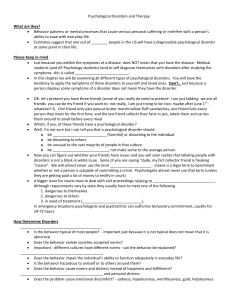
Psychological Disorders and Therapy What are they? • Behavior
... can hurt us, animals, falling, etc. while things like flowers are almost never feared. • One attack ‐ fear of another attack leads to more ‐ vicious circle ...
... can hurt us, animals, falling, etc. while things like flowers are almost never feared. • One attack ‐ fear of another attack leads to more ‐ vicious circle ...

Chapter Five - Anxiety and the Anxiety Disorders
... • The expression of anxiety is culturally relative Nervios: Generalized anxiety symptoms in Latino populations (often with somatic features) Ataque de nervios: Panic symptoms in Latino populations (often with behavioral features) Shenjing shuairuo: Mixed anxiety, mood, and physical symptoms in ...
... • The expression of anxiety is culturally relative Nervios: Generalized anxiety symptoms in Latino populations (often with somatic features) Ataque de nervios: Panic symptoms in Latino populations (often with behavioral features) Shenjing shuairuo: Mixed anxiety, mood, and physical symptoms in ...
abnormal dissociative and schizophrenia
... • A viral infection during the middle of pregnancy may increase schizophrenia risk. ...
... • A viral infection during the middle of pregnancy may increase schizophrenia risk. ...
Anxiety Disorders
... 1. Behaviors which are associated with a classification are seen but there is uncertainty regarding the diagnostic category due to the fact that The client presents some symptoms of the category but a complete clinical impression is not clear The client responds to external stimuli with symptoms ...
... 1. Behaviors which are associated with a classification are seen but there is uncertainty regarding the diagnostic category due to the fact that The client presents some symptoms of the category but a complete clinical impression is not clear The client responds to external stimuli with symptoms ...
axis i - School-Based Health Alliance
... required to repeat grade, frequent school suspensions, and serious self doubts and low self-esteem). ...
... required to repeat grade, frequent school suspensions, and serious self doubts and low self-esteem). ...
Attention-Deficit Hyperactivity Disorder
... (a) often fails to give close attention to details or makes careless mistakes in schoolwork, work or other activities (b) often has difficulty sustaining attention in tasks or play activity (c) often does not seem to listen when spoken to directly (d) often does not follow through on instructions an ...
... (a) often fails to give close attention to details or makes careless mistakes in schoolwork, work or other activities (b) often has difficulty sustaining attention in tasks or play activity (c) often does not seem to listen when spoken to directly (d) often does not follow through on instructions an ...
Assessment Evaluation Sample Paper
... This paper evaluates the Eating Disorder Inventory-3 (EDI-3) for its use as an assessment tool. It includes information about the development, publishing, content, and administration of the assessment. The scoring of the assessment, the reliability, and the validity information will be discussed. Fi ...
... This paper evaluates the Eating Disorder Inventory-3 (EDI-3) for its use as an assessment tool. It includes information about the development, publishing, content, and administration of the assessment. The scoring of the assessment, the reliability, and the validity information will be discussed. Fi ...

Psychological disorders
... Phobia: an intense, irrational fear and avoidance of a specific object or situation. Here anxiety is focused so intensely on an object or situation that the individual is acutely uncomfortable around it and will often go to great length to avoid it. Phobic disorders differ from generalized anxiety d ...
... Phobia: an intense, irrational fear and avoidance of a specific object or situation. Here anxiety is focused so intensely on an object or situation that the individual is acutely uncomfortable around it and will often go to great length to avoid it. Phobic disorders differ from generalized anxiety d ...
( “Autistic Spectrum”) Disorders
... Seizure disorders, congenital infection, metabolic abnl (PKU) Neurocutaneous disorders (TS, NF) Genetic Disorders (Fra X, Angelman’s, Smith-Lemli Opitz ) No proven ass’n with vaccines (MMR, thimerasol) ...
... Seizure disorders, congenital infection, metabolic abnl (PKU) Neurocutaneous disorders (TS, NF) Genetic Disorders (Fra X, Angelman’s, Smith-Lemli Opitz ) No proven ass’n with vaccines (MMR, thimerasol) ...

Suicide Attempts in Anorexia Nervosa C M. B , P
... studies on suicide and suicide attempts in persons with eating disorders, and reported that suicide attempts occur in 3% to 20% of patients with AN, whereas the standardized mortality ratio for suicide ranges from 1.0 to 5.3. In an earlier report (4), this group assessed suicidality in an 8-year pro ...
... studies on suicide and suicide attempts in persons with eating disorders, and reported that suicide attempts occur in 3% to 20% of patients with AN, whereas the standardized mortality ratio for suicide ranges from 1.0 to 5.3. In an earlier report (4), this group assessed suicidality in an 8-year pro ...
Critical Overview of DSM-5 – Michael First, MD
... • Problem is lack of diagnostic specificity on an individual patient level – Tests able to identify clear differences between groups but not between individuals because of within group variability (i.e., some non-affected people will have abnormal value on test that is higher than “affected” individ ...
... • Problem is lack of diagnostic specificity on an individual patient level – Tests able to identify clear differences between groups but not between individuals because of within group variability (i.e., some non-affected people will have abnormal value on test that is higher than “affected” individ ...
Psychological disorders
... • Stressful events related to work, marriage and close relationships often precede depression • With each new generation, depression is striking earlier and affecting more people ...
... • Stressful events related to work, marriage and close relationships often precede depression • With each new generation, depression is striking earlier and affecting more people ...
Are Inflated Responsibility Beliefs Specific to OCD?
... non-clinical samples, and this was the rationale for which both studies on clinical and non-clinical individuals were included in the current meta-analysis. With regard to the clinical samples, studies were included if they were conducted on patients who had a primary diagnosis of OCD, any primary a ...
... non-clinical samples, and this was the rationale for which both studies on clinical and non-clinical individuals were included in the current meta-analysis. With regard to the clinical samples, studies were included if they were conducted on patients who had a primary diagnosis of OCD, any primary a ...
A critical evaluation of obsessive–compulsive disorder
... 1. The empirical status of obsessive–compulsive disorder subtypes Obsessive– compulsive disorder (OCD) is a heterogeneous condition composed of multiple symptoms. Individuals seeking treatment have clinical presentations associated with many different types of obsessional concerns and compulsive beh ...
... 1. The empirical status of obsessive–compulsive disorder subtypes Obsessive– compulsive disorder (OCD) is a heterogeneous condition composed of multiple symptoms. Individuals seeking treatment have clinical presentations associated with many different types of obsessional concerns and compulsive beh ...
the course and clinical features of obsessive compulsive disorder
... DEVELOPMENTAL PSYCHOPATHOLOGY ...
... DEVELOPMENTAL PSYCHOPATHOLOGY ...

Pharmacy and Eating Disorders - National Eating Disorders
... antibiotics and some antihistamines). Patients with AN are at an increased risk of cardiac complications, and medicines that may compromise cardiac functioning should be avoided. Because of the increased risk of toxicity in individuals with eating disorders, medications should initially be provided ...
... antibiotics and some antihistamines). Patients with AN are at an increased risk of cardiac complications, and medicines that may compromise cardiac functioning should be avoided. Because of the increased risk of toxicity in individuals with eating disorders, medications should initially be provided ...
ch._9-1
... affected by some form of mental disorder. Fewer than 8 million people with mental disorders actually A mental disorder is seek treatment. an illness of the mind that can affect the thoughts, Of the 20 percent of children and adolescents who suffer from feelings, andthe behaviors of mental health pro ...
... affected by some form of mental disorder. Fewer than 8 million people with mental disorders actually A mental disorder is seek treatment. an illness of the mind that can affect the thoughts, Of the 20 percent of children and adolescents who suffer from feelings, andthe behaviors of mental health pro ...
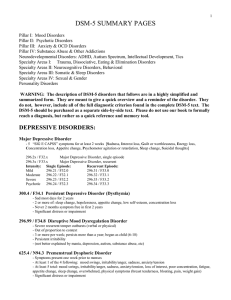
AFFECTIVE DISORDERS: (DSM-IV) - 1
... - Recurrent subjective detachment (as if an “outside observer” or in a dream) - Intact reality testing (not psychotic) - Marked distress or impairment ...
... - Recurrent subjective detachment (as if an “outside observer” or in a dream) - Intact reality testing (not psychotic) - Marked distress or impairment ...
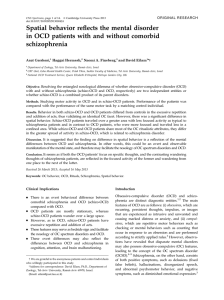
Spatial behavior reflects the mental disorder in OCD patients with
... Furthermore, schizo-OCD patients are considered more impaired14 and have greater neurocognitive deficits compared with either patients with OCD or schizophrenia alone.10 A synthesis of both comorbidity and spectrum notions has also been suggested, presenting a continuum of comorbidity between OCD an ...
... Furthermore, schizo-OCD patients are considered more impaired14 and have greater neurocognitive deficits compared with either patients with OCD or schizophrenia alone.10 A synthesis of both comorbidity and spectrum notions has also been suggested, presenting a continuum of comorbidity between OCD an ...
Summary of Somatoform and Dissociative
... Most remain single, and many seek out plastic surgeons Usually runs a lifelong chronic course ...
... Most remain single, and many seek out plastic surgeons Usually runs a lifelong chronic course ...

Lighten your Load. Lose the OCD!
... similar, and some of the symptoms may look the same on the outside. But these disorders are very different. People with OCPD are generally preoccupied with orderliness, perfectionism, and control in virtually every part of their lives. Someone who wants to keep his dorm room and car spotlessly clean ...
... similar, and some of the symptoms may look the same on the outside. But these disorders are very different. People with OCPD are generally preoccupied with orderliness, perfectionism, and control in virtually every part of their lives. Someone who wants to keep his dorm room and car spotlessly clean ...