CE-1421 / Dual Diagnosis and Co
... b. to battle symptoms of excitation or mania, beta blockers commonly used for prevention of migraine headache. c. to treat symptoms of psychosis. d. to combat symptoms of depression. 8. Pharmacological treatments for impulse disorders include neuroleptics: a. to stabilize mood or otherwise battle sy ...
... b. to battle symptoms of excitation or mania, beta blockers commonly used for prevention of migraine headache. c. to treat symptoms of psychosis. d. to combat symptoms of depression. 8. Pharmacological treatments for impulse disorders include neuroleptics: a. to stabilize mood or otherwise battle sy ...

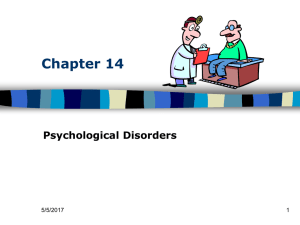
Psychological Disorders
... – Unit subsections hyperlinks: Immediately after the unit title slide, a page (slide #3) can be found listing all of the unit’s subsections. While in slide show mode, clicking on any of these hyperlinks will take the user directly to the beginning of that subsection. This allows teachers quick acces ...
... – Unit subsections hyperlinks: Immediately after the unit title slide, a page (slide #3) can be found listing all of the unit’s subsections. While in slide show mode, clicking on any of these hyperlinks will take the user directly to the beginning of that subsection. This allows teachers quick acces ...
Assessment and Treatment of Anxiety Disorders in Children and
... adolescents and typically 6 months or more in adults. C. Causes clinically significant distress or impairment in social, academic, occupational, or other important areas of functioning. D. Not better explained by another mental disorder, such as refusing to leave home because of excessive resist ...
... adolescents and typically 6 months or more in adults. C. Causes clinically significant distress or impairment in social, academic, occupational, or other important areas of functioning. D. Not better explained by another mental disorder, such as refusing to leave home because of excessive resist ...
Dysfunctional_Behavior_web_notes_2
... – Disorder in which an individual experiences one or more manic episodes accompanied by periods of depression – Divided into two categories: Bipolar I (LP 0.4-1.6%) and Bipolar II (LP .5%) • Bipolar I is marked by a higher level of mania – Individuals alternate btw. depression and mania • Symptoms o ...
... – Disorder in which an individual experiences one or more manic episodes accompanied by periods of depression – Divided into two categories: Bipolar I (LP 0.4-1.6%) and Bipolar II (LP .5%) • Bipolar I is marked by a higher level of mania – Individuals alternate btw. depression and mania • Symptoms o ...
Anxiety Disorders
... B. The situations are avoided (e.g., travel is restricted) or else are endured with marked distress or anxiety about having a Panic Attack or panic-like symptoms, or require the presence of a companion C. The anxiety or phobic avoidance is not better accounted for by another mental disorder, such as ...
... B. The situations are avoided (e.g., travel is restricted) or else are endured with marked distress or anxiety about having a Panic Attack or panic-like symptoms, or require the presence of a companion C. The anxiety or phobic avoidance is not better accounted for by another mental disorder, such as ...
Eating Disorders and Disordered Eating in Persons with Type 1
... from food restrictions and rigid rules around eating --“Learned perfectionism” around food and ...
... from food restrictions and rigid rules around eating --“Learned perfectionism” around food and ...
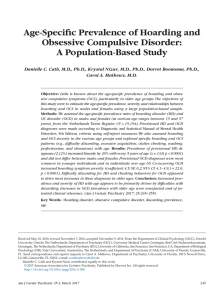
Age-Specific Prevalence of Hoarding and Obsessive Compulsive
... of and persistent difficulty in parting with possessions, leading to excessive clutter, distress, and functional impairment. Pathologic hoarding occurs both independently and in conjunction with many neuropsychiatric disorders, including dementia, schizophrenia, obsessive compulsive disorder (OCD), ...
... of and persistent difficulty in parting with possessions, leading to excessive clutter, distress, and functional impairment. Pathologic hoarding occurs both independently and in conjunction with many neuropsychiatric disorders, including dementia, schizophrenia, obsessive compulsive disorder (OCD), ...
Anxiety Disorders by Dr Sarma
... that are experienced during the disturbance, as intrusive and inappropriate, and cause marked anxiety or distress. The thoughts, impulses, or images are not simply excessive worries about real life problems. The person attempts to ignore or suppress such thoughts impulses or to neutralize them w ...
... that are experienced during the disturbance, as intrusive and inappropriate, and cause marked anxiety or distress. The thoughts, impulses, or images are not simply excessive worries about real life problems. The person attempts to ignore or suppress such thoughts impulses or to neutralize them w ...

Understanding Psychological Disorders
... two fingers apart… I touched my bedroom wall before leaving the house… I had constant anxiety… I thought I might be nuts. ...
... two fingers apart… I touched my bedroom wall before leaving the house… I had constant anxiety… I thought I might be nuts. ...

Mood Disorders - Solon City Schools
... • Stressful events related to work, marriage and close relationships often precede depression • With each new generation, depression is striking earlier and affecting more people ...
... • Stressful events related to work, marriage and close relationships often precede depression • With each new generation, depression is striking earlier and affecting more people ...
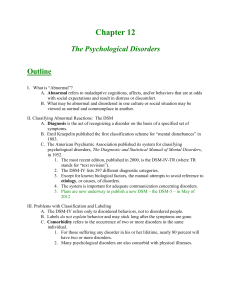
Chapter 12
... A. Schizophrenia involves a distortion of reality and a retreat from other people, accompanied by disturbances in affect, behavior, and cognition. B. Schizophrenia can be found around the world at the same rate: about 1 percent C. Recent research indicates that schizophrenia has three dimensions of ...
... A. Schizophrenia involves a distortion of reality and a retreat from other people, accompanied by disturbances in affect, behavior, and cognition. B. Schizophrenia can be found around the world at the same rate: about 1 percent C. Recent research indicates that schizophrenia has three dimensions of ...
Borderline Personality Disorder: Podcast Script #1 A personality
... A personality disorder can best be described as behavior that is very different from what is considered “normal” for one’s culture (American Psychiatric Association [DSM-IV-TR], 2000). Personality disorders are stable over time, usually cause great distress or impairment to those affected, and typi ...
... A personality disorder can best be described as behavior that is very different from what is considered “normal” for one’s culture (American Psychiatric Association [DSM-IV-TR], 2000). Personality disorders are stable over time, usually cause great distress or impairment to those affected, and typi ...

Comer, Abnormal Psychology, 5th edition
... symptoms are often found in cases of acute and posttraumatic stress disorders • When such symptoms occur as part of a stress disorder, they do not necessarily indicate a dissociative disorder (a pattern in which dissociative symptoms dominate) • However, some research suggests that people with one o ...
... symptoms are often found in cases of acute and posttraumatic stress disorders • When such symptoms occur as part of a stress disorder, they do not necessarily indicate a dissociative disorder (a pattern in which dissociative symptoms dominate) • However, some research suggests that people with one o ...
Chapter_15_answers
... be taken into account when deciding whether they meet criteria for any mental disorder. 4) Answer: (c). Mental disorders are surprisingly common. A World Health Organization study examined the prevalence of disorders in people visiting primary care settings in 14 countries. The study revealed that 2 ...
... be taken into account when deciding whether they meet criteria for any mental disorder. 4) Answer: (c). Mental disorders are surprisingly common. A World Health Organization study examined the prevalence of disorders in people visiting primary care settings in 14 countries. The study revealed that 2 ...
Eating Disorders in the School Context: What
... Parents cause eating disorders by being too controlling over their child. F To effectively help a youth with an eating disorder, the youth must first have intensive individual psychotherapy. F Eating disorder treatment for youth best happens at a slow and gentle pace. F Teaching youth about eating d ...
... Parents cause eating disorders by being too controlling over their child. F To effectively help a youth with an eating disorder, the youth must first have intensive individual psychotherapy. F Eating disorder treatment for youth best happens at a slow and gentle pace. F Teaching youth about eating d ...
psychological disorders
... • Once admitted they immediately acted “normal” • How long before they were discharged? Statistic: ...
... • Once admitted they immediately acted “normal” • How long before they were discharged? Statistic: ...
Eating Disorders in Obsessive-Compulsive Disorder
... to 26%, and point prevalence was between 0% and 3%. Regarding bulimia in patients with OCD, the lifetime prevalence rate ranged from 3% to 9.6%, while the point frequency was from 0% to 3.5% (see Appendix for an overview over these studies.). There seems to be some difference in prevalence of eating ...
... to 26%, and point prevalence was between 0% and 3%. Regarding bulimia in patients with OCD, the lifetime prevalence rate ranged from 3% to 9.6%, while the point frequency was from 0% to 3.5% (see Appendix for an overview over these studies.). There seems to be some difference in prevalence of eating ...
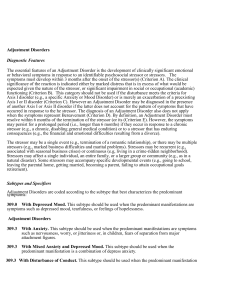
Adjustment Disorders
... occur in the stressor. For example, an individual may develop Adjustment Disorder with Depressed Mood after losing a job and at the same time have a diagnosis of Obsessive-Compulsive Disorder. Because Personality Disorders are frequently exacerbated by stress, the additional of Adjustment Disorder i ...
... occur in the stressor. For example, an individual may develop Adjustment Disorder with Depressed Mood after losing a job and at the same time have a diagnosis of Obsessive-Compulsive Disorder. Because Personality Disorders are frequently exacerbated by stress, the additional of Adjustment Disorder i ...
Introduction To DSM-5- Part II
... disorders due to a general medical condition and substance-induced anxiety disorder – Reflect recognition that substances, medication and medical conditions can present with symptoms similar to primary OC and related disorders such as pediatric acute-onset neuropsychiatric syndrome (PANS) * Codes ar ...
... disorders due to a general medical condition and substance-induced anxiety disorder – Reflect recognition that substances, medication and medical conditions can present with symptoms similar to primary OC and related disorders such as pediatric acute-onset neuropsychiatric syndrome (PANS) * Codes ar ...

Personality Disorders - American Academy of Family Physicians
... impairment in social, occupational, or other important areas of functioning; is stable and ...
... impairment in social, occupational, or other important areas of functioning; is stable and ...

Modern History Paper – Dissociative Identity
... n.d.) DID is most likely caused by severe trauma during early childhood, such as repetitive physical, sexual, or emotional abuse. It is thought to be a coping mechanism, where the person dissociates himself or herself from the situation that is too traumatic, painful, or violent for their conscious ...
... n.d.) DID is most likely caused by severe trauma during early childhood, such as repetitive physical, sexual, or emotional abuse. It is thought to be a coping mechanism, where the person dissociates himself or herself from the situation that is too traumatic, painful, or violent for their conscious ...

EXPLORING PSYCHOLOGY (7th Edition in
... bedroom wall before leaving the house … I had constant anxiety … I thought I might be nuts. Marc, diagnosed with obsessive-compulsive disorder (from Summers, 1996) ...
... bedroom wall before leaving the house … I had constant anxiety … I thought I might be nuts. Marc, diagnosed with obsessive-compulsive disorder (from Summers, 1996) ...

myers ap – unit 12
... – Unit subsections hyperlinks: Immediately after the unit title slide, a page (slide #3) can be found listing all of the unit’s subsections. While in slide show mode, clicking on any of these hyperlinks will take the user directly to the beginning of that subsection. This allows teachers quick acces ...
... – Unit subsections hyperlinks: Immediately after the unit title slide, a page (slide #3) can be found listing all of the unit’s subsections. While in slide show mode, clicking on any of these hyperlinks will take the user directly to the beginning of that subsection. This allows teachers quick acces ...

Mood Disorders - Psychology for you and me
... D. No major depressive episode has been present during the first 2 years of the disturbance (1 year for children and adolescent_ I.e. the disturbance is not better accounted for by chronic major depressive disorder, in partial remission. Note: there may have been previous major depressive episode pr ...
... D. No major depressive episode has been present during the first 2 years of the disturbance (1 year for children and adolescent_ I.e. the disturbance is not better accounted for by chronic major depressive disorder, in partial remission. Note: there may have been previous major depressive episode pr ...
Ch 14 Disorders
... Clinical Syndromes: Anxiety Disorders • anxiety disorders are a class of disorders marked by feelings of excessive apprehension and anxiety • Generalized anxiety disorder – “marked by a chronic, high level of anxiety that is not tied to any specific threat…” ...
... Clinical Syndromes: Anxiety Disorders • anxiety disorders are a class of disorders marked by feelings of excessive apprehension and anxiety • Generalized anxiety disorder – “marked by a chronic, high level of anxiety that is not tied to any specific threat…” ...