PREDISPOSED BORDERLINE PERSONALITY DISORDER (PreBPD)
... discouraged from diagnosing anyone before the age of 18, due to adolescence and a stilldeveloping personality. There are some instances when BPD can be evident and diagnosed before the age of 18. The (DSM-IV, 2007) : "To diagnose a personality disorder in an individual under 18 years, the features m ...
... discouraged from diagnosing anyone before the age of 18, due to adolescence and a stilldeveloping personality. There are some instances when BPD can be evident and diagnosed before the age of 18. The (DSM-IV, 2007) : "To diagnose a personality disorder in an individual under 18 years, the features m ...
DSM – 5 Substance-Related and Addictive Disorders
... • The symptoms contained in the respective diagnostic criteria sets do not constitute comprehensive definitions of underlying disorders, which encompass cognitive, emotional, behavioral, and physiological processes that are far more complex than can be described in these brief summaries. Rather, th ...
... • The symptoms contained in the respective diagnostic criteria sets do not constitute comprehensive definitions of underlying disorders, which encompass cognitive, emotional, behavioral, and physiological processes that are far more complex than can be described in these brief summaries. Rather, th ...
bipolar disorder - mrsashleymhelmsclass
... The prognosis for bipolar disorder differs amongst people considering there are three different types of bipolar disorder which are bipolar I, bipolar II, and cyclothymia. In some cases it can be very severe and longterm or mild with less episodes occurring. The depressive states and manic states di ...
... The prognosis for bipolar disorder differs amongst people considering there are three different types of bipolar disorder which are bipolar I, bipolar II, and cyclothymia. In some cases it can be very severe and longterm or mild with less episodes occurring. The depressive states and manic states di ...

Richard J. Gerrig, Ph.D. and Philip Zimbardo, Ph.D.
... How can we pinpoint interactions of nature and nurture? Can you answer the above question and provide an example from your own life? ...
... How can we pinpoint interactions of nature and nurture? Can you answer the above question and provide an example from your own life? ...
Eating Disorders 1. Anorexia Nervosa
... 2. Bulimia Nervosa Introduction Like anorexia nervosa, bulimia nervosa is also an eating disorder, but with a different pattern of disordered eating. Unlike people with anorexia who are seen as “starving” themselves, those with bulimia regularly engage in binge eating episodes during which they con ...
... 2. Bulimia Nervosa Introduction Like anorexia nervosa, bulimia nervosa is also an eating disorder, but with a different pattern of disordered eating. Unlike people with anorexia who are seen as “starving” themselves, those with bulimia regularly engage in binge eating episodes during which they con ...
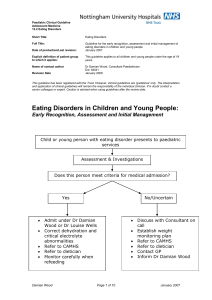
Eating Disorders Clinical Guideline
... All young people admitted with an eating disorder should have routine phosphate supplementation during refeeding. Prevention of the refeeding syndrome Gradual introduction of nutrition (discuss with dietician) Correction of dehydration Monitoring of electrolytes including Routine phosphate s ...
... All young people admitted with an eating disorder should have routine phosphate supplementation during refeeding. Prevention of the refeeding syndrome Gradual introduction of nutrition (discuss with dietician) Correction of dehydration Monitoring of electrolytes including Routine phosphate s ...
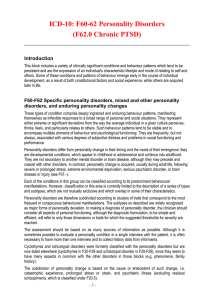
ICD-10: F60-62 Personality Disorders (F62.0
... thinks, feels, and particularly relates to others. Such behaviour patterns tend to be stable and to encompass multiple domains of behaviour and psychological functioning. They are frequently, but not always, associated with various degrees of subjective distress and problems in social functioning an ...
... thinks, feels, and particularly relates to others. Such behaviour patterns tend to be stable and to encompass multiple domains of behaviour and psychological functioning. They are frequently, but not always, associated with various degrees of subjective distress and problems in social functioning an ...

Anxiety Disorder lecture 1
... Posttraumatic Stress Disorder D. Negative alterations in cognitions and mood associated with the traumatic event(s), beginning or worsening after the traumatic event(s) occurred, as evidenced by two (or more) of the following: 1. Inability to remember an important aspect of the traumatic event(s) ( ...
... Posttraumatic Stress Disorder D. Negative alterations in cognitions and mood associated with the traumatic event(s), beginning or worsening after the traumatic event(s) occurred, as evidenced by two (or more) of the following: 1. Inability to remember an important aspect of the traumatic event(s) ( ...

anxiety - Science Mission
... Anxiety is highly treatable (up to 90% of cases), but only one-third of those who suffer from it receive treatment ...
... Anxiety is highly treatable (up to 90% of cases), but only one-third of those who suffer from it receive treatment ...

ANXIETY
... Anxiety is highly treatable (up to 90% of cases), but only one-third of those who suffer from it receive treatment ...
... Anxiety is highly treatable (up to 90% of cases), but only one-third of those who suffer from it receive treatment ...
Cognitive-Behavioral Therapy for Children and Adolescents with
... True OCD must also be differentiated from normal developmental rituals and fears that are commonplace in childhood. The child’s lack of ability to introspect or give specific examples of symptoms or triggers also limits the therapist’s ability to design effective treatment. Diagnosis is also confounde ...
... True OCD must also be differentiated from normal developmental rituals and fears that are commonplace in childhood. The child’s lack of ability to introspect or give specific examples of symptoms or triggers also limits the therapist’s ability to design effective treatment. Diagnosis is also confounde ...
Chapter Overview
... characterized by a focus on one or more physical symptoms accompanied by marked anxiety and distress focused on the symptom that is disproportionate to the nature or severity of the physical symptoms. This condition may dominate the individual’s life and interpersonal relationships. Illness anxiety ...
... characterized by a focus on one or more physical symptoms accompanied by marked anxiety and distress focused on the symptom that is disproportionate to the nature or severity of the physical symptoms. This condition may dominate the individual’s life and interpersonal relationships. Illness anxiety ...

Document
... Global Assessment of Functioning Scale (GAF) For those 18 years of age and older 91-100 Superior functioning in a wide rage of activities, life's problems never seem to get out of hand, is sought out by others because of his or her many qualities. No symptoms. 90-81 Absent or minimal symptoms, good ...
... Global Assessment of Functioning Scale (GAF) For those 18 years of age and older 91-100 Superior functioning in a wide rage of activities, life's problems never seem to get out of hand, is sought out by others because of his or her many qualities. No symptoms. 90-81 Absent or minimal symptoms, good ...
dsm5 - Index of
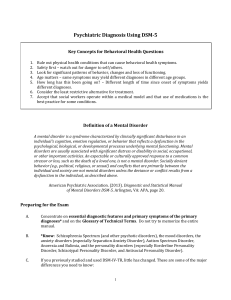
... p. Post-Traumatic Stress Disorder (PTSD) has a criterion around how someone experience a “traumatic event” and allows a lower threshold for children six and under. There are four symptom clusters: arousal, avoidance, Persistent negative changes in cognitions and mood, and re-experiencing. To learn m ...
... p. Post-Traumatic Stress Disorder (PTSD) has a criterion around how someone experience a “traumatic event” and allows a lower threshold for children six and under. There are four symptom clusters: arousal, avoidance, Persistent negative changes in cognitions and mood, and re-experiencing. To learn m ...
Personality Disorder? - Yorkshire and the Humber Deanery
... The impairments in personality functioning and the individual’s personality trait expression are relatively stable across time and consistent across situations The impairments in personality functioning and the individual’s personality trait expressions are not better understood as normative for the ...
... The impairments in personality functioning and the individual’s personality trait expression are relatively stable across time and consistent across situations The impairments in personality functioning and the individual’s personality trait expressions are not better understood as normative for the ...
Anxiety Disorders 2010
... 35% of 1st degree relatives of OCD also have OCD - Neuroimaging studies - show increased metabolism of frontal lobes, caudate and cingulum - Behavioural, psychosocial factors involved ...
... 35% of 1st degree relatives of OCD also have OCD - Neuroimaging studies - show increased metabolism of frontal lobes, caudate and cingulum - Behavioural, psychosocial factors involved ...
personality disorders - People Server at UNCW
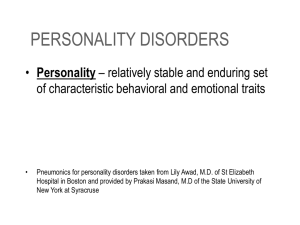
... psychological disorders. Having a personality disorder can negatively affect one's work, one's family, and one's social life. • During times of increased stress or external pressures (work, family, a new relationship, etc.), the symptoms of the personality disorder will gain strength and begin to se ...
... psychological disorders. Having a personality disorder can negatively affect one's work, one's family, and one's social life. • During times of increased stress or external pressures (work, family, a new relationship, etc.), the symptoms of the personality disorder will gain strength and begin to se ...
dsm 5 major changes from dsm iv - Stanford Geriatric Education
... While some level of disturbance of awareness and attention can be observed in all Neurocognitive Disorders, particularly in the more severe form of Major Neurocognitive Disorder, these disturbances are not prominent in Major or Minor Neurocognitive Disorder (the relative absence of this disturba ...
... While some level of disturbance of awareness and attention can be observed in all Neurocognitive Disorders, particularly in the more severe form of Major Neurocognitive Disorder, these disturbances are not prominent in Major or Minor Neurocognitive Disorder (the relative absence of this disturba ...
Beyond anorexia and bulimia nervosa: what`s “new” in eating
... populations will probably shed further light on the true psychopathology of this syndrome. At present, orthorexia would most appropriately be categorised, within DSM-5 options, as “avoidant/restrictive food intake disorder” (ARFID), although it has been suggested that it may represent a distinct sub ...
... populations will probably shed further light on the true psychopathology of this syndrome. At present, orthorexia would most appropriately be categorised, within DSM-5 options, as “avoidant/restrictive food intake disorder” (ARFID), although it has been suggested that it may represent a distinct sub ...
Nonspecific eating disorders – a subjective review
... sleep-related eating disorder. Some studies suggest that NES is caused by circadian delay of food intake with normal circadian sleep onset [25]. These eating habits may also be the effects of poor behavioural control. As there is an increased activity of serotoninergic transporter in mesencephalon, ...
... sleep-related eating disorder. Some studies suggest that NES is caused by circadian delay of food intake with normal circadian sleep onset [25]. These eating habits may also be the effects of poor behavioural control. As there is an increased activity of serotoninergic transporter in mesencephalon, ...
DSM 5: A Primer - National Association of Social Workers
... 1) deficits in social communication and social interaction and 2) restricted repetitive behaviors, interests, and activities (RRBs). Because both components are required for diagnosis of ASD, social communication disorder is diagnosed if no RRBs are present. ...
... 1) deficits in social communication and social interaction and 2) restricted repetitive behaviors, interests, and activities (RRBs). Because both components are required for diagnosis of ASD, social communication disorder is diagnosed if no RRBs are present. ...
DSM * 5 and Trauma Related Diagnosis
... Trauma- and StressorRelated Disorders Posttraumatic Stress Disorder Acute Stress Disorder Adjustment Disorders Reactive Attachment Disorder Disinhibited Social Engagement Disorder Other Specified Trauma- and Stressor-Related Disorder • Unspecified Trauma- and Stressor-Related Disorder ...
... Trauma- and StressorRelated Disorders Posttraumatic Stress Disorder Acute Stress Disorder Adjustment Disorders Reactive Attachment Disorder Disinhibited Social Engagement Disorder Other Specified Trauma- and Stressor-Related Disorder • Unspecified Trauma- and Stressor-Related Disorder ...
Comorbidity Between Attention Deficit/Hyperactivity Disorder and
... co-occurrence rates, (2) outline methodological caveats that may have contributed to the variability seen across studies, (3) evaluate the theoretical and etiological accounts for ADHD-OCD comorbidity in light of fundamental neurobiological and clinical differences between the two disorders, (4) exa ...
... co-occurrence rates, (2) outline methodological caveats that may have contributed to the variability seen across studies, (3) evaluate the theoretical and etiological accounts for ADHD-OCD comorbidity in light of fundamental neurobiological and clinical differences between the two disorders, (4) exa ...
Comer, Abnormal Psychology, 8th edition
... Mutually amnesic relationships – subpersonalities have no awareness of one another Mutually cognizant patterns – each subpersonality is well aware of the rest One-way amnesic relationships – most common pattern; some personalities are aware of others, but the awareness is not mutual ...
... Mutually amnesic relationships – subpersonalities have no awareness of one another Mutually cognizant patterns – each subpersonality is well aware of the rest One-way amnesic relationships – most common pattern; some personalities are aware of others, but the awareness is not mutual ...
personality disorders
... personality disorders have high rates of suicide attempts, aggressive behavior, drug-seeking behavior, promiscuity, or involvement in dangerous behaviors such as exotic dancing, drug-dealing, etc. Structural and functional brain imaging studies on persons with borderline personality disorder show re ...
... personality disorders have high rates of suicide attempts, aggressive behavior, drug-seeking behavior, promiscuity, or involvement in dangerous behaviors such as exotic dancing, drug-dealing, etc. Structural and functional brain imaging studies on persons with borderline personality disorder show re ...