Overview of DSM-V
... Social (Pragmatic) Communication Disorder • There are no repetitive patterns or restricted interests (i.e. criteria for ASD would not be met). • Language impairment is a common associated feature as is ADHD, behavior problems and specific learning disorders • Symptoms present in early childhood yet ...
... Social (Pragmatic) Communication Disorder • There are no repetitive patterns or restricted interests (i.e. criteria for ASD would not be met). • Language impairment is a common associated feature as is ADHD, behavior problems and specific learning disorders • Symptoms present in early childhood yet ...

Abnormal Psychology - Complementary course of BA Sociology/ BA Philosophy - III semester - CUCBCSS 2014 Admn onwards
... Generalized anxiety disorder (GAD) is a common, chronic disorder characterized by long-lasting anxiety that is not focused on any one object or situation. Those suffering from generalized anxiety disorder experience non-specific persistent fear and worry, and become overly concerned with everyday ma ...
... Generalized anxiety disorder (GAD) is a common, chronic disorder characterized by long-lasting anxiety that is not focused on any one object or situation. Those suffering from generalized anxiety disorder experience non-specific persistent fear and worry, and become overly concerned with everyday ma ...
anxiety disorders in the dsm-5
... an individual is exposed to the situation or event (it is not Agoraphobia if the response occurs only some of the time). Avoidance of the event or situation must also be present and can include cognitive or behavioral aspects (APA, 2013). • Acute stress disorder and Posttraumatic Stress Disorder can ...
... an individual is exposed to the situation or event (it is not Agoraphobia if the response occurs only some of the time). Avoidance of the event or situation must also be present and can include cognitive or behavioral aspects (APA, 2013). • Acute stress disorder and Posttraumatic Stress Disorder can ...
CONVERSION DISORDER - Association for Academic Psychiatry
... • The symptom or deficit causes clinically significant distress or impairment in social, occupational, or other important areas of functioning or warrants medical evaluation. • The symptom or deficit is not limited to pain or sexual dysfunction, does not occur exclusively during the course of somati ...
... • The symptom or deficit causes clinically significant distress or impairment in social, occupational, or other important areas of functioning or warrants medical evaluation. • The symptom or deficit is not limited to pain or sexual dysfunction, does not occur exclusively during the course of somati ...
File - The Psychological Experience
... individual that are shown in his ways of behaving in a wide variety of circumstances. It can be defined as the sum total of a person’s intellectual, emotional and volitional traits; and it is revealed by his appearance, behavior, habits and relationships with other people, which differentiate him as ...
... individual that are shown in his ways of behaving in a wide variety of circumstances. It can be defined as the sum total of a person’s intellectual, emotional and volitional traits; and it is revealed by his appearance, behavior, habits and relationships with other people, which differentiate him as ...
The many faces of Bipolar Spectrum disorders
... Marriage problems Hospitalized due to dysphoria Transferred to a drug abuse clinic Eights week later discharged from a general hospital without one leg due to ...
... Marriage problems Hospitalized due to dysphoria Transferred to a drug abuse clinic Eights week later discharged from a general hospital without one leg due to ...
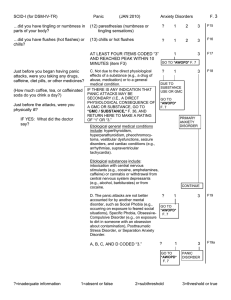
SCID-I (for DSM-IV-TR) Panic (JAN 2010) Anxiety Disorders F. 3
... COMPULSION) have on your life? (Did [OBSESSION OR COMPULSION] bother you a lot?) (How much time do you spend [OBSESSION OR COMPULSION])? IF NOT ALREADY CLEAR: RETURN TO THIS ITEM AFTER COMPLETING INTERVIEW ...
... COMPULSION) have on your life? (Did [OBSESSION OR COMPULSION] bother you a lot?) (How much time do you spend [OBSESSION OR COMPULSION])? IF NOT ALREADY CLEAR: RETURN TO THIS ITEM AFTER COMPLETING INTERVIEW ...
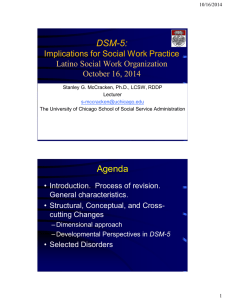
DSM-5: Implications for Social Work Practice Latino Social Work Organization October 16, 2014
... forms may not be identified until early adolescence. – Trajectory is variable with some experiencing substantial improvement over time while others continue with problems through adult years. ...
... forms may not be identified until early adolescence. – Trajectory is variable with some experiencing substantial improvement over time while others continue with problems through adult years. ...
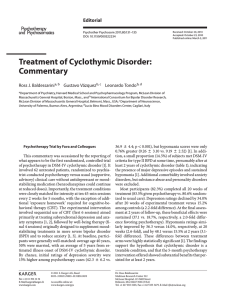
Treatment of Cyclothymic Disorder: Commentary Editorial Ross J. Baldessarini
... disorder over time, (2) the proportion of early subsyndromal and later major hypomanic, depressive, or mixed states in the course of disorders considered primarily cyclothymic, (3) typical cycling rates as well as the frequency and duration of intervening periods of stability, and (4) risks of suici ...
... disorder over time, (2) the proportion of early subsyndromal and later major hypomanic, depressive, or mixed states in the course of disorders considered primarily cyclothymic, (3) typical cycling rates as well as the frequency and duration of intervening periods of stability, and (4) risks of suici ...
Separation-Anxiety-Disorder-2013-Maddy-num2
... C. The disturbance causes clinically significant distress or impairment in social, academic (occupational), or other important areas of functioning. D. The disturbance is not better explained by another mental disorder, such as refusing to leave home because of excessive resistance to change in ...
... C. The disturbance causes clinically significant distress or impairment in social, academic (occupational), or other important areas of functioning. D. The disturbance is not better explained by another mental disorder, such as refusing to leave home because of excessive resistance to change in ...
Chapter 7
... People with these problems are healthy but mistakenly worry that there is something physically wrong with them They misinterpret and overreact to bodily symptoms or features ...
... People with these problems are healthy but mistakenly worry that there is something physically wrong with them They misinterpret and overreact to bodily symptoms or features ...

LO 31.2
... sensitivity, or vulnerability, to a certain disorder will develop under the right conditions of environmental or emotional stress. ...
... sensitivity, or vulnerability, to a certain disorder will develop under the right conditions of environmental or emotional stress. ...
psychological disorders.notebook
... people's problems in terms of their symptoms which says that it is a mental illness they do however still see it as a very practical tool when diagnosing and treating people with disorders health insurance companies require a DSMIV diagnosis before they will pay for therapy DSMIV defines ...
... people's problems in terms of their symptoms which says that it is a mental illness they do however still see it as a very practical tool when diagnosing and treating people with disorders health insurance companies require a DSMIV diagnosis before they will pay for therapy DSMIV defines ...
ORTHOREXIA NERVOSA: PSYCHOLOGICAL DISORDER OR
... individuals are striving to improve or manage their diet by only eating the most biologically pure and nutritious foods, whereas anorexic individuals are concerned with their physical appearance motivated to lose weight by the fear of obesity (Koven & Senbonmatsu, 2013). Additionally, individuals w ...
... individuals are striving to improve or manage their diet by only eating the most biologically pure and nutritious foods, whereas anorexic individuals are concerned with their physical appearance motivated to lose weight by the fear of obesity (Koven & Senbonmatsu, 2013). Additionally, individuals w ...

Compulsive Hoarding
... media. It is featured in popular television series such as “Hoarders” or “Hoarding: Buried Alive”. This condition is called compulsive hoarding and it usually begins early in life during teen years, but doesn’t become severe until adulthood. These individuals find it difficult to get rid of items th ...
... media. It is featured in popular television series such as “Hoarders” or “Hoarding: Buried Alive”. This condition is called compulsive hoarding and it usually begins early in life during teen years, but doesn’t become severe until adulthood. These individuals find it difficult to get rid of items th ...
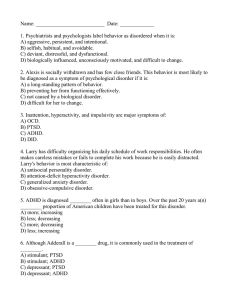
AP abnormal test bank 2016 2017
... 7. In one study, rats were given prolonged exposure to Ritalin early in life. When the drug was withdrawn later in life, the rats were more likely to show symptoms of ________ than were their control-group counterparts. A) catatonia B) depression C) panic disorder D) dissociation 8. The greatest sh ...
... 7. In one study, rats were given prolonged exposure to Ritalin early in life. When the drug was withdrawn later in life, the rats were more likely to show symptoms of ________ than were their control-group counterparts. A) catatonia B) depression C) panic disorder D) dissociation 8. The greatest sh ...
Introduction to Eating Disorders and Self-Harm
... fatal of all mental health disorders with up to 10 per cent of sufferers dying either as a result of suicide or, more commonly, due to complicating factors arising from low weight, such as organ failure or heart attack. The most apparent symptom of anorexia is low weight – people with anorexia are u ...
... fatal of all mental health disorders with up to 10 per cent of sufferers dying either as a result of suicide or, more commonly, due to complicating factors arising from low weight, such as organ failure or heart attack. The most apparent symptom of anorexia is low weight – people with anorexia are u ...
PERSONALITY DISORDERS
... These individuals frequently have pervasive difficulties in maintaining relationships and tolerating real or imagined abandonment. They tend to have volatile and unstable relationships and engage in extreme behaviour to prevent abandonment, including suicidal behaviour and self-harm. They have diffi ...
... These individuals frequently have pervasive difficulties in maintaining relationships and tolerating real or imagined abandonment. They tend to have volatile and unstable relationships and engage in extreme behaviour to prevent abandonment, including suicidal behaviour and self-harm. They have diffi ...

Changes from DSM-IV-TR to DSM-5
... Amnestic Disorders (amnesia now a feature of neurocognitive disorders) Dissociative Fugue (now a subtype of dissociative amnesia) Pain Disorder (gone) Hypochondriasis (cases now divided between Somatic Symptom Disorder and Illness Anxiety Disorder depending on severity of physical symptoms) Asperger ...
... Amnestic Disorders (amnesia now a feature of neurocognitive disorders) Dissociative Fugue (now a subtype of dissociative amnesia) Pain Disorder (gone) Hypochondriasis (cases now divided between Somatic Symptom Disorder and Illness Anxiety Disorder depending on severity of physical symptoms) Asperger ...
Which Diagnostic Approach Is More Valid?
... disorganized speech, see DSM-IV-TR, APA, 2000). Quantitatively, psychotic symptoms impact the individual’s attention and daily functioning more profoundly than neurotic symptoms (1); For this reason alone, the prevalence of these behaviors must be lower than neurosis (2); Not only are psychotic pati ...
... disorganized speech, see DSM-IV-TR, APA, 2000). Quantitatively, psychotic symptoms impact the individual’s attention and daily functioning more profoundly than neurotic symptoms (1); For this reason alone, the prevalence of these behaviors must be lower than neurosis (2); Not only are psychotic pati ...
Psychiatric comorbidities in asperger syndrome and high functioning
... HFA may show an impairment in describing their own feelings and emotions [4], so it is not easy to detect and recognize another psychiatric comorbidity that could be masked by the autistic symptoms themselves. One of the main problems with individuals suffering from AS/HFA is that behavioral symptom ...
... HFA may show an impairment in describing their own feelings and emotions [4], so it is not easy to detect and recognize another psychiatric comorbidity that could be masked by the autistic symptoms themselves. One of the main problems with individuals suffering from AS/HFA is that behavioral symptom ...
IOSR Journal of Dental and Medical Sciences (IOSR-JDMS)
... I.Introduction: Eating disorders(ED) are mental illness defined by abnormal eating habits that negatively affect a person’s physical or mental health [1].The cause of ED is not clear. Both genetic and environmental factors appear to play a role[2].Cultural idealization of thinness is believed to con ...
... I.Introduction: Eating disorders(ED) are mental illness defined by abnormal eating habits that negatively affect a person’s physical or mental health [1].The cause of ED is not clear. Both genetic and environmental factors appear to play a role[2].Cultural idealization of thinness is believed to con ...