Education and Science Vol 39 (2014) No 176 369
... Education and Science 2014, Vol 39, No 176, 369-382 ...
... Education and Science 2014, Vol 39, No 176, 369-382 ...

Eating disorders
... • Compulsive overeaters use food as a way to cope with stress, emotional conflicts and daily problems. The food can block out feelings and emotions. • Compulsive overeating usually starts in early childhood when eating patterns are formed. • Most people who become compulsive eaters are people who n ...
... • Compulsive overeaters use food as a way to cope with stress, emotional conflicts and daily problems. The food can block out feelings and emotions. • Compulsive overeating usually starts in early childhood when eating patterns are formed. • Most people who become compulsive eaters are people who n ...

Perplexities of treatment resistence in eating disorders Open Access
... Background: Treatment resistance is an omnipresent frustration in eating disorders. Attempts to identify the features of this resistance and subsequently develop novel treatments have had modest effects. This selective review examines treatment resistant features expressed in core eating disorder ps ...
... Background: Treatment resistance is an omnipresent frustration in eating disorders. Attempts to identify the features of this resistance and subsequently develop novel treatments have had modest effects. This selective review examines treatment resistant features expressed in core eating disorder ps ...
Treating Eating Disorders With the Buddhist Tradition of Mindfulness
... disorder does not normally involve purging methods after binging. Some inappropriate purging behavior may occur occasionally, but it is not regularly used to offset the effects of the binge eating. Binge eating typically begins in late adolescence or in the early 20s, often coming soon after signifi ...
... disorder does not normally involve purging methods after binging. Some inappropriate purging behavior may occur occasionally, but it is not regularly used to offset the effects of the binge eating. Binge eating typically begins in late adolescence or in the early 20s, often coming soon after signifi ...
The Prosecutor`s Guide to Mental Health Disorders
... expert, if necessary, to explain the typical effects of these disorders. In addition, prosecutors who work with mental health professionals can lessen the impact of the legal process on the victim and present the victim’s testimony in the best possible light. Anxiety Disorders Anxiety Disorders incl ...
... expert, if necessary, to explain the typical effects of these disorders. In addition, prosecutors who work with mental health professionals can lessen the impact of the legal process on the victim and present the victim’s testimony in the best possible light. Anxiety Disorders Anxiety Disorders incl ...
Anxiety Disorders - School District #83
... But if you often feel the heart-pounding, chest-tightening adrenaline rush of the "fight or flight" response, even though nothing and no one is actively threatening you, or if fear and worry continuously occupy your thoughts, interfering with your daily life, that could indicate an anxiety disorder. ...
... But if you often feel the heart-pounding, chest-tightening adrenaline rush of the "fight or flight" response, even though nothing and no one is actively threatening you, or if fear and worry continuously occupy your thoughts, interfering with your daily life, that could indicate an anxiety disorder. ...

Copyright 2006, the FSU CPEIP and Robert J
... Forming relationships/mutual engagement [p 63] [typically observable between 3 and 6 months] From: Does the infant develop a relationship with an emotionally available caregiver for soothing, security, and pleasure? To: Is the child able to experience the full range of positive and negative emotions ...
... Forming relationships/mutual engagement [p 63] [typically observable between 3 and 6 months] From: Does the infant develop a relationship with an emotionally available caregiver for soothing, security, and pleasure? To: Is the child able to experience the full range of positive and negative emotions ...

Abnormal - Community Unit School District 200
... Carla and her best friend Cutis, both aged 25, have been close since third grade, but Curtis said something unkind about Carla’s latest haircut. Carla decided he was a mean and evil person, and she didn’t want anything to do with him. Curtis complains that this is a pattern with Carla-that she consi ...
... Carla and her best friend Cutis, both aged 25, have been close since third grade, but Curtis said something unkind about Carla’s latest haircut. Carla decided he was a mean and evil person, and she didn’t want anything to do with him. Curtis complains that this is a pattern with Carla-that she consi ...
PROGRAMME DIPLOMA IN NURSING
... 5. If personality patterns are experience as egosyntonic, clients rarely seek treatment as they tend to externalize the cause of any functional impairment or subjective distress 6. If personality patterns are experience as egodystonic, clients are more likely to seek treatment to ease their distres ...
... 5. If personality patterns are experience as egosyntonic, clients rarely seek treatment as they tend to externalize the cause of any functional impairment or subjective distress 6. If personality patterns are experience as egodystonic, clients are more likely to seek treatment to ease their distres ...
II. ANOREXIA NERVOSA
... This, in turn, leads to preoccupation with food, increased anxiety and depression, and medical problems c. These cause them to feel even more afraid that they will lose control over their weight, their eating, and themselves d. This leads to even greater attempts to achieve thinness ...
... This, in turn, leads to preoccupation with food, increased anxiety and depression, and medical problems c. These cause them to feel even more afraid that they will lose control over their weight, their eating, and themselves d. This leads to even greater attempts to achieve thinness ...
Interacting mechanisms of impulsivity in bipolar disorder and
... conditions or could cut across seemingly disparate disorders. The relationship between bipolar disorder and ASPD may provide evidence about specificity of impulsivity across psychiatric illnesses. In ASPD, impulsivity occurs without the strong relationship to mania that characterizes bipolar disorder ...
... conditions or could cut across seemingly disparate disorders. The relationship between bipolar disorder and ASPD may provide evidence about specificity of impulsivity across psychiatric illnesses. In ASPD, impulsivity occurs without the strong relationship to mania that characterizes bipolar disorder ...
DSM-5 FEEDING AND EATING DISORDERS, MARSHA D
... half of the working group were women. And I think this is fitting since women are differentially affected by these disorders. ...
... half of the working group were women. And I think this is fitting since women are differentially affected by these disorders. ...
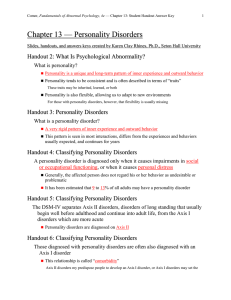
Between 1 and 2% of adults have avoidant personality disorder
... or occupational functioning, or when it causes personal distress ...
... or occupational functioning, or when it causes personal distress ...
PSYC 100 Chapter 14
... the day, nearly every day (as indicated by either subjective account or observation made by others) Significant weight loss when not dieting or weight gain (e.g., a change of more than 5% of body weight in a month), or decrease or increase in appetite nearly every day. Note: In children, consider fa ...
... the day, nearly every day (as indicated by either subjective account or observation made by others) Significant weight loss when not dieting or weight gain (e.g., a change of more than 5% of body weight in a month), or decrease or increase in appetite nearly every day. Note: In children, consider fa ...

Treatment-resistant anxiety disorders
... first process involves the neuronal circuits responsible for the initial detection and reaction to the threat (i.e. alarm). These circuits well described by several scientists play an important role in all anxiety disorders and specifically in Panic. The amygdale and adjunct limbic system play the c ...
... first process involves the neuronal circuits responsible for the initial detection and reaction to the threat (i.e. alarm). These circuits well described by several scientists play an important role in all anxiety disorders and specifically in Panic. The amygdale and adjunct limbic system play the c ...
Personality Student Presentation
... about our personality ? Links between personality, emotion, health and illness have long been described The link gained credibility as present day research between stress and illness grew Our personality can be molded in different ways Nature vs Nurture - genes (biological factors ) - environmental ...
... about our personality ? Links between personality, emotion, health and illness have long been described The link gained credibility as present day research between stress and illness grew Our personality can be molded in different ways Nature vs Nurture - genes (biological factors ) - environmental ...

29 Behavioral and Psychiatric Disorders in Children with Disabilities
... to profound levels of intellectual disability. These behaviors include stereotypic movement disorder (i.e., repetitive, self-stimulating, nonfunctional motor behavior, which may include self-injurious behavior [SIB]) and pica (i.e., the persistent ingesting of nonfood items). In some cases, the ca ...
... to profound levels of intellectual disability. These behaviors include stereotypic movement disorder (i.e., repetitive, self-stimulating, nonfunctional motor behavior, which may include self-injurious behavior [SIB]) and pica (i.e., the persistent ingesting of nonfood items). In some cases, the ca ...
BIPOLAR DISORDERS
... Pressured speech Racing thoughts and flight of ideas Easy distractibility, failure to keep attention ...
... Pressured speech Racing thoughts and flight of ideas Easy distractibility, failure to keep attention ...
Repetitive Behaviors in Autism and Obsessive–Compulsive Disorder
... provides a framework through which we can assess whether autism and OCD represent two distinct but highly comorbid disorders (Bejerot 2007) or whether this is a potential case of symptom overlap (Bartz and Hollander 2006; Ivarsson and Melin 2008). Some suggest that the stereotyped and rigid behavior ...
... provides a framework through which we can assess whether autism and OCD represent two distinct but highly comorbid disorders (Bejerot 2007) or whether this is a potential case of symptom overlap (Bartz and Hollander 2006; Ivarsson and Melin 2008). Some suggest that the stereotyped and rigid behavior ...
Child and Adolescent Psychopathology
... cream) or healthy foods (i.e., carrots) Restricted intake before and after binge episode Can be spontaneous or planned Triggered by negative/positive emotions, interpersonal stressors, presence of tempting food, violation of a dieting rule, body image dissatisfaction, excessive hunger, and so ...
... cream) or healthy foods (i.e., carrots) Restricted intake before and after binge episode Can be spontaneous or planned Triggered by negative/positive emotions, interpersonal stressors, presence of tempting food, violation of a dieting rule, body image dissatisfaction, excessive hunger, and so ...

updated April 17, 2011 [Review Sheet 210 Final exam]
... 1. Describe the essential features of personality disorders according to the DSM-IV and why they are listed on Axis II A personality disorder is enduring, it cannot go away and it is a patter of inner experience and behavior that is not normal for one’s cultural expectations. They are pervasive, inf ...
... 1. Describe the essential features of personality disorders according to the DSM-IV and why they are listed on Axis II A personality disorder is enduring, it cannot go away and it is a patter of inner experience and behavior that is not normal for one’s cultural expectations. They are pervasive, inf ...
Beyond Clutter The Complex Disorder of Hoarding
... Inclusion and Criteria The proposed diagnostic criteria are: C. The symptoms cause clinically significant distress or impairment in social, occupational, or other important areas of functioning (including maintaining a safe environment for self and others). D. The hoarding symptoms are not due to a ...
... Inclusion and Criteria The proposed diagnostic criteria are: C. The symptoms cause clinically significant distress or impairment in social, occupational, or other important areas of functioning (including maintaining a safe environment for self and others). D. The hoarding symptoms are not due to a ...

Anxiety: What is it and what to do about it
... treatment varies among people. Some may respond to treatment after a few months, while others may need longer. Treatment is sometimes complicated by the fact that people may have more than one anxiety disorder or suffer from depression or substance abuse. This is why treatment must be tailored to th ...
... treatment varies among people. Some may respond to treatment after a few months, while others may need longer. Treatment is sometimes complicated by the fact that people may have more than one anxiety disorder or suffer from depression or substance abuse. This is why treatment must be tailored to th ...

Mental Disorders in Litigation - The Continuing Legal Education
... touched on above. DSM-IV in fact provides a relatively narrow definition but also readily acknowledges in the introduction that there is a large element of abstraction involved in defining mental disorder. They note, however, that similar abstractions are found in our definitions of more traditional ...
... touched on above. DSM-IV in fact provides a relatively narrow definition but also readily acknowledges in the introduction that there is a large element of abstraction involved in defining mental disorder. They note, however, that similar abstractions are found in our definitions of more traditional ...
Overview of Psychopathologies and Their Treatments
... manifested by current or historic functioning (e.g., lack of reciprocity in conversation, abnormal eye contact and other body expressions, difficulty in developing, maintaining, and understanding relationships) B. Restricted or repetitive patterns of behaviors, interests, or activities including 2+ ...
... manifested by current or historic functioning (e.g., lack of reciprocity in conversation, abnormal eye contact and other body expressions, difficulty in developing, maintaining, and understanding relationships) B. Restricted or repetitive patterns of behaviors, interests, or activities including 2+ ...