Understanding-ICD-10-CM-in-the-Era-of-the-DSM-5
... epigastric discomfort are common. Fears that the sufferer or a relative will shortly become ill or have an accident are often expressed, together with a variety of other worries and forebodings. This disorder is more common in women, and often related to chronic environmental stress. Its course is v ...
... epigastric discomfort are common. Fears that the sufferer or a relative will shortly become ill or have an accident are often expressed, together with a variety of other worries and forebodings. This disorder is more common in women, and often related to chronic environmental stress. Its course is v ...
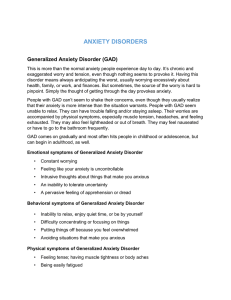
File
... diagnosed, the behaviors must occur for at least a period of 6 months. Negative and defiant behaviors are expressed by persistent stubbornness, resistance to directions, and unwillingness to compromise, give in, or negotiate with adults or peers. Defiance may also include deliberate or persistent te ...
... diagnosed, the behaviors must occur for at least a period of 6 months. Negative and defiant behaviors are expressed by persistent stubbornness, resistance to directions, and unwillingness to compromise, give in, or negotiate with adults or peers. Defiance may also include deliberate or persistent te ...
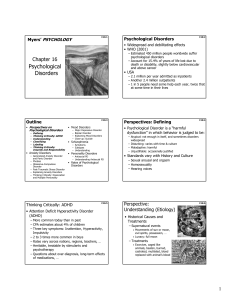
Chapter 16
... symptoms take a bodily form without physical cause. This type of disorder is more common in Asian, Latin American, and African cultures where people are less ...
... symptoms take a bodily form without physical cause. This type of disorder is more common in Asian, Latin American, and African cultures where people are less ...

A Brief Overview of the New DSM 5 With Ethical Citations
... familiar with these codes as NBCC will begin testing for licensure using these codes in the summer of 2014. The new DSM is designed to help clinicians form more systematic and objective means of assessment. According to our ACA Code of Ethics, E.1.a states “The primary purpose of educational, psycho ...
... familiar with these codes as NBCC will begin testing for licensure using these codes in the summer of 2014. The new DSM is designed to help clinicians form more systematic and objective means of assessment. According to our ACA Code of Ethics, E.1.a states “The primary purpose of educational, psycho ...
Preview the test
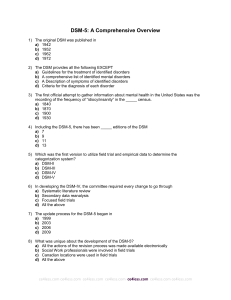
... 46) Studies show that the prevalence of excoriation is estimated at approximately _____ of the population. a) 0.5 -1% b) 1 - 2% c) 2 - 4% d) 4 - 6% 47) The arguments against the inclusion of excoriation as a separate disorder include all the following EXCEPT a) It does not meet the criteria for a me ...
... 46) Studies show that the prevalence of excoriation is estimated at approximately _____ of the population. a) 0.5 -1% b) 1 - 2% c) 2 - 4% d) 4 - 6% 47) The arguments against the inclusion of excoriation as a separate disorder include all the following EXCEPT a) It does not meet the criteria for a me ...
DSM-5: A Comprehensive Overview
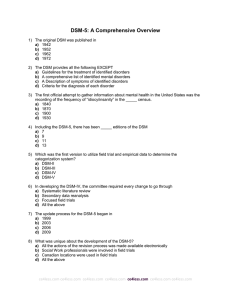
... 46) Studies show that the prevalence of excoriation is estimated at approximately _____ of the population. a) 0.5 -1% b) 1 - 2% c) 2 - 4% d) 4 - 6% 47) The arguments against the inclusion of excoriation as a separate disorder include all the following EXCEPT a) It does not meet the criteria for a me ...
... 46) Studies show that the prevalence of excoriation is estimated at approximately _____ of the population. a) 0.5 -1% b) 1 - 2% c) 2 - 4% d) 4 - 6% 47) The arguments against the inclusion of excoriation as a separate disorder include all the following EXCEPT a) It does not meet the criteria for a me ...
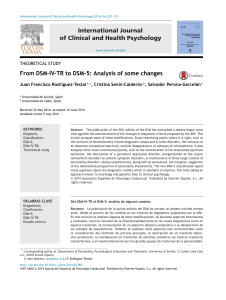
From DSM-IV-TR to DSM-5
... the DSM-5 with the ICD-10. It is not a matter of forcing a choice between categorical and dimensional. As Wakefield and First (2013) point out, numerous dimensional variables end up generating a point of inflection (points of rarity) based on which categories are established. Perhaps the most difficult ...
... the DSM-5 with the ICD-10. It is not a matter of forcing a choice between categorical and dimensional. As Wakefield and First (2013) point out, numerous dimensional variables end up generating a point of inflection (points of rarity) based on which categories are established. Perhaps the most difficult ...
PERSONALITY DISORDER
... Epidemiological Statistics:The prevalence of borderline personality disorder affects 2% to 3% of the general population, about 11% of psychiatric outpatients, & nearly 20% of psychiatric inpatients. It’s three times more common in females than in males. Clinical Features:Major signs & symptoms of b ...
... Epidemiological Statistics:The prevalence of borderline personality disorder affects 2% to 3% of the general population, about 11% of psychiatric outpatients, & nearly 20% of psychiatric inpatients. It’s three times more common in females than in males. Clinical Features:Major signs & symptoms of b ...
File
... • Theorists argue that there is a species-specific biological predisposition to develop certain fears • Called “preparedness”: humans are more “prepared” to develop phobias around certain objects or situations • Model explains why some phobias (snakes, heights) are more common than others (grass, me ...
... • Theorists argue that there is a species-specific biological predisposition to develop certain fears • Called “preparedness”: humans are more “prepared” to develop phobias around certain objects or situations • Model explains why some phobias (snakes, heights) are more common than others (grass, me ...
Chapter 12 Psychological Disorders
... Five or more of the following symptoms must be present during the same 2 week period AND at least one of the symptoms is either (1) depressed mood or (2) loss of interest or pleasure: ...
... Five or more of the following symptoms must be present during the same 2 week period AND at least one of the symptoms is either (1) depressed mood or (2) loss of interest or pleasure: ...
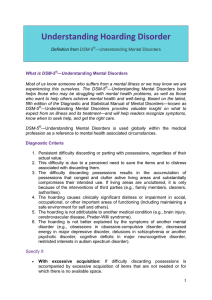
Definition from DSM-5 ®—Understanding Mental Disorders What is
... without hoarding disorder. However, individuals with hoarding disorder often have possessions that spill beyond the active living areas and can occupy and impair the use of other spaces, such as vehicles, yards, the workplace, and friends’ and relatives’ houses. In some cases, living areas may be un ...
... without hoarding disorder. However, individuals with hoarding disorder often have possessions that spill beyond the active living areas and can occupy and impair the use of other spaces, such as vehicles, yards, the workplace, and friends’ and relatives’ houses. In some cases, living areas may be un ...
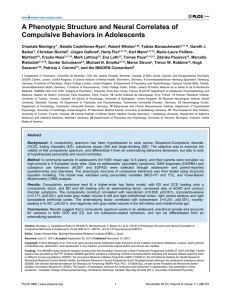
A Phenotypic Structure and Neural Correlates of Compulsive Behaviors in Adolescents
... affect phase, considered to be characterized by compulsivity [27]. The same switch from impulsivity to compulsivity has been found in rats prone to compulsive cocaine selfadministration [2,28]. Furthermore, in animal models of stimulant drug abuse, individual differences in impulsivity are understoo ...
... affect phase, considered to be characterized by compulsivity [27]. The same switch from impulsivity to compulsivity has been found in rats prone to compulsive cocaine selfadministration [2,28]. Furthermore, in animal models of stimulant drug abuse, individual differences in impulsivity are understoo ...
this PDF file - Journal of Research and Practice in K
... response” (APA, 2013, p. 12). The researchers suggested that these validation findings were helpful for suggesting groupings of disorders, rather than for empirical validity for specific disorder diagnostic criteria. These groupings are intended to inspire future research that explores the origins o ...
... response” (APA, 2013, p. 12). The researchers suggested that these validation findings were helpful for suggesting groupings of disorders, rather than for empirical validity for specific disorder diagnostic criteria. These groupings are intended to inspire future research that explores the origins o ...
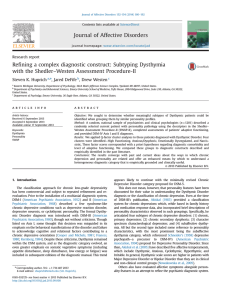
- Journal of Affective Disorders
... This does not mean, however, that personality features have been discounted for their value in understanding the Dysthymic Disorder diagnosis or the classification of chronic depression. Even at the time of DSM-III's publication, Akiskal (1983) provided a classification system for chronic depressions ...
... This does not mean, however, that personality features have been discounted for their value in understanding the Dysthymic Disorder diagnosis or the classification of chronic depression. Even at the time of DSM-III's publication, Akiskal (1983) provided a classification system for chronic depressions ...

ANXIETY DISORDERS
... More than one phobia is common (does not in and of itself constitute a diagnosis of GAD) Adolescents and adults typically recognize that the fear is unreasonable; children often do not Avoidance is key Generally begins in childhood ...
... More than one phobia is common (does not in and of itself constitute a diagnosis of GAD) Adolescents and adults typically recognize that the fear is unreasonable; children often do not Avoidance is key Generally begins in childhood ...

eating disorders - Women`s Health Clinic
... An EKG is of importance especially in clients with bradycardia to rule out a prolonged QTc interval (normal <0.44). A repeat EKG is usually not required unless cardiac symptoms persist, new cardiac symptoms develop, or if abnormalities were noted on EKG previously. For patients with Anorexia Nervosa ...
... An EKG is of importance especially in clients with bradycardia to rule out a prolonged QTc interval (normal <0.44). A repeat EKG is usually not required unless cardiac symptoms persist, new cardiac symptoms develop, or if abnormalities were noted on EKG previously. For patients with Anorexia Nervosa ...
16.Abnormal PsychologyDSM5
... Cluster B: Antisocial, Borderline (a disordered behavior pattern with onset by early adulthood that is characterized by multiple types of psychological instability and impulsiveness, often involves fear of abandonment and a risk of suicide, and may ameliorate with age), Histrionic, Narcissistic Clus ...
... Cluster B: Antisocial, Borderline (a disordered behavior pattern with onset by early adulthood that is characterized by multiple types of psychological instability and impulsiveness, often involves fear of abandonment and a risk of suicide, and may ameliorate with age), Histrionic, Narcissistic Clus ...
Abnormal Psychology - Henry County Schools
... Cluster B: Antisocial, Borderline (a disordered behavior pattern with onset by early adulthood that is characterized by multiple types of psychological instability and impulsiveness, often involves fear of abandonment and a risk of suicide, and may ameliorate with age), Histrionic, Narcissistic Clus ...
... Cluster B: Antisocial, Borderline (a disordered behavior pattern with onset by early adulthood that is characterized by multiple types of psychological instability and impulsiveness, often involves fear of abandonment and a risk of suicide, and may ameliorate with age), Histrionic, Narcissistic Clus ...

Managing mood disorders and comorbid personality disorders
... to personality, suggests no benefit of personality pathology but that ‘comorbid personality pathology should not be seen as an impediment to good treatment response’ [8] (p. 359); the other, using a metaanalysis of studies in which patients were separated into those with and without personality diso ...
... to personality, suggests no benefit of personality pathology but that ‘comorbid personality pathology should not be seen as an impediment to good treatment response’ [8] (p. 359); the other, using a metaanalysis of studies in which patients were separated into those with and without personality diso ...
Psychological Disorders CHAPTER 12 CHAPTER 12
... worries with no real source that can be pinpointed as leading to the anxiety. The psychoanalytical model states that anxiety disorders are caused by repressed urges or conflicts that are threatening to surface, while the behaviorist model sees anxious behavior as learned or conditioned responses. Co ...
... worries with no real source that can be pinpointed as leading to the anxiety. The psychoanalytical model states that anxiety disorders are caused by repressed urges or conflicts that are threatening to surface, while the behaviorist model sees anxious behavior as learned or conditioned responses. Co ...
DSM 5 AND DISRUPTIVE MOOD DYSREGULATION DISORDER Gail Fernandez, M.D.
... but parents report a mean age at onset nearly 7 years earlier. • The mean Children’s Global Assessment Scale (CGAS) score was 45.8 (SD=6.9), compared with a mean score of 46.5 (SD=12.4) for 107 youths with bipolar disorder recruited over the same period, indicating that youths with severe mood dysre ...
... but parents report a mean age at onset nearly 7 years earlier. • The mean Children’s Global Assessment Scale (CGAS) score was 45.8 (SD=6.9), compared with a mean score of 46.5 (SD=12.4) for 107 youths with bipolar disorder recruited over the same period, indicating that youths with severe mood dysre ...
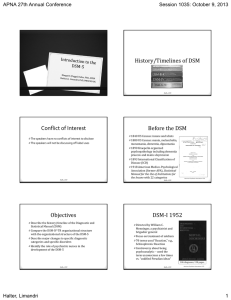
History/Timelines of DSM - American Psychiatric Nurses Association
... 0 Sexual Sadism Disorder 0 Transvestic Disorder 0 Voyeuristic Disorder ...
... 0 Sexual Sadism Disorder 0 Transvestic Disorder 0 Voyeuristic Disorder ...