2003년 1학기 이상심리학 Abnormal Psychology V.M. Durand & …
... anxiety disorder => individuals who are extremely and painfully shy in almost all social situations. ...
... anxiety disorder => individuals who are extremely and painfully shy in almost all social situations. ...
DSM5, ICD10, PDM, 2013 - Mmpi
... depressive episode that was applied to depressive symptoms lasting less than 2 months following the death of a loved one (i.e., the bereavement exclusion). This exclusion is omitted in DSM-5. 1, to remove the implication that bereavement typically lasts only 2 months when both physicians and grief c ...
... depressive episode that was applied to depressive symptoms lasting less than 2 months following the death of a loved one (i.e., the bereavement exclusion). This exclusion is omitted in DSM-5. 1, to remove the implication that bereavement typically lasts only 2 months when both physicians and grief c ...
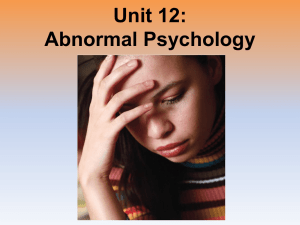
Myers AP - Unit 12
... • prevalence: the percentage of a population that exhibits a disorder during a specific time period • lifetime prevalence: the percentage of people who endure a specific disorder at any time in their lives ...
... • prevalence: the percentage of a population that exhibits a disorder during a specific time period • lifetime prevalence: the percentage of people who endure a specific disorder at any time in their lives ...
DSM 5: TOP 10 Changes Justin K. Hughes, MA, LPC, NCC
... variations in ASD from person to person – Symptoms must now be evidenced in early childhood • Attempts to encourage earlier recognition (within 1-2 years if possible) • If ASD is not realized until beyond childhood, it can still be diagnosed, but only if there is prior criteria ...
... variations in ASD from person to person – Symptoms must now be evidenced in early childhood • Attempts to encourage earlier recognition (within 1-2 years if possible) • If ASD is not realized until beyond childhood, it can still be diagnosed, but only if there is prior criteria ...
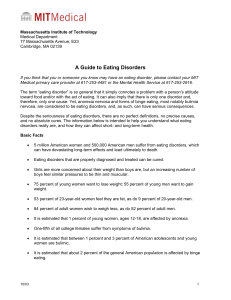
A Guide to Eating Disorders
... There are three major types of eating disorders — anorexia nervosa, bulimia nervosa, and binge eating, which is closely related to bulimia: Anorexia nervosa: People with anorexia nervosa have a distorted body image that causes them to see themselves as overweight, even when they're dangerously thin. ...
... There are three major types of eating disorders — anorexia nervosa, bulimia nervosa, and binge eating, which is closely related to bulimia: Anorexia nervosa: People with anorexia nervosa have a distorted body image that causes them to see themselves as overweight, even when they're dangerously thin. ...

Understanding Depressive and Bipolar Disorders
... = a psychological disorder marked by the appearance by age 7 of one or more of three key symptoms; extreme inattention, hyperactivity, and impulsivity. ...
... = a psychological disorder marked by the appearance by age 7 of one or more of three key symptoms; extreme inattention, hyperactivity, and impulsivity. ...
Neurodevelopmental disorders
... manifested verbally (e.g. verbal rages) and/or behaviorally (e.g. physical aggression toward people or property) ... grossly out of proportion in intensity or duration to situation/provocation ...
... manifested verbally (e.g. verbal rages) and/or behaviorally (e.g. physical aggression toward people or property) ... grossly out of proportion in intensity or duration to situation/provocation ...
Day 1 PPT
... • Outlines symptoms & conditions by which mental illness is diagnosed • Axis system discontinued • Replaced with 0-4 severity ratings ...
... • Outlines symptoms & conditions by which mental illness is diagnosed • Axis system discontinued • Replaced with 0-4 severity ratings ...

PERSONALITY DISORDERS - Immaculateheartacademy.org
... Relaxation Techniques help individuals develop the ability to more effectively cope with the stresses that contribute to anxiety, as well as with some of the physical symptoms of anxiety. The techniques taught include breathing re-training and exercise. Medication Medication can be very useful in th ...
... Relaxation Techniques help individuals develop the ability to more effectively cope with the stresses that contribute to anxiety, as well as with some of the physical symptoms of anxiety. The techniques taught include breathing re-training and exercise. Medication Medication can be very useful in th ...
MH Listings Section A
... persistent concern or worry about additional panic attacks or their consequences ◦ Disproportionate fear/anxiety about at least two different situations (e.g. using public transportation, being in a crowd or in a line, being outside of your home, being in open spaces) ...
... persistent concern or worry about additional panic attacks or their consequences ◦ Disproportionate fear/anxiety about at least two different situations (e.g. using public transportation, being in a crowd or in a line, being outside of your home, being in open spaces) ...
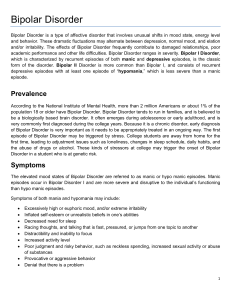
Bipolar Disorder
... A trained mental health professional can diagnosis Bipolar Disorder on the basis of symptoms, the course of the illness and family history. It is important to seek help for Bipolar Disorder as it is a lifelong disorder and is likely to worsen without treatment. Without effect treatment, manic and de ...
... A trained mental health professional can diagnosis Bipolar Disorder on the basis of symptoms, the course of the illness and family history. It is important to seek help for Bipolar Disorder as it is a lifelong disorder and is likely to worsen without treatment. Without effect treatment, manic and de ...
Eating Disorders in Primary Care
... 3. Eating large amounts of food when not feeling physically hungry. 4. Eating alone because of embarrassment. 5. Feeling disgusted with oneself, depressed, or very guilty after overeating. C. Marked distress regarding binge eating is present. D. At least once a week for 3 months. E. The binge eating ...
... 3. Eating large amounts of food when not feeling physically hungry. 4. Eating alone because of embarrassment. 5. Feeling disgusted with oneself, depressed, or very guilty after overeating. C. Marked distress regarding binge eating is present. D. At least once a week for 3 months. E. The binge eating ...

z2r012162576so2 - American Psychological Association
... but hypothesized that highly pleiotropic genetic influences explain the correlations among personality disorders, with additional genetic influences shared by the members of four clusters and unique genetic influences on each personality disorder (Livesley & Jang, 2008). What is still not clear at t ...
... but hypothesized that highly pleiotropic genetic influences explain the correlations among personality disorders, with additional genetic influences shared by the members of four clusters and unique genetic influences on each personality disorder (Livesley & Jang, 2008). What is still not clear at t ...
Intensive Treatment for Intractable OCD
... Research shows that when correctly used, ERP can produce a 76% symptom reduction in patients for 3 months to 6 years following termination of treatment This rate increases for those sufferers of severe OCD when participating in an intensive treatment program Foa& Kozak, 1996 © Westwood Institute ...
... Research shows that when correctly used, ERP can produce a 76% symptom reduction in patients for 3 months to 6 years following termination of treatment This rate increases for those sufferers of severe OCD when participating in an intensive treatment program Foa& Kozak, 1996 © Westwood Institute ...

Document
... Overindulgence and overvaluation by parents Valued by parents as a means to regulate their own self-esteem Excessive admiration that is never balanced with realistic feedback Unpredictable or unreliable caregiving from parents Severe emotional abuse in childhood Being praised for perceived exception ...
... Overindulgence and overvaluation by parents Valued by parents as a means to regulate their own self-esteem Excessive admiration that is never balanced with realistic feedback Unpredictable or unreliable caregiving from parents Severe emotional abuse in childhood Being praised for perceived exception ...
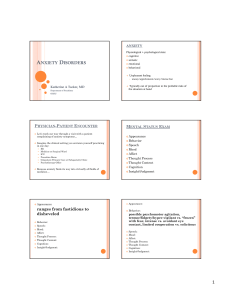
Anxiety Disorders
... Repetitive behaviors or mental acts driven to perform in response to an obsession or rigid rules Aimed at preventing or reducing distress Not realistically connected to the target of prevention ...
... Repetitive behaviors or mental acts driven to perform in response to an obsession or rigid rules Aimed at preventing or reducing distress Not realistically connected to the target of prevention ...
DsM-5 - Northeast Iowa Family Practice Center
... bipolar diagnoses in the past 20 years, due to the incorrect characterization of non-episodic irritability as mania. – May reduce the likelihood of such children inappropriately prescribed antipsychotic medication. ...
... bipolar diagnoses in the past 20 years, due to the incorrect characterization of non-episodic irritability as mania. – May reduce the likelihood of such children inappropriately prescribed antipsychotic medication. ...

document
... Cluster C: The Anxious Cluster Individuals diagnosed with disorders belonging to this cluster are characterized by behaviours that are designed to reduce or avoid anxiety. The disorders included in this cluster are obsessivecompulsive PD, avoidant PD, and dependent PD. ...
... Cluster C: The Anxious Cluster Individuals diagnosed with disorders belonging to this cluster are characterized by behaviours that are designed to reduce or avoid anxiety. The disorders included in this cluster are obsessivecompulsive PD, avoidant PD, and dependent PD. ...

PATHOPHYSIOLOGY AND CLINICAL BIOCHEMISTRY (PAT …
... embarrassing manner two types: specific social phobia: fear of one or more discrete social situations, especially performance anxiety generalized social phobia: difficulty with most social situations ...
... embarrassing manner two types: specific social phobia: fear of one or more discrete social situations, especially performance anxiety generalized social phobia: difficulty with most social situations ...

Anxiety Disorders
... anxiety disorders OR secondary to substance abuse (Substance-Induced Anxiety Disorder), a medical condition (Anxiety Disorder Due to a General Medical Condition), another psychiatric condition, or psychosocial stressors (Adjustment Disorder with Anxiety) The differential diagnosis of anxiety. Psychi ...
... anxiety disorders OR secondary to substance abuse (Substance-Induced Anxiety Disorder), a medical condition (Anxiety Disorder Due to a General Medical Condition), another psychiatric condition, or psychosocial stressors (Adjustment Disorder with Anxiety) The differential diagnosis of anxiety. Psychi ...

An Overview of Mood Disorders/Depression
... common among close relatives, and twin studies have also shown a strong genetic basis. Additionally, research has shown that people who tend to be more negative and have low self-esteem are more likely to develop a mood disorder. In addition to the genetic causes of mood disorders, studies have also ...
... common among close relatives, and twin studies have also shown a strong genetic basis. Additionally, research has shown that people who tend to be more negative and have low self-esteem are more likely to develop a mood disorder. In addition to the genetic causes of mood disorders, studies have also ...
DSM 5 Changes that May Affect Adolescents
... The new category of Neurodevelopmental Disorders includes many disorders previously classified as childhood onset disorders, however it excludes disorders involving abnormal emotional development, such as separation anxiety disorder and selective mutism. Where does this new classification leave the ...
... The new category of Neurodevelopmental Disorders includes many disorders previously classified as childhood onset disorders, however it excludes disorders involving abnormal emotional development, such as separation anxiety disorder and selective mutism. Where does this new classification leave the ...

Coexisting Disorders in Children
... Approximately 30 to 50% of children with ADHD will meet the criteria for oppositional defiant disorder or conduct disorder. Children with oppositional defiant disorder often argue with adults and are angry, resentful, and easily annoyed, blaming others when things go wrong. Conduct disorder ...
... Approximately 30 to 50% of children with ADHD will meet the criteria for oppositional defiant disorder or conduct disorder. Children with oppositional defiant disorder often argue with adults and are angry, resentful, and easily annoyed, blaming others when things go wrong. Conduct disorder ...
Obsessive-Compulsive Disorder: An Information Guide
... When worries consume someone, we call them “obsessions.” Obsessions are uninvited or “intrusive” thoughts, urges or images that surface in the mind over and over again. People with OCD know their obsessions are unrealistic creations of their own minds, but they can’t get rid of them, they can’t cont ...
... When worries consume someone, we call them “obsessions.” Obsessions are uninvited or “intrusive” thoughts, urges or images that surface in the mind over and over again. People with OCD know their obsessions are unrealistic creations of their own minds, but they can’t get rid of them, they can’t cont ...

Memory
... – A disorder in which a person exhibits two or more personality states, each with its own patterns of thought and behavior – Previously known as “Multiple Personality Disorder” – A person may have anywhere from 2 to 100 different distinct personalities – The transition from one personality to anothe ...
... – A disorder in which a person exhibits two or more personality states, each with its own patterns of thought and behavior – Previously known as “Multiple Personality Disorder” – A person may have anywhere from 2 to 100 different distinct personalities – The transition from one personality to anothe ...