
Paranoid Personality Disorder
... The exact cause of PPD is not known, but it likely involves a combination of biological and psychological factors. The fact that PPD is more common in people who have close relatives with schizophrenia suggests a genetic link between the two disorders. Early childhood experiences, including physical ...
... The exact cause of PPD is not known, but it likely involves a combination of biological and psychological factors. The fact that PPD is more common in people who have close relatives with schizophrenia suggests a genetic link between the two disorders. Early childhood experiences, including physical ...
Feeding and eating disorders
... The DSM-5 includes changes from the previous DSM, which aim to better represent the behaviors and symptoms of people dealing with eating disorders. In order to do this there are updated clinical classification categories for eating disorders, and changes to diagnostic criteria (symptom lists). One ...
... The DSM-5 includes changes from the previous DSM, which aim to better represent the behaviors and symptoms of people dealing with eating disorders. In order to do this there are updated clinical classification categories for eating disorders, and changes to diagnostic criteria (symptom lists). One ...

abnormal psychology - Oxford University Press
... It can be described as sorcery/witchcraft or use of superpower to harm or even kill someone, usually an enemy. A widow has to wear black clothes for 12 months to show that she is mourning for her husband. This only applies to wives, not husbands. If this practice is not properly followed, it can cau ...
... It can be described as sorcery/witchcraft or use of superpower to harm or even kill someone, usually an enemy. A widow has to wear black clothes for 12 months to show that she is mourning for her husband. This only applies to wives, not husbands. If this practice is not properly followed, it can cau ...
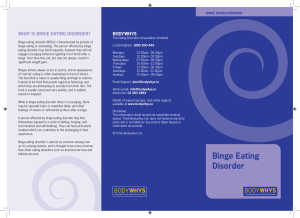
Binge eating disorder
... may be sporadic fasts or repetitive diets, and often feelings of shame or self-hatred surface after a binge. A person affected by binge eating disorder may find themselves trapped in a cycle of dieting, binging, selfrecrimination and self-loathing. They can feel particularly isolated which can contr ...
... may be sporadic fasts or repetitive diets, and often feelings of shame or self-hatred surface after a binge. A person affected by binge eating disorder may find themselves trapped in a cycle of dieting, binging, selfrecrimination and self-loathing. They can feel particularly isolated which can contr ...
Disorders Pt. 2
... from the Freudian theory that anxiety has been “converted” into serious somatic symptoms in this condition rather than being directly experienced as anxiety. Individuals with these problems experience functional blindness, deafness, paralysis, fainting, seizures, inability to speak, or other serious ...
... from the Freudian theory that anxiety has been “converted” into serious somatic symptoms in this condition rather than being directly experienced as anxiety. Individuals with these problems experience functional blindness, deafness, paralysis, fainting, seizures, inability to speak, or other serious ...
a anxiety disorders
... • Problems with exclusion from affective disorders, when over 60% of depressed patients suffer from significant anxiety • Borderline diagnoses: F34.1 Dysthymia (“depressive neurosis“); F41.2 Mixed anxiety and depressive disorder ...
... • Problems with exclusion from affective disorders, when over 60% of depressed patients suffer from significant anxiety • Borderline diagnoses: F34.1 Dysthymia (“depressive neurosis“); F41.2 Mixed anxiety and depressive disorder ...

L5_Anxiety
... to symptoms of anxiety due to either side effects or withdrawal from the drug. • In very rare cases, a tumor of the adrenal gland (pheochromocytoma) may be the cause of anxiety. ...
... to symptoms of anxiety due to either side effects or withdrawal from the drug. • In very rare cases, a tumor of the adrenal gland (pheochromocytoma) may be the cause of anxiety. ...
4468 ANXIETY DISORDERS - PANIC DISORDER
... a. responsiveness to medication b. intensity and sudden, episodic nature c. co-occurrence with substance abuse 11. Typically, an early age of onset of panic disorder carries greater risks that it will: a. develop into a personality disorder b. become chronic and cause more impairment c. evolve into ...
... a. responsiveness to medication b. intensity and sudden, episodic nature c. co-occurrence with substance abuse 11. Typically, an early age of onset of panic disorder carries greater risks that it will: a. develop into a personality disorder b. become chronic and cause more impairment c. evolve into ...
DSM-5 Changes In Intellectual Disabilities And Mental Health
... Symptoms must be present in early childhood (but may not become fully manifest until social demands exceed limited capacities, or may be masked by learned strategies later in life) Symptoms cause clinically significant impairment in social, occupational, or other important areas of current functioni ...
... Symptoms must be present in early childhood (but may not become fully manifest until social demands exceed limited capacities, or may be masked by learned strategies later in life) Symptoms cause clinically significant impairment in social, occupational, or other important areas of current functioni ...
Psychology 101: Introduction to Psychology
... people. Narcissistic personality disorder involves a greatly exaggerated sense of self, accompanied by a high need for admiration. Paranoid personality disorder is typified by an inordinate amount of suspiciousness and mistrust of others. In schizoid personality disorder, people have minimal intere ...
... people. Narcissistic personality disorder involves a greatly exaggerated sense of self, accompanied by a high need for admiration. Paranoid personality disorder is typified by an inordinate amount of suspiciousness and mistrust of others. In schizoid personality disorder, people have minimal intere ...

Psychiatry and the Skin - Oklahoma Osteopathic Association
... larger after the experiment, compared to that same person's response on the day when they were not stressed ...
... larger after the experiment, compared to that same person's response on the day when they were not stressed ...
Durand and Barlow Chapter 5: Somatoform and Dissociative
... – Physical complaints without a clear cause – Severe anxiety about the possibility of having a serious disease ...
... – Physical complaints without a clear cause – Severe anxiety about the possibility of having a serious disease ...

Introduction to Anxiety Disorders Professor Craig A. Jackson Head
... anticipate terror from encountering the object understand their fear is not proportional to the actual potential danger ...
... anticipate terror from encountering the object understand their fear is not proportional to the actual potential danger ...

The Nervous System
... • Often treated successfully with drugs – Low compliance with drug treatment because manic phases are often pleasant for the individual – Untreated bipolar disorder is associated with suicide risk and other maladaptive behaviors ...
... • Often treated successfully with drugs – Low compliance with drug treatment because manic phases are often pleasant for the individual – Untreated bipolar disorder is associated with suicide risk and other maladaptive behaviors ...

Obsessive Compulsive Disorder (OCD)
... It’s very likely that you thought about a pink elephant. The more you try not to think about something, the more likely it is that you will think about it. It is not possible to control thoughts that come into your head. But what you can do is control how you interpret these thoughts. The thoughts ...
... It’s very likely that you thought about a pink elephant. The more you try not to think about something, the more likely it is that you will think about it. It is not possible to control thoughts that come into your head. But what you can do is control how you interpret these thoughts. The thoughts ...
Somatoform Disorders Somatoform Disorders Hypochondriasis
... Involves dissociative symptoms and sudden changes in personality Symptoms and personality changes are often attributed to possession by a spirit Symptoms must be considered undesirable/pathological by the culture ...
... Involves dissociative symptoms and sudden changes in personality Symptoms and personality changes are often attributed to possession by a spirit Symptoms must be considered undesirable/pathological by the culture ...
Chapter 9 Teachers 1. According to DSM-IV
... 36. According to community based twin studies, there is a heritability component of eating disorders may be greater than: a) 50% (A) b) 20% c) 80% d) 10% 37. Animal research has shown that lesions to which part of the brain can cause appetite loss resulting in a self-starvation syndrome? a) Cerebell ...
... 36. According to community based twin studies, there is a heritability component of eating disorders may be greater than: a) 50% (A) b) 20% c) 80% d) 10% 37. Animal research has shown that lesions to which part of the brain can cause appetite loss resulting in a self-starvation syndrome? a) Cerebell ...
Personality Disorders - Dobson Social Studies
... Psychological disorders, also known as mental disorders, are patterns of behavioral or psychological symptoms that impact multiple areas of life. These disorders create distress for the person experiencing these symptoms. The following list of psychological disorders includes some of the major categ ...
... Psychological disorders, also known as mental disorders, are patterns of behavioral or psychological symptoms that impact multiple areas of life. These disorders create distress for the person experiencing these symptoms. The following list of psychological disorders includes some of the major categ ...

Chapter 3
... images, or impulses that are experienced as disturbing and inappropriate. Compulsions- overt repetitive behaviors (such as hand washing, checking or ordering) or covert mental acts (such as counting, praying, or saying certain words silently). The person feels driven to perform the compulsive behavi ...
... images, or impulses that are experienced as disturbing and inappropriate. Compulsions- overt repetitive behaviors (such as hand washing, checking or ordering) or covert mental acts (such as counting, praying, or saying certain words silently). The person feels driven to perform the compulsive behavi ...
Pfeiffer_5_IM_Chapter05
... 1. Anorexia nervosa is characterized by self-starvation motivated by an obsession with being thin and an overwhelming fear of being fat. People with this condition have grossly distorted body images. They think of themselves as fat even though they are abnormally lean. 2. Bulimia nervosa is characte ...
... 1. Anorexia nervosa is characterized by self-starvation motivated by an obsession with being thin and an overwhelming fear of being fat. People with this condition have grossly distorted body images. They think of themselves as fat even though they are abnormally lean. 2. Bulimia nervosa is characte ...

Obsessive Compulsive Disorder (OCD)
... efficacy of potent blockers of serotonin reuptake in OCD • However, direct support for a role of serotonin in the pathophysiology (e.g., biomarkers in pharmacological challenge studies) of OCD is lacking • Functional imaging studies (both fMRI and PET) show fairly consistent evidence for increased b ...
... efficacy of potent blockers of serotonin reuptake in OCD • However, direct support for a role of serotonin in the pathophysiology (e.g., biomarkers in pharmacological challenge studies) of OCD is lacking • Functional imaging studies (both fMRI and PET) show fairly consistent evidence for increased b ...

Mood Disorders - School District of Cambridge
... Research suggests that the lifetime prevalence rate of depression is between 7 and 18%. Evidence suggests that the prevalence of depression is increasing, particularly in more recent age cohorts, and that it is 2X as high in women as in men. ...
... Research suggests that the lifetime prevalence rate of depression is between 7 and 18%. Evidence suggests that the prevalence of depression is increasing, particularly in more recent age cohorts, and that it is 2X as high in women as in men. ...
14 CHAPTER Psychological Disorders Chapter Preview Mental
... Mental health workers label behavior as psychologically disordered when there is a significant dysfunction in a person’s thoughts, feelings, or behaviors. The Diagnostic and Statistical Manual of Mental Disorders (DSM-IV-TR) provides an authoritative classification scheme. Whether we use a medical m ...
... Mental health workers label behavior as psychologically disordered when there is a significant dysfunction in a person’s thoughts, feelings, or behaviors. The Diagnostic and Statistical Manual of Mental Disorders (DSM-IV-TR) provides an authoritative classification scheme. Whether we use a medical m ...
CHAPTER OUTLINE
... The fourth edition of the Diagnostic and Statistical Manual of Mental Disorders provides specific criteria outlining the conditions that must be present for diagnosis of a particular disorder. It says nothing about what causes disorders. a) There are five dimensions, or axes, for DSM-IV evaluation. ...
... The fourth edition of the Diagnostic and Statistical Manual of Mental Disorders provides specific criteria outlining the conditions that must be present for diagnosis of a particular disorder. It says nothing about what causes disorders. a) There are five dimensions, or axes, for DSM-IV evaluation. ...

Mood Disorders PPT
... Research suggests that the lifetime prevalence rate of depression is between 7 and 18%. Evidence suggests that the prevalence of depression is increasing, particularly in more recent age cohorts, and that it is 2X as high in women as in men. ...
... Research suggests that the lifetime prevalence rate of depression is between 7 and 18%. Evidence suggests that the prevalence of depression is increasing, particularly in more recent age cohorts, and that it is 2X as high in women as in men. ...