
Durand and Barlow Chapter 4: Anxiety Disorders
... – Extreme and irrational fear in social/performance situations – Markedly interferes with one’s ability to function – Often avoid social situations or endure them with great distress ...
... – Extreme and irrational fear in social/performance situations – Markedly interferes with one’s ability to function – Often avoid social situations or endure them with great distress ...

PERSONALITY DISORDER
... and inflexibility, manifested as subjective distress, or socio professional functional impairment, or both. DSM-IV defines personality disorders as: an enduring pattern of inner experience and behavior that deviates markedly from the expectations of the individual's culture. The pattern is manifeste ...
... and inflexibility, manifested as subjective distress, or socio professional functional impairment, or both. DSM-IV defines personality disorders as: an enduring pattern of inner experience and behavior that deviates markedly from the expectations of the individual's culture. The pattern is manifeste ...
Psych B
... sudden bouts of intense, unexplained panic • Panic attacks may happen several times a day ...
... sudden bouts of intense, unexplained panic • Panic attacks may happen several times a day ...

Obsessive-Compulsive Disorder (OCD)
... Proposed DSM-5 Criteria for Posttraumatic Stress Disorder A. The person was exposed to death or threatened death, actual or threatened serious injury, or actual or threatened sexual violation, in one or more of the following ways: experiencing the event personally, witnessing the event, learning th ...
... Proposed DSM-5 Criteria for Posttraumatic Stress Disorder A. The person was exposed to death or threatened death, actual or threatened serious injury, or actual or threatened sexual violation, in one or more of the following ways: experiencing the event personally, witnessing the event, learning th ...
Personality Disorders
... pleasure. In extreme cases, people suffering from major depression may experience psychotic behaviors. • Psychotic: Relating to a break with reality, as manifested by delusional thinking or hallucinations. ...
... pleasure. In extreme cases, people suffering from major depression may experience psychotic behaviors. • Psychotic: Relating to a break with reality, as manifested by delusional thinking or hallucinations. ...

Chapter 8 Somatic Symptom and Dissociative Disorders
... The DSM-5 now includes somatic symptom disorder (formerly known as somatoform disorders), which is comprised of disorders previously known as hypochondriasis, somatization disorder, and pain disorder. Related disorders now include illness anxiety disorder, conversion disorder, and factitious disorde ...
... The DSM-5 now includes somatic symptom disorder (formerly known as somatoform disorders), which is comprised of disorders previously known as hypochondriasis, somatization disorder, and pain disorder. Related disorders now include illness anxiety disorder, conversion disorder, and factitious disorde ...

Psychological Disorders
... within 40 years. However, very few became symptomfree and some became worse. ©2006 Prentice Hall ...
... within 40 years. However, very few became symptomfree and some became worse. ©2006 Prentice Hall ...
Ch. 15 Abnormal Psychology/Psychopathology Take Home Test
... b) avoidant c) dependent d) borderline 64. Which of the following statements represents the cognitive-learning theorist’s view of personality disorders? a) They are due to an inadequate resolution of the Oedipus complex. b) They are a type of learned behavior. c) They have physiological causes. d) T ...
... b) avoidant c) dependent d) borderline 64. Which of the following statements represents the cognitive-learning theorist’s view of personality disorders? a) They are due to an inadequate resolution of the Oedipus complex. b) They are a type of learned behavior. c) They have physiological causes. d) T ...

Psychological Disorders
... Classifying Mental Disorders Psychology classifies disorders to: 1) Describe the disorder 2) Predict the future course of the disorder 3) Treat the disorder appropriately 4) Provide a springboard for research into the disorder’s causes ...
... Classifying Mental Disorders Psychology classifies disorders to: 1) Describe the disorder 2) Predict the future course of the disorder 3) Treat the disorder appropriately 4) Provide a springboard for research into the disorder’s causes ...
Eating Disorders - School of Psychiatry
... restore their child’s weight. The second phase begins when the child has reached 90% of ideal body weight and is eating without much resistance; at this point the parents are supported in returning the responsibility for their child’s eating back to the child. The final phase generally begins wh ...
... restore their child’s weight. The second phase begins when the child has reached 90% of ideal body weight and is eating without much resistance; at this point the parents are supported in returning the responsibility for their child’s eating back to the child. The final phase generally begins wh ...

Eating disorders and anxiety
... For people who develop an eating disorder before they develop anxiety, these severe anxious feelings may arise from difficulties associated with the symptoms of eating disorders, such as changes ...
... For people who develop an eating disorder before they develop anxiety, these severe anxious feelings may arise from difficulties associated with the symptoms of eating disorders, such as changes ...
A magnetic resonance spectroscopy investigation of obsessive
... brain metabolites between patients with OCD and healthy controls. MRS has been used primarily to measure concentrations of metabolites in brain tissue such as N-acetyl-l-aspartate (NAA; a marker of neuronal viability), combined glutamate and glutamine (Glx; a marker for excitatory neurotransmitters) ...
... brain metabolites between patients with OCD and healthy controls. MRS has been used primarily to measure concentrations of metabolites in brain tissue such as N-acetyl-l-aspartate (NAA; a marker of neuronal viability), combined glutamate and glutamine (Glx; a marker for excitatory neurotransmitters) ...
Obsessive-Compulsive and Related Disorders: A Critical Review of
... Avoidance. Although not listed among the DSM criteria, avoidance behavior is present to some degree in most people with OCD. Specifically, avoidance is intended to prevent exposure to situations that would provoke obsessional anxiety and compulsive rituals. For example, one man avoided going to swimm ...
... Avoidance. Although not listed among the DSM criteria, avoidance behavior is present to some degree in most people with OCD. Specifically, avoidance is intended to prevent exposure to situations that would provoke obsessional anxiety and compulsive rituals. For example, one man avoided going to swimm ...
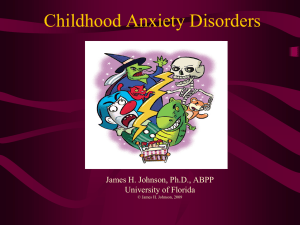
Child Anxiety Disorders
... social phobia had at some time met criteria for an additional anxiety disorder. • The anxiety disorders found most frequently were” – overanxious disorder (48% of the cases), – simple phobia (41%) and – separation anxiety disorder (26%). ...
... social phobia had at some time met criteria for an additional anxiety disorder. • The anxiety disorders found most frequently were” – overanxious disorder (48% of the cases), – simple phobia (41%) and – separation anxiety disorder (26%). ...
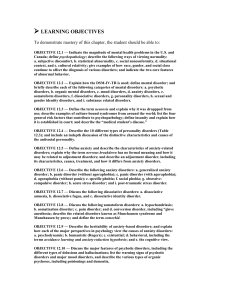
LEARNING OBJECTIVES To demonstrate mastery of this chapter
... To demonstrate mastery of this chapter, the student should be able to: OBJECTIVE 12.1 — Indicate the magnitude of mental health problems in the U.S. and Canada; define psychopathology; describe the following ways of viewing normality: a. subjective discomfort, b. statistical abnormality, c. social n ...
... To demonstrate mastery of this chapter, the student should be able to: OBJECTIVE 12.1 — Indicate the magnitude of mental health problems in the U.S. and Canada; define psychopathology; describe the following ways of viewing normality: a. subjective discomfort, b. statistical abnormality, c. social n ...
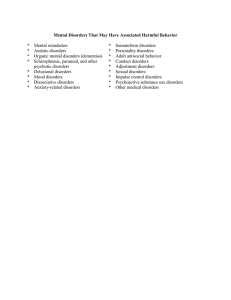
Mental Disorders That May Have Associated Harmful Behavior
... Behavior necessary to establish the diagnosis. If history of serious violation of rights of others or property (e.g. stealing, fire setting) ...
... Behavior necessary to establish the diagnosis. If history of serious violation of rights of others or property (e.g. stealing, fire setting) ...

What personality disorders are recognized by the DSM-IV-TR?
... readily admitted that the job met her two most important needs: money and attention, “two things I cannot live without.” Roxanne decided to take some psychology courses for self-improvement. She typically came to class “dressed to kill” and seemed out of place. Once she went to her professor’s offic ...
... readily admitted that the job met her two most important needs: money and attention, “two things I cannot live without.” Roxanne decided to take some psychology courses for self-improvement. She typically came to class “dressed to kill” and seemed out of place. Once she went to her professor’s offic ...

2017 Unit 12 Abnormal Psych Class Notes - Lewis
... Defining Psychological Disorders Mental health workers view psychological disorders as persistently harmful thoughts, feelings, and actions. Please be very thoughtful when speaking in this section and only share your own thoughts. Do not share other people’s stories. When behavior is deviant, distr ...
... Defining Psychological Disorders Mental health workers view psychological disorders as persistently harmful thoughts, feelings, and actions. Please be very thoughtful when speaking in this section and only share your own thoughts. Do not share other people’s stories. When behavior is deviant, distr ...

word document
... A. Recurrent episodes of binge eating. An episode of binge eating is characterized by both of the following: (1) Eating, in a discrete period of time (for example, within any 2-hour period), an amount of food that is definitely larger than most people would eat during a similar period of time under ...
... A. Recurrent episodes of binge eating. An episode of binge eating is characterized by both of the following: (1) Eating, in a discrete period of time (for example, within any 2-hour period), an amount of food that is definitely larger than most people would eat during a similar period of time under ...

Psychological Disorders - Welcome to AP Psychology
... It’s the extreme fear of being scrutinized and judged by others in social or performance situations. People with social anxiety disorder feel powerless against their anxiety. They are terrified they will humiliate or embarrass themselves. The anxiety can interfere significantly with daily routines, ...
... It’s the extreme fear of being scrutinized and judged by others in social or performance situations. People with social anxiety disorder feel powerless against their anxiety. They are terrified they will humiliate or embarrass themselves. The anxiety can interfere significantly with daily routines, ...
CBT - ETSU.edu
... leads to increased rates of anxiety disorders, depression, and substance abuse later in life, as well as to educational underachievement.2 In this issue of the Journal, the report by Walkup et al. on the Child-Adolescent Anxiety Multimodal Study (CAMS)3 addresses the need of early treatment for thes ...
... leads to increased rates of anxiety disorders, depression, and substance abuse later in life, as well as to educational underachievement.2 In this issue of the Journal, the report by Walkup et al. on the Child-Adolescent Anxiety Multimodal Study (CAMS)3 addresses the need of early treatment for thes ...
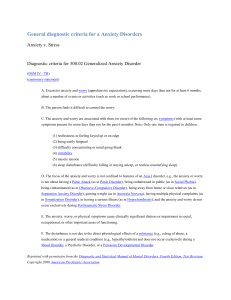
General diagnostic criteria for a Anxiety Disorders
... with what they are designed to neutralize or prevent or are clearly excessive ...
... with what they are designed to neutralize or prevent or are clearly excessive ...
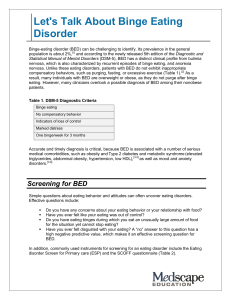
Let`s Talk About Binge Eating Disorder
... Let's Talk About Binge Eating Disorder Binge-eating disorder (BED) can be challenging to identify. Its prevalence in the general population is about 2%,[1] and according to the newly released 5th edition of the Diagnostic and Statistical Manual of Mental Disorders (DSM-5), BED has a distinct clinica ...
... Let's Talk About Binge Eating Disorder Binge-eating disorder (BED) can be challenging to identify. Its prevalence in the general population is about 2%,[1] and according to the newly released 5th edition of the Diagnostic and Statistical Manual of Mental Disorders (DSM-5), BED has a distinct clinica ...