
Mental Health
... psychotherapy in which the person learns to recognize and change thought patterns and behaviors that lead to ...
... psychotherapy in which the person learns to recognize and change thought patterns and behaviors that lead to ...

Psychological Disorders
... • Avoidant personality disorder differs from schizoid personality disorder in that avoidant individuals want to have close relationships with other people. • Some believe this disorder is really the same thing as social phobia ...
... • Avoidant personality disorder differs from schizoid personality disorder in that avoidant individuals want to have close relationships with other people. • Some believe this disorder is really the same thing as social phobia ...

Chapter 16PP part one
... I felt the need to clean my room … spent four to five hour at it … At the time I loved it but then didn't want to do it any more, but could not stop … The clothes hung … two fingers apart …I touched my bedroom wall before leaving the house … I had constant anxiety … I thought I might be nuts. Marc, ...
... I felt the need to clean my room … spent four to five hour at it … At the time I loved it but then didn't want to do it any more, but could not stop … The clothes hung … two fingers apart …I touched my bedroom wall before leaving the house … I had constant anxiety … I thought I might be nuts. Marc, ...
Unit 12 Practice-No Answers
... about swollen glands, heart palpitations, constipation, or some other physical symptom. He is sure these symptoms are a sign of cancer, even though more than a dozen physicians have told him he is physically healthy. Ruslan's behavior is most characteristic of a(n) ________ disorder. a. somatic symp ...
... about swollen glands, heart palpitations, constipation, or some other physical symptom. He is sure these symptoms are a sign of cancer, even though more than a dozen physicians have told him he is physically healthy. Ruslan's behavior is most characteristic of a(n) ________ disorder. a. somatic symp ...

Mental Disorders Crossword Puzzle
... 14. Type of disorder of impulse control characterized by impulsive, aggressive, violent behavior resulting in serious assaults and verbal outburst; degree of aggressiveness is out of proportion to the provocation or situational stress 15. Mental condition where a person suffers from neurologic sympt ...
... 14. Type of disorder of impulse control characterized by impulsive, aggressive, violent behavior resulting in serious assaults and verbal outburst; degree of aggressiveness is out of proportion to the provocation or situational stress 15. Mental condition where a person suffers from neurologic sympt ...
Is it an Anxiety Disorder?
... medical condition or high risk for developing a general medical condition is present, the illness concerns are clearly excessive or disproportionate. The individual's concern is focused not on any physical distress per se, but rather on a suspected, underlying medical diagnosis. C. High level of anx ...
... medical condition or high risk for developing a general medical condition is present, the illness concerns are clearly excessive or disproportionate. The individual's concern is focused not on any physical distress per se, but rather on a suspected, underlying medical diagnosis. C. High level of anx ...


Durand and Barlow Chapter 4: Anxiety Disorders
... Anxiety and Fear are Normal Emotional States From Normal to Disordered Anxiety and Fear Characteristics of Anxiety Disorders – Psychological disorders – Pervasive and persistent symptoms of anxiety and fear – Involve excessive avoidance and escapist tendencies – Symptoms and avoidance causes clinica ...
... Anxiety and Fear are Normal Emotional States From Normal to Disordered Anxiety and Fear Characteristics of Anxiety Disorders – Psychological disorders – Pervasive and persistent symptoms of anxiety and fear – Involve excessive avoidance and escapist tendencies – Symptoms and avoidance causes clinica ...

How to Help Your Child: A Parent`s Guide to OCD
... ERP is the first line of treatment for OCD in children. Many children can learn to manage the disorder with ERP therapy alone. However, if a child’s symptoms are severe and debilitating, or if therapy does not provide sufficient relief, antidepressant drugs that selectively affect the neurotransmitt ...
... ERP is the first line of treatment for OCD in children. Many children can learn to manage the disorder with ERP therapy alone. However, if a child’s symptoms are severe and debilitating, or if therapy does not provide sufficient relief, antidepressant drugs that selectively affect the neurotransmitt ...
Mood Disorders
... Psychosis: A loss of contact with reality, usually including delusions & hallucinations. Can be caused by drugs (using & withdrawal), brain tumors, dementia & other brain diseases..plus certain psychiatric disorders Neurosis: a relatively mild mental illness that is not caused by physical disease, i ...
... Psychosis: A loss of contact with reality, usually including delusions & hallucinations. Can be caused by drugs (using & withdrawal), brain tumors, dementia & other brain diseases..plus certain psychiatric disorders Neurosis: a relatively mild mental illness that is not caused by physical disease, i ...

Child and Adolescent Psychopathology
... Rebuttal: Incorrect diagnoses may lead to stigma, but correct diagnoses may actually lead to reduced stigma by providing an explanation for otherwise unexplainable behavior (Ruscio, 2004) ...
... Rebuttal: Incorrect diagnoses may lead to stigma, but correct diagnoses may actually lead to reduced stigma by providing an explanation for otherwise unexplainable behavior (Ruscio, 2004) ...
Disruptive, Impulse-Control and Conduct Disorders
... improve one’s living circumstances, in response to a delusion or hallucination, or as a result of impaired judgment F. The fire setting is not better explained by conduct disorder, a manic episode, or antisocial personality disorder. ...
... improve one’s living circumstances, in response to a delusion or hallucination, or as a result of impaired judgment F. The fire setting is not better explained by conduct disorder, a manic episode, or antisocial personality disorder. ...
Mood and Anxiety Disorders
... NIMH Research Domain Criteria (RDoC) • RDoC is intended as a framework to guide classification of patients for research studies, not as an immediately useful clinical tool ...
... NIMH Research Domain Criteria (RDoC) • RDoC is intended as a framework to guide classification of patients for research studies, not as an immediately useful clinical tool ...
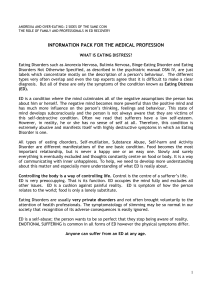
full GP information pack
... something they do or say, and it is taken as a personal judgement. ED person is not just a need for approval, but a hunger for care and affection as well. Despite the feeling of dependency, people with ED don’t want to rely on or need other people. Feeling dependent or needy leaves them feeling weak ...
... something they do or say, and it is taken as a personal judgement. ED person is not just a need for approval, but a hunger for care and affection as well. Despite the feeling of dependency, people with ED don’t want to rely on or need other people. Feeling dependent or needy leaves them feeling weak ...

Generalized anxiety disorder and personality traits
... After much research he concludes that whether people are extraverted or introverted relates significantly to anxiety. For example the introvert is quiet, introspective, and reserved. When stress occurs, the introvert is apt to lapse into various neuroses. In treating anxiety disorder, it is useful t ...
... After much research he concludes that whether people are extraverted or introverted relates significantly to anxiety. For example the introvert is quiet, introspective, and reserved. When stress occurs, the introvert is apt to lapse into various neuroses. In treating anxiety disorder, it is useful t ...


SpEd-OHD-ADHD-MEDICAL-DOCUMENTATION-blank
... Directions: Please indicate Attention-Deficit/Hyperactivity Disorder criteria by checking any/all symptoms that apply as indicated by your evaluation. Diagnostic and Statistical Manual of Mental Disorders DSM-5 A. A persistent pattern of inattention and/or hyperactivity-impulsivity that interferes w ...
... Directions: Please indicate Attention-Deficit/Hyperactivity Disorder criteria by checking any/all symptoms that apply as indicated by your evaluation. Diagnostic and Statistical Manual of Mental Disorders DSM-5 A. A persistent pattern of inattention and/or hyperactivity-impulsivity that interferes w ...

Chapter 3 CLASSIFICATION OF MENTAL DISORDERS This chapter
... possible to have a mental disorder, and a psychotic symptom, but not to have a greatly reduced capacity to function in everyday life. Thus, it is possible to have a psychotic symptom without having a fully developed psychotic disorder. Consider a person who has suffered an acute psychotic disorder, ...
... possible to have a mental disorder, and a psychotic symptom, but not to have a greatly reduced capacity to function in everyday life. Thus, it is possible to have a psychotic symptom without having a fully developed psychotic disorder. Consider a person who has suffered an acute psychotic disorder, ...
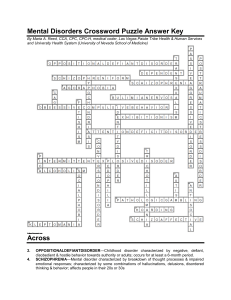
Mental Disorders Crossword Puzzle Answer Key Across
... continuously gamble despite negative consequences or desire OBSESSIVECOMPULSIVEBEHAVIOR—An anxiety disorder characterized by unreasonable, unwanted thoughts & fears (obsessions) that lead to repetitive behavior (compulsion) AGORAPHOBIA—Condition where an individual has intense fear & anxiety of any ...
... continuously gamble despite negative consequences or desire OBSESSIVECOMPULSIVEBEHAVIOR—An anxiety disorder characterized by unreasonable, unwanted thoughts & fears (obsessions) that lead to repetitive behavior (compulsion) AGORAPHOBIA—Condition where an individual has intense fear & anxiety of any ...
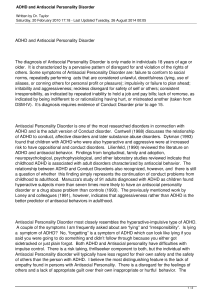
ADHD and Antisocial Personality Disorder
... section, Antisocial Personality disorder is not easily and quickly treated. The personality disorders in general are long standing patterns of behavior and personality that have developed over a life time. Individuals with personality disorders are so familiar with the symptoms and behaviors that ...
... section, Antisocial Personality disorder is not easily and quickly treated. The personality disorders in general are long standing patterns of behavior and personality that have developed over a life time. Individuals with personality disorders are so familiar with the symptoms and behaviors that ...
Anxiety Disorders
... 30% of persons with agoraphobia have panic attacks or panic disorder Confers higher risk of other anxiety disorders, depressive and ...
... 30% of persons with agoraphobia have panic attacks or panic disorder Confers higher risk of other anxiety disorders, depressive and ...

Durand and Barlow Chapter 5: Somatoform and Dissociative
... – Substantial impairment in social or occupational functioning – Concerned over the symptoms themselves, not what they might mean – Symptoms become the person’s identity ...
... – Substantial impairment in social or occupational functioning – Concerned over the symptoms themselves, not what they might mean – Symptoms become the person’s identity ...

Comer, Abnormal Psychology, 8th edition
... The precise causes of factitious disorder are not understood, although clinical reports have pointed to factors such as depression, unsupportive parental relationships during childhood, and an extreme need for social support Clinicians have been unable to develop dependably effective treatments for ...
... The precise causes of factitious disorder are not understood, although clinical reports have pointed to factors such as depression, unsupportive parental relationships during childhood, and an extreme need for social support Clinicians have been unable to develop dependably effective treatments for ...

Dissociation Disorder: What is it and Is There Treatment for it? A
... Depersonalization/derealization is the most commonly seen disorder among the dissociative disorders classification . It is the one disorder that most clinicians run across in their practice and often confuse with major depression. Over time, depersonalization disorder leads to despondence and obses ...
... Depersonalization/derealization is the most commonly seen disorder among the dissociative disorders classification . It is the one disorder that most clinicians run across in their practice and often confuse with major depression. Over time, depersonalization disorder leads to despondence and obses ...