Module 12: Effects of Stress
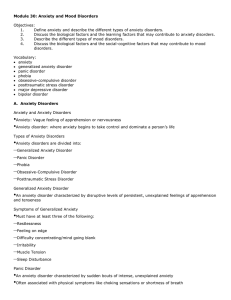
... •Often associated with physical symptoms like choking sensations or shortness of breath ...
... •Often associated with physical symptoms like choking sensations or shortness of breath ...
Disorders Classification + Answer Key
... Directions: Using the cards provided by your instructor determine to which category of illnesses belongs. In the second column find the characteristics that best suit each of the categories of illnesses. In the third column create your own example of an individual experiencing one of the disorders i ...
... Directions: Using the cards provided by your instructor determine to which category of illnesses belongs. In the second column find the characteristics that best suit each of the categories of illnesses. In the third column create your own example of an individual experiencing one of the disorders i ...
Basic Statistics for the Behavioral Sciences
... • Concept of “personality” in psychology means three things: – Refers to individual’s recognizable behaviors in which pattern, order, and regularity can be identified – Personality is a psychological construct – Personality influences how we respond but also causes us to act in certain ways ...
... • Concept of “personality” in psychology means three things: – Refers to individual’s recognizable behaviors in which pattern, order, and regularity can be identified – Personality is a psychological construct – Personality influences how we respond but also causes us to act in certain ways ...
DSM-5: A First Look - Mental Health Heroes
... homogeneous populations for treatment and research resulted in narrow diagnostic categories that did not capture clinical reality, symptom heterogeneity within disorders, and significant sharing of symptoms across multiple disorders.” (p12) ...
... homogeneous populations for treatment and research resulted in narrow diagnostic categories that did not capture clinical reality, symptom heterogeneity within disorders, and significant sharing of symptoms across multiple disorders.” (p12) ...
Psychological Disord..
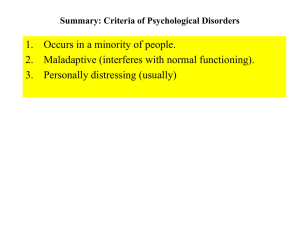
... “Each of the mental disorders is conceptualized as: A clinically significant (=abnormal) behavioural or psychological syndrome or pattern that – Occurs in a person and that is associated with present distress (a painful symptom) – Or disability (impairment in one or more important areas of functioni ...
... “Each of the mental disorders is conceptualized as: A clinically significant (=abnormal) behavioural or psychological syndrome or pattern that – Occurs in a person and that is associated with present distress (a painful symptom) – Or disability (impairment in one or more important areas of functioni ...
Are responsibility beliefs inflated in non
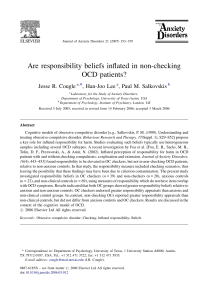
... measured by the RIQ frequency scores) were noted relative to both healthy and anxious controls for both OCD groups. The belief ratings for responsibility appraisals in non-checking OCD patients as compared to anxious controls did not significantly differ; examination of the means suggest that this m ...
... measured by the RIQ frequency scores) were noted relative to both healthy and anxious controls for both OCD groups. The belief ratings for responsibility appraisals in non-checking OCD patients as compared to anxious controls did not significantly differ; examination of the means suggest that this m ...

psychological disorders
... Any behavior or emotional state that causes an individual great suffering or worry, is self-defeating or self-destructive, or is maladaptive and disrupts the person’s relationship to the larger community, ...
... Any behavior or emotional state that causes an individual great suffering or worry, is self-defeating or self-destructive, or is maladaptive and disrupts the person’s relationship to the larger community, ...

Abnormal Psychology
... Learned Helplessness (prior events convince a person of the inability to control future) = passivity and depression More prevalent in Western societies Epidemic hopelessness due to individualism and decline of commitment to family and religion ...
... Learned Helplessness (prior events convince a person of the inability to control future) = passivity and depression More prevalent in Western societies Epidemic hopelessness due to individualism and decline of commitment to family and religion ...
The Numbers Count: Mental Disorders in America
... developmental disorders. ASDs range in severity, with autism being the most debilitating form while other disorders, such as Asperger syndrome, produce milder symptoms. ...
... developmental disorders. ASDs range in severity, with autism being the most debilitating form while other disorders, such as Asperger syndrome, produce milder symptoms. ...


Discussion Questions
... ANRED: Anorexia Nervosa and Related Eating Disorders This is a nonprofit organization that provides information about anorexia nervosa, bulimia nervosa, binge eating disorder, compulsive exercising, and other less well-known food and weight disorders. Their material includes details about recovery a ...
... ANRED: Anorexia Nervosa and Related Eating Disorders This is a nonprofit organization that provides information about anorexia nervosa, bulimia nervosa, binge eating disorder, compulsive exercising, and other less well-known food and weight disorders. Their material includes details about recovery a ...
Dissociative identity disorder.
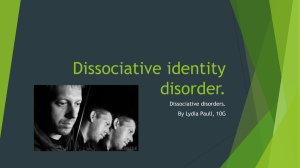
... There is no particular age that is starts but you are more vulnerable as a child, Diagnosis of dissociative identity disorder is usually made in adulthood. (WebMD, 2015) ...
... There is no particular age that is starts but you are more vulnerable as a child, Diagnosis of dissociative identity disorder is usually made in adulthood. (WebMD, 2015) ...
DSM-5 - Wiley
... Over a month’s time, a change of more than 5% of body weight should be noted to be considered significant. Eating behaviors and appetite change need to be examined over a 1-month time frame as opposed to the 2 weeks relevant to the condition; Therefore, counting this criterion for the diagnosis requ ...
... Over a month’s time, a change of more than 5% of body weight should be noted to be considered significant. Eating behaviors and appetite change need to be examined over a 1-month time frame as opposed to the 2 weeks relevant to the condition; Therefore, counting this criterion for the diagnosis requ ...
Classifying and treating personality disorders: back to the future?
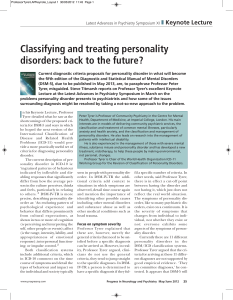
... treatment, nidotherapy, to help these people by making environmental, not personal, changes. Professor Tyrer is Chair of the World Health Organization ICD-11 Working Group for the Revision of Classification of Personality Disorders. ...
... treatment, nidotherapy, to help these people by making environmental, not personal, changes. Professor Tyrer is Chair of the World Health Organization ICD-11 Working Group for the Revision of Classification of Personality Disorders. ...

General Classification of Psychiatric Disorders
... developed a tolerance, (b) the substance is taken more frequently and in more dangerous situations such as drinking and driving, or (c) the person continues to take the substance despite negative results and/or the desire to quit, or (d) withdrawal symptoms are present when the substance is stopped, ...
... developed a tolerance, (b) the substance is taken more frequently and in more dangerous situations such as drinking and driving, or (c) the person continues to take the substance despite negative results and/or the desire to quit, or (d) withdrawal symptoms are present when the substance is stopped, ...
Personality Disorders
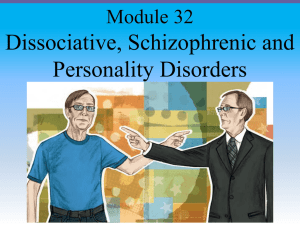
... • The brain of those with schizophrenia operates differently than the normal brain. • The frontal lobes show less activity. • Those with schizophrenia have a larger number of receptor sites for the neurotransmitter dopamine. ...
... • The brain of those with schizophrenia operates differently than the normal brain. • The frontal lobes show less activity. • Those with schizophrenia have a larger number of receptor sites for the neurotransmitter dopamine. ...

Somatic Disorders DSM V Handout
... A. One or more somatic symptoms that are distressing or result in significant disruption of daily life. B. Excessive thoughts, feelings, or behaviors related to the somatic symptoms or associated health concerns as manifested by at least one of the following: 1. Disproportionate and persistent thoug ...
... A. One or more somatic symptoms that are distressing or result in significant disruption of daily life. B. Excessive thoughts, feelings, or behaviors related to the somatic symptoms or associated health concerns as manifested by at least one of the following: 1. Disproportionate and persistent thoug ...
Obsession Subtypes. Relationships with - e-Spacio
... hypotheses is still scarce. Thefíndingsfromsome correlational studies suggest that different presentations of obsessive-compulsive symptoms may be especially associated with different OCD-related beliefs (Emmelkamp, & Aardema, 1999; Faull, Joseph, Meaden, & Lawrence, 2004; Taylor et al, 2006; Tolin, ...
... hypotheses is still scarce. Thefíndingsfromsome correlational studies suggest that different presentations of obsessive-compulsive symptoms may be especially associated with different OCD-related beliefs (Emmelkamp, & Aardema, 1999; Faull, Joseph, Meaden, & Lawrence, 2004; Taylor et al, 2006; Tolin, ...

Anxiety Disorders - NAMI
... But what if you were to find yourself feeling anxious most of the time instead of just under specific circumstances? What if you couldn't even find a particular reason for feeling this way? What if you found yourself avoiding certain everyday routines or activities altogether in an effort to curb th ...
... But what if you were to find yourself feeling anxious most of the time instead of just under specific circumstances? What if you couldn't even find a particular reason for feeling this way? What if you found yourself avoiding certain everyday routines or activities altogether in an effort to curb th ...

Abnormal Psychology
... U.S. posed to rank #1 in mental illness… So what is a mental illness and what criteria qualify somehow as mentally ill…? ...
... U.S. posed to rank #1 in mental illness… So what is a mental illness and what criteria qualify somehow as mentally ill…? ...
Chapter Outline
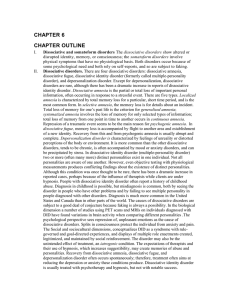
... Dissociative and somatoform disorders The dissociative disorders show altered or disrupted identity, memory, or consciousness; the somatoform disorders involve physical symptoms that have no physiological basis. Both disorders occur because of some psychological need and both rely on self-reports, a ...
... Dissociative and somatoform disorders The dissociative disorders show altered or disrupted identity, memory, or consciousness; the somatoform disorders involve physical symptoms that have no physiological basis. Both disorders occur because of some psychological need and both rely on self-reports, a ...
Comorbidity - VCU Autism Center for Excellence
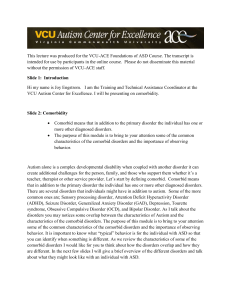
... Compulsions can be described as repetitive behaviors or mental acts that the person feels driven to perform in response to an obsession. These acts are aimed at preventing or reducing distress or preventing some dreaded event or situation. These behaviors or mental acts either are not connected real ...
... Compulsions can be described as repetitive behaviors or mental acts that the person feels driven to perform in response to an obsession. These acts are aimed at preventing or reducing distress or preventing some dreaded event or situation. These behaviors or mental acts either are not connected real ...
DSM-5 Overview
... • The APA created the DSM, which contains sets of diagnostic criteria (symptoms being experienced) grouped into categories (disorders) to assist clinicians with effective diagnoses and care of people with mental health disorders. There are several diagnostic criteria manuals used worldwide, but the ...
... • The APA created the DSM, which contains sets of diagnostic criteria (symptoms being experienced) grouped into categories (disorders) to assist clinicians with effective diagnoses and care of people with mental health disorders. There are several diagnostic criteria manuals used worldwide, but the ...

Class 8: Mental Illness and Diagnosis
... • Provisional Diagnosis – May be used if there is a strong presumption that the full criteria will be met but there is not enough information available (i.e., the individual cannot give a full history) – Diagnosis or differential diagnosis is dependent on length of time ...
... • Provisional Diagnosis – May be used if there is a strong presumption that the full criteria will be met but there is not enough information available (i.e., the individual cannot give a full history) – Diagnosis or differential diagnosis is dependent on length of time ...
Unit 1 Notes: Psychological Disorders
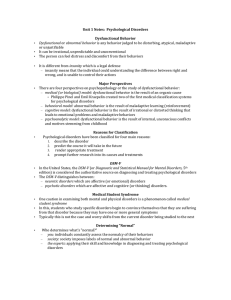
... DSM-V In the United States, the DSM-V (or Diagnostic and Statistical Manual for Mental Disorders, 5th edition) is considered the authoritative source on diagnosing and treating psychological disorders The DSM-V distinguishes between: – neurotic disorders which are affective (or emotional) disorders ...
... DSM-V In the United States, the DSM-V (or Diagnostic and Statistical Manual for Mental Disorders, 5th edition) is considered the authoritative source on diagnosing and treating psychological disorders The DSM-V distinguishes between: – neurotic disorders which are affective (or emotional) disorders ...