
Acne as a Potential Adverse Effect of Duloxetine
... with the treatment of particular anti-depressants, specifically amineptine 4-9, making it imperative for physicians to be well aware of all potential adverse effects their patients experience in relation to their pharmacological treatment. Our clinic recently observed a 25-year-old female patient ...
... with the treatment of particular anti-depressants, specifically amineptine 4-9, making it imperative for physicians to be well aware of all potential adverse effects their patients experience in relation to their pharmacological treatment. Our clinic recently observed a 25-year-old female patient ...
chapter8-phobia-and-personality-disorder-rica
... life. Others indicate that people are genetically predisposed to personality disorders. In some cases, however, environmental facts may cause a person who is already genetically vulnerable to develop a personality disorder. ...
... life. Others indicate that people are genetically predisposed to personality disorders. In some cases, however, environmental facts may cause a person who is already genetically vulnerable to develop a personality disorder. ...

Psychological Disorders
... • is marked by a feeling of detachment or distance from one's own experience, body, or self. One can easily relate to feeling as they are in a dream, or being "spaced out." A person's experience with depersonalization can be so severe that he or she believes the external world is unreal or distorted ...
... • is marked by a feeling of detachment or distance from one's own experience, body, or self. One can easily relate to feeling as they are in a dream, or being "spaced out." A person's experience with depersonalization can be so severe that he or she believes the external world is unreal or distorted ...
DIRECTIONS: (Items 1-28) Each of the questions or incomplete
... 28. According to DSM-IV, if an individual was expected to weight 120 pounds but currently weights 100 pounds, refuses to eat, fears gaining weight, and binges and purges daily would meet diagnostic criteria for? A. B. C. D. E. ...
... 28. According to DSM-IV, if an individual was expected to weight 120 pounds but currently weights 100 pounds, refuses to eat, fears gaining weight, and binges and purges daily would meet diagnostic criteria for? A. B. C. D. E. ...

Child and Adolescent Psychopathology
... 2) Parents maintain control over eating, but sessions turn to identify cognitions that are underlying eating disorder 3) Patient assumes responsibility for his/her own eating and weight Evidence indicates this is a promising therapy ...
... 2) Parents maintain control over eating, but sessions turn to identify cognitions that are underlying eating disorder 3) Patient assumes responsibility for his/her own eating and weight Evidence indicates this is a promising therapy ...
Slide 1
... Clinical syndromes (Axis I) 1. Childhood disorders 2. Organic mental disorders 3. Substance related 4. Schizophrenia and other psychotic disorders 5. Mood disorders ...
... Clinical syndromes (Axis I) 1. Childhood disorders 2. Organic mental disorders 3. Substance related 4. Schizophrenia and other psychotic disorders 5. Mood disorders ...

MPHLECTURE6 - health and wellness
... Mood swings or other mood symptoms, such as depression or mania ...
... Mood swings or other mood symptoms, such as depression or mania ...

a PowerPoint Presentation of Module 48
... Cognition includes worried thoughts, as well as interpretations, appraisals, beliefs, predictions, and ruminations. Cognition includes mental habits such as hypervigilance (persistently watching out for danger). This accompanies anxiety in PTSD. In anxiety disorders, such cognitions appear rep ...
... Cognition includes worried thoughts, as well as interpretations, appraisals, beliefs, predictions, and ruminations. Cognition includes mental habits such as hypervigilance (persistently watching out for danger). This accompanies anxiety in PTSD. In anxiety disorders, such cognitions appear rep ...

Psychological Disorders - Eric Sweetwood's PTHS Psychology
... compelling desire to avoid a situation in which the individual is exposed to possible scrutiny by others and fears he or she may act in a way that will be humiliating or embarrassing". Social phobias often develop in adolescence and include a fear of criticism, fear of making mistakes and fear of pu ...
... compelling desire to avoid a situation in which the individual is exposed to possible scrutiny by others and fears he or she may act in a way that will be humiliating or embarrassing". Social phobias often develop in adolescence and include a fear of criticism, fear of making mistakes and fear of pu ...
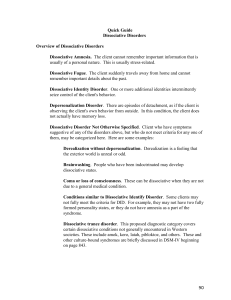
Quick Guide
... client may not remember important aspects of personal history. Acute Stress Disorder. Immediately following a severe trauma, clients may not remember important aspects of personal history. Substance-Induced Disorders. Use of alcohol or other substances may produce blackouts, in which the client does ...
... client may not remember important aspects of personal history. Acute Stress Disorder. Immediately following a severe trauma, clients may not remember important aspects of personal history. Substance-Induced Disorders. Use of alcohol or other substances may produce blackouts, in which the client does ...
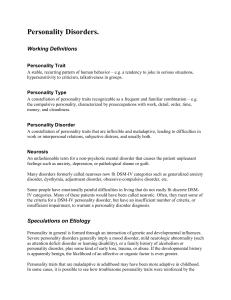
Personality Disorders
... Obsessive-compulsive personality Preoccupation with orderliness, perfectionism, and mental and interpersonal control, at the expense of flexibility. (Note: obsessive-compulsive personality disorder, an Axis II diagnosis, is different from obsessive-compulsive disorder, an Axis I diagnosis. People wi ...
... Obsessive-compulsive personality Preoccupation with orderliness, perfectionism, and mental and interpersonal control, at the expense of flexibility. (Note: obsessive-compulsive personality disorder, an Axis II diagnosis, is different from obsessive-compulsive disorder, an Axis I diagnosis. People wi ...
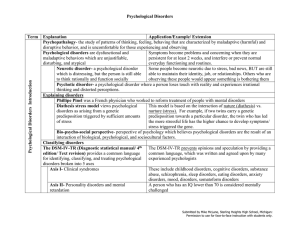
13A-Psychdisorder-table - Miami Beach Senior High School
... Heredity- some people have a genetic predisposition that could lead to the development of an anxiety disorder Brain- people who have anxiety disorders Frontal lobes are in charge of thinking and planning, which could experience heightened activity in frontal explain why heightened activity would lea ...
... Heredity- some people have a genetic predisposition that could lead to the development of an anxiety disorder Brain- people who have anxiety disorders Frontal lobes are in charge of thinking and planning, which could experience heightened activity in frontal explain why heightened activity would lea ...
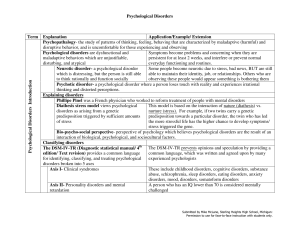
Psychological Disorders Term Explanation Application
... Heredity- some people have a genetic predisposition that could lead to the development of an anxiety disorder Brain- people who have anxiety disorders Frontal lobes are in charge of thinking and planning, which could experience heightened activity in frontal explain why heightened activity would lea ...
... Heredity- some people have a genetic predisposition that could lead to the development of an anxiety disorder Brain- people who have anxiety disorders Frontal lobes are in charge of thinking and planning, which could experience heightened activity in frontal explain why heightened activity would lea ...

15% of the population has a personality disorder
... disorder experience the other. Similarities between the two disorders include a fear of humiliation and low self-confidence. A key difference is that people with social anxiety disorder mainly fear social circumstances, while people with avoidant personality disorder tend to fear close social relati ...
... disorder experience the other. Similarities between the two disorders include a fear of humiliation and low self-confidence. A key difference is that people with social anxiety disorder mainly fear social circumstances, while people with avoidant personality disorder tend to fear close social relati ...
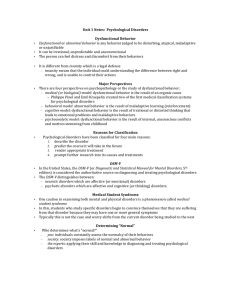
Unit 1 Notes: Psychological Disorders Dysfunctional Behavior
... DSM-‐V In the United States, the DSM-‐V (or Diagnostic and Statistical Manual for Mental Disorders, 5th edition) is considered the authoritative source on diagnosing and treating psychological disorders The D ...
... DSM-‐V In the United States, the DSM-‐V (or Diagnostic and Statistical Manual for Mental Disorders, 5th edition) is considered the authoritative source on diagnosing and treating psychological disorders The D ...

eating disorder
... • Most individuals with the binge-eating/purging type of anorexia nervosa who binge eat also purge through self-induced vomiting or the misuse of laxatives, diuretics, or enemas. • Some individuals with this subtype of anorexia nervosa do not binge eat but do regularly purge after the consumption of ...
... • Most individuals with the binge-eating/purging type of anorexia nervosa who binge eat also purge through self-induced vomiting or the misuse of laxatives, diuretics, or enemas. • Some individuals with this subtype of anorexia nervosa do not binge eat but do regularly purge after the consumption of ...

GEETA MUDHAR
... sleep and appetite disturbances, fatigue, loss of interest in favorite activities, concentrating problems, self-loathing, apathy, shyness, depersonalization, lack of motivation, irritability, pain or suicidal thoughts. During drastic levels of depressions, these people might become psychotic. This p ...
... sleep and appetite disturbances, fatigue, loss of interest in favorite activities, concentrating problems, self-loathing, apathy, shyness, depersonalization, lack of motivation, irritability, pain or suicidal thoughts. During drastic levels of depressions, these people might become psychotic. This p ...

Anxiety Disorder
... 3. maladaptive- harmful; causes suffering 4. unjustifiable- sometimes there’s a good reason ...
... 3. maladaptive- harmful; causes suffering 4. unjustifiable- sometimes there’s a good reason ...
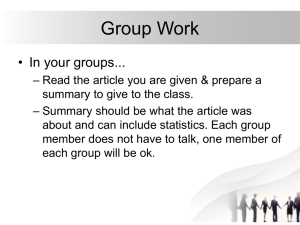
Lesson 9 "Developing a Healthy Mind"
... – Read the article you are given & prepare a summary to give to the class. – Summary should be what the article was about and can include statistics. Each group member does not have to talk, one member of each group will be ok. ...
... – Read the article you are given & prepare a summary to give to the class. – Summary should be what the article was about and can include statistics. Each group member does not have to talk, one member of each group will be ok. ...
Personality Disorders
... -Attachment Theory: speculates that any disruption in bonding will cause individuals to be constantly anxious that they will lose people close to them ...
... -Attachment Theory: speculates that any disruption in bonding will cause individuals to be constantly anxious that they will lose people close to them ...


available now #2
... Depression? What to Ask • Who’s Your Daddy? – Family history of : • Psychiatric Hospitalizations • Suicide • ECT • Anyone who took lithium, mood stabilizers, antipsychotics or antidepressants • Postpartum mood episode, especially psychosis ...
... Depression? What to Ask • Who’s Your Daddy? – Family history of : • Psychiatric Hospitalizations • Suicide • ECT • Anyone who took lithium, mood stabilizers, antipsychotics or antidepressants • Postpartum mood episode, especially psychosis ...

Myers3-Ch 13
... Post traumatic Stress Disorder (PTSD) Post Traumatic stress disorder (PTSD) A disorder characterized by haunting memories, nightmares, social withdrawal, jumpy anxiety, numbness of feeling, and/or insomnia lingering for four weeks or more after a traumatic experience Often involves battle-scarred v ...
... Post traumatic Stress Disorder (PTSD) Post Traumatic stress disorder (PTSD) A disorder characterized by haunting memories, nightmares, social withdrawal, jumpy anxiety, numbness of feeling, and/or insomnia lingering for four weeks or more after a traumatic experience Often involves battle-scarred v ...
File
... Concept that diseases have physical causes Can be diagnosed, treated, and in most cases, cured Assumes that these “mental” illnesses can be diagnosed on the basis of their symptoms and cured through therapy, which may include treatment in a psychiatric hospital (p.533) ...
... Concept that diseases have physical causes Can be diagnosed, treated, and in most cases, cured Assumes that these “mental” illnesses can be diagnosed on the basis of their symptoms and cured through therapy, which may include treatment in a psychiatric hospital (p.533) ...