
Psychological Disorders - BowkerPsych
... criminal behavior, believing that their victims are weak and deserving of being taken advantage of. They tend to lie and steal ...
... criminal behavior, believing that their victims are weak and deserving of being taken advantage of. They tend to lie and steal ...
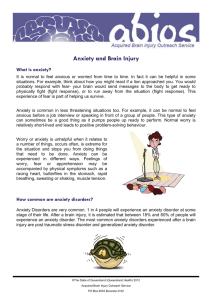
Anxiety and Brain Injury
... having another panic attack, and may be afraid to be away from home or far from ...
... having another panic attack, and may be afraid to be away from home or far from ...

I. Introduction: Understanding Psychological Disorders
... a slightly higher level of violent and illegal behavior than do “normal” people. d. “. . . there is very little risk of violence or harm to a stranger from casual contact with an individual who has a mental isorder.” A. What Is a Psychological Disorder? 1. A psychological disorder or mental disorder ...
... a slightly higher level of violent and illegal behavior than do “normal” people. d. “. . . there is very little risk of violence or harm to a stranger from casual contact with an individual who has a mental isorder.” A. What Is a Psychological Disorder? 1. A psychological disorder or mental disorder ...
Affective and Personality Disorder
... Difficulty controlling anger Transient dissociative symptoms ...
... Difficulty controlling anger Transient dissociative symptoms ...

DSM-IV-TR to DSM-V
... A mental disorder is a syndrome characterized by clinically significant disturbance in a individual’s cognition, emotion regulation, or behavior that reflects a dysfunction in the psychological, biological, or developmental ...
... A mental disorder is a syndrome characterized by clinically significant disturbance in a individual’s cognition, emotion regulation, or behavior that reflects a dysfunction in the psychological, biological, or developmental ...

Chapter 14
... Figure 14.F04: St. Elizabeth's Psychiatric Hospital, in Washington, D.C., was one of the sites of the Roesnhan Pseudopatient Study Courtesy of Library of Congress, Prints & ...
... Figure 14.F04: St. Elizabeth's Psychiatric Hospital, in Washington, D.C., was one of the sites of the Roesnhan Pseudopatient Study Courtesy of Library of Congress, Prints & ...

A Measure of Conduct Disorder for Incarcerated
... • MACI item responses were scored via computer scoring software and entered into a database for analysis. ...
... • MACI item responses were scored via computer scoring software and entered into a database for analysis. ...
Module 23 - WLWV Staff Blogs
... • Mood disorders – prolonged and disturbed emotional state that affects almost all of a person’s thoughts, feelings, and behaviors • Major depression – major depressive disorder – marked by at least two weeks of continually being in a bad mood, having no interest in anything, and getting no pleasure ...
... • Mood disorders – prolonged and disturbed emotional state that affects almost all of a person’s thoughts, feelings, and behaviors • Major depression – major depressive disorder – marked by at least two weeks of continually being in a bad mood, having no interest in anything, and getting no pleasure ...
PERSONALITY DISORDERS and the “difficult patient”
... attractiveness. Failure to recognize others needs and feelings. Envious of others and think people envy them. Lack empathy. Use subterfuge. Cannot ...
... attractiveness. Failure to recognize others needs and feelings. Envious of others and think people envy them. Lack empathy. Use subterfuge. Cannot ...

Memory - Oakton Community College
... mental disorders, they started using medical models to review the physical causes of these disorders. A mental illness must be diagnosed on the basis of symptoms and cured through therapy which may include treatment in a hospital. ...
... mental disorders, they started using medical models to review the physical causes of these disorders. A mental illness must be diagnosed on the basis of symptoms and cured through therapy which may include treatment in a hospital. ...
Antecedents of Personality Disorders in Young
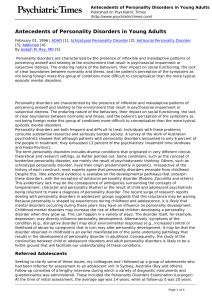
... Personality disorders are characterized by the presence of inflexible and maladaptive patterns of perceiving oneself and relating to the environment that result in psychosocial impairment or subjective distress. The enduring nature of the behaviors, their impact on social functioning, the lack of cl ...
... Personality disorders are characterized by the presence of inflexible and maladaptive patterns of perceiving oneself and relating to the environment that result in psychosocial impairment or subjective distress. The enduring nature of the behaviors, their impact on social functioning, the lack of cl ...

No adaptations for Mild to Moderate ID
... • Repetitive behaviors (hand washing, ordering, checking, asking questions, hoarding or rubbing) or mental acts (praying, counting repeating words silently) that the person feels driven to perform according to rules that must be applied rigidly • Behaviors are aimed at preventing or reducing distres ...
... • Repetitive behaviors (hand washing, ordering, checking, asking questions, hoarding or rubbing) or mental acts (praying, counting repeating words silently) that the person feels driven to perform according to rules that must be applied rigidly • Behaviors are aimed at preventing or reducing distres ...

DSM___Multiaxial_Diagnosis_1
... Organization of One Disorder Features Associated features and disorders Associated laboratory findings Culture, age and gender features Course of the disorder Prevalence of the disorder Differential diagnosis guidelines Criteria for episode or disorder ...
... Organization of One Disorder Features Associated features and disorders Associated laboratory findings Culture, age and gender features Course of the disorder Prevalence of the disorder Differential diagnosis guidelines Criteria for episode or disorder ...

Behavioral/Social Learning Perspective
... Choose one: A. Becoming a success is a matter of hard work; luck has little or nothing to do with it. B. Getting a good job depends mainly on being in the right place at the right time. ...
... Choose one: A. Becoming a success is a matter of hard work; luck has little or nothing to do with it. B. Getting a good job depends mainly on being in the right place at the right time. ...

pptx
... Choose one: A. Becoming a success is a matter of hard work; luck has little or nothing to do with it. B. Getting a good job depends mainly on being in the right place at the right time. ...
... Choose one: A. Becoming a success is a matter of hard work; luck has little or nothing to do with it. B. Getting a good job depends mainly on being in the right place at the right time. ...
SOMATIC SYMPTOM and RELATED DISORDERS
... GP over many years. Her complaints have varied and include abdominal pain, dysuria, dysmennorhea, and tiredness. Over the years she has been referred to gynecologists, urologists, and general surgeons. Extensive investigations have revealed no clear cause for her symptoms. Despite this, she remains ...
... GP over many years. Her complaints have varied and include abdominal pain, dysuria, dysmennorhea, and tiredness. Over the years she has been referred to gynecologists, urologists, and general surgeons. Extensive investigations have revealed no clear cause for her symptoms. Despite this, she remains ...

8th Edition
... I felt the need to clean my room … spent four to five hour at it … At the time I loved it but then didn't want to do it any more, but could not stop … The clothes hung … two fingers apart …I touched my bedroom wall before leaving the house … I had constant anxiety … I thought I might be nuts. Marc, ...
... I felt the need to clean my room … spent four to five hour at it … At the time I loved it but then didn't want to do it any more, but could not stop … The clothes hung … two fingers apart …I touched my bedroom wall before leaving the house … I had constant anxiety … I thought I might be nuts. Marc, ...
Disorders Usually First Diagnosed in Infancy, Childhood
... Disorders Usually First Diagnosed in Infancy, Childhood, or Adolescence Mental Retardation; Learning Disorders Communication Disorders Autistic Spectrum Disorders Attention-Deficit and Disruptive Behavior Disorders Feeding and Eating Disorders of Infancy or Early Childhood Tic Disorders Other Disor ...
... Disorders Usually First Diagnosed in Infancy, Childhood, or Adolescence Mental Retardation; Learning Disorders Communication Disorders Autistic Spectrum Disorders Attention-Deficit and Disruptive Behavior Disorders Feeding and Eating Disorders of Infancy or Early Childhood Tic Disorders Other Disor ...
( ! ) Notice: Undefined index
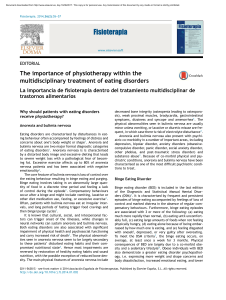
... exposure to body-oriented situations in physiotherapy will enable patients to discover any changing attitudes during the exercises and will enable them to become familiar with these changes. Visual feedback with for example mirrorand video-exposure intensifies the kinesthetic sensations by providing ...
... exposure to body-oriented situations in physiotherapy will enable patients to discover any changing attitudes during the exercises and will enable them to become familiar with these changes. Visual feedback with for example mirrorand video-exposure intensifies the kinesthetic sensations by providing ...
Dyslexia and Learning Disorders
... condition. The inattention is readily recognized during activities that require increased cognitive functions. The onset can be gradual or sudden, with a waxing and waning pattern, but usually worse under stress. It usually affects boys age 6 to 15 years old, and females, 20 to 29 years old. Compuls ...
... condition. The inattention is readily recognized during activities that require increased cognitive functions. The onset can be gradual or sudden, with a waxing and waning pattern, but usually worse under stress. It usually affects boys age 6 to 15 years old, and females, 20 to 29 years old. Compuls ...
Personality Disorders and Substance Use Disorders
... According to the American Psychiatric Association (APA), a personality disorder exists when an individual’s “personality traits are inflexible and maladaptive and cause either significant impairment in social or occupational functioning or subjective distress.” ...
... According to the American Psychiatric Association (APA), a personality disorder exists when an individual’s “personality traits are inflexible and maladaptive and cause either significant impairment in social or occupational functioning or subjective distress.” ...
Types of Mood Disorders
... Factors that place people at increased risk of developing major depression include: ...
... Factors that place people at increased risk of developing major depression include: ...
PDF available - Jonathan S. Abramowitz, PhD
... Such “tic-like” compulsions can be difficult to distinguish from tics as observed in Tourette’s syndrome. The most significant change for OCD in DSM-5, however, is the classification of this disorder within the DSM; specifically, OCD is no longer considered an anxiety disorder. Along with several pu ...
... Such “tic-like” compulsions can be difficult to distinguish from tics as observed in Tourette’s syndrome. The most significant change for OCD in DSM-5, however, is the classification of this disorder within the DSM; specifically, OCD is no longer considered an anxiety disorder. Along with several pu ...
Document
... of loss, rejection, and abandonment while using Freudian techniques to analyze dreams of depressed individuals – Aim is to reveal irrational thinking and help the client think differently ...
... of loss, rejection, and abandonment while using Freudian techniques to analyze dreams of depressed individuals – Aim is to reveal irrational thinking and help the client think differently ...
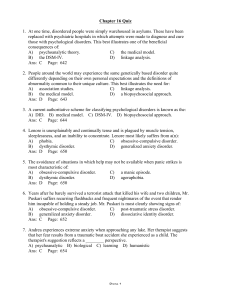
Chapter 16 Quiz 1. At one time, disordered people were
... Chapter 16 Quiz 1. At one time, disordered people were simply warehoused in asylums. These have been replaced with psychiatric hospitals in which attempts were made to diagnose and cure those with psychological disorders. This best illustrates one of the beneficial consequences of: A) psychoanalytic ...
... Chapter 16 Quiz 1. At one time, disordered people were simply warehoused in asylums. These have been replaced with psychiatric hospitals in which attempts were made to diagnose and cure those with psychological disorders. This best illustrates one of the beneficial consequences of: A) psychoanalytic ...