ABNORMAL PSYCHOLOGY SIXTH EDITION
... development of dependency. Insecurely or anxiously attached children are likely to become dependent. ...
... development of dependency. Insecurely or anxiously attached children are likely to become dependent. ...
Document
... in the diagnostic manual (DSM - IV) of the American Psychiatric Association. According to the CDC, the three main types of ASD are: 1- Asperger's syndrome 2- Pervasive developmental disorder, not otherwise specified (PDDNOS) 3- Autistic disorder ...
... in the diagnostic manual (DSM - IV) of the American Psychiatric Association. According to the CDC, the three main types of ASD are: 1- Asperger's syndrome 2- Pervasive developmental disorder, not otherwise specified (PDDNOS) 3- Autistic disorder ...

ANALYSIS OF MULTI-INSTRUMENTAL ASSESSMENT OF EATING
... them are described a broad and heterogeneous category (EDNOS) of "atypical eating disorders," that is a clinically significant eating disorder, but that does not meet all the diagnostic criteria for Anorexia Nervosa or Bulimia Nervosa. The aim of this pilot study was to analyze the differences detec ...
... them are described a broad and heterogeneous category (EDNOS) of "atypical eating disorders," that is a clinically significant eating disorder, but that does not meet all the diagnostic criteria for Anorexia Nervosa or Bulimia Nervosa. The aim of this pilot study was to analyze the differences detec ...
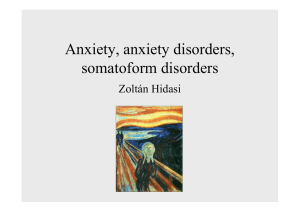
Anxiety, anxiety disorders, somatoform disorders
... • Phobia: Excessive fear of a specific object, circumstance or situation (unreasonable, marked, persistent) • 6 month prevalence: 5-10% • Exposure: immediate anxiety • Types: animal type, natural environment type (e.g., storms, water), blood-injection-injury type, situational type (e.g., airplanes), ...
... • Phobia: Excessive fear of a specific object, circumstance or situation (unreasonable, marked, persistent) • 6 month prevalence: 5-10% • Exposure: immediate anxiety • Types: animal type, natural environment type (e.g., storms, water), blood-injection-injury type, situational type (e.g., airplanes), ...

Intermittent Explosive Disorder:
... first and only treatment for adults with moderate to severe BED. Now, the Research Institute at Lindner Center of HOPE is participating in a 12 week open label study of Lisdexamfetime (LDX/ Vyvanse) in participants with binge eating disorder. The goal is to compare the brain functioning as observed ...
... first and only treatment for adults with moderate to severe BED. Now, the Research Institute at Lindner Center of HOPE is participating in a 12 week open label study of Lisdexamfetime (LDX/ Vyvanse) in participants with binge eating disorder. The goal is to compare the brain functioning as observed ...

ABNORMAL BEHAVIOR Theories and Diagnoses of Psychopathology
... did not report hearing any unusual noises and behaved as they usually would in the outside world. While institutionalized, however, all of their behaviors were seen through the lens of mental illness. Even when these individuals were released, they were diagnosed with schizophrenia in remission. The ...
... did not report hearing any unusual noises and behaved as they usually would in the outside world. While institutionalized, however, all of their behaviors were seen through the lens of mental illness. Even when these individuals were released, they were diagnosed with schizophrenia in remission. The ...


Eating disorders - Back to Medical School
... • Overcoming Bulimia Nervosa and Binge Eating: A Guide to Recovery (Cooper 1993) • Overcoming Binge Eating (Fairburn 1995) Family and carers • Skills-based Learning for Caring for a Loved One with an Eating Disorder: The New Maudsley Method (Treasure 2007). Eating disorders in men • The Invisible Ma ...
... • Overcoming Bulimia Nervosa and Binge Eating: A Guide to Recovery (Cooper 1993) • Overcoming Binge Eating (Fairburn 1995) Family and carers • Skills-based Learning for Caring for a Loved One with an Eating Disorder: The New Maudsley Method (Treasure 2007). Eating disorders in men • The Invisible Ma ...

Chapter 10:Conversion and dissociation
... The original Freudian theory suggested that ideas which were completely absent from the patient's memory in a normal state, or present only in ‘a highly summary form', could be revealed by hypnosis. ...
... The original Freudian theory suggested that ideas which were completely absent from the patient's memory in a normal state, or present only in ‘a highly summary form', could be revealed by hypnosis. ...
The Use and Misuse of Exposure Therapy for Obsessive
... sensations that sometimes accompany anxiety and fear (e.g., racing heart, breathlessness).The choice of exposure type is determined by features of the patient’s individual fears; and it is often the case that different types of exposure are used together in the treatment of a given individual [9]. T ...
... sensations that sometimes accompany anxiety and fear (e.g., racing heart, breathlessness).The choice of exposure type is determined by features of the patient’s individual fears; and it is often the case that different types of exposure are used together in the treatment of a given individual [9]. T ...

02 Psychology of personality. Modern theories of personality
... • pain presumed to be of psychological origin occurring during the course of depression or schizophrenia • pain due to known or inferred physiological mechanism such as muscle tension pain or migraine but still believed to have psychological cause are coded as P54 • the somatoform pain disorder has ...
... • pain presumed to be of psychological origin occurring during the course of depression or schizophrenia • pain due to known or inferred physiological mechanism such as muscle tension pain or migraine but still believed to have psychological cause are coded as P54 • the somatoform pain disorder has ...
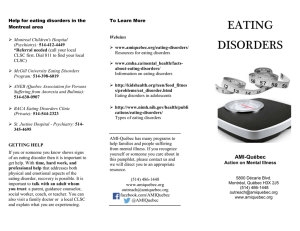
Eating Disorders - AMI
... invitations, being anxious and depressed, not being able to focus in school and her anorexia became the solution to everything. The fact that home was a very tense environment didn’t help either. Linda has spent the last 11 years in and out of hospitals, treatment programs and therapy sessions. She ...
... invitations, being anxious and depressed, not being able to focus in school and her anorexia became the solution to everything. The fact that home was a very tense environment didn’t help either. Linda has spent the last 11 years in and out of hospitals, treatment programs and therapy sessions. She ...

somatoform disorders
... slight physical anomaly is present, the person’s concern is markedly excessive. B. The preoccupation causes clinically significant distress or impairment in social, occupational, or other important areas of functioning. C. The preoccupation is not better accounted for by another mental disorder (e.g ...
... slight physical anomaly is present, the person’s concern is markedly excessive. B. The preoccupation causes clinically significant distress or impairment in social, occupational, or other important areas of functioning. C. The preoccupation is not better accounted for by another mental disorder (e.g ...

11-3-anxiety_disorders
... • Doing things in a certain order, with symmetry • Mental acts such as praying, counting, etc. ...
... • Doing things in a certain order, with symmetry • Mental acts such as praying, counting, etc. ...

Slide 1
... • Doing things in a certain order, with symmetry • Mental acts such as praying, counting, etc. ...
... • Doing things in a certain order, with symmetry • Mental acts such as praying, counting, etc. ...


Disorders - Fulton County Schools
... Genain sisters suffer from schizophrenia. Two more than others, thus there are contributing environmental factors. ...
... Genain sisters suffer from schizophrenia. Two more than others, thus there are contributing environmental factors. ...

Psychological Disorders
... A. Definition: behavior patterns or mental processes that cause serious personal suffering or interfere with a person’s ability to cope with everyday life B. More common than you think: estimates suggest that almost one third (33%) of US adults have experienced some form of psychological disorder ...
... A. Definition: behavior patterns or mental processes that cause serious personal suffering or interfere with a person’s ability to cope with everyday life B. More common than you think: estimates suggest that almost one third (33%) of US adults have experienced some form of psychological disorder ...


Abnormal Behaviors
... because of particular thoughts and behaviors that are often based upon their false assumptions. This is how the information is being decoded and retrieved (interpreted or memory issues). ...
... because of particular thoughts and behaviors that are often based upon their false assumptions. This is how the information is being decoded and retrieved (interpreted or memory issues). ...

Unit 12 Psychiological Disorders
... The genetically identical Genain sisters suffer from schizophrenia. Two more than others, thus there are contributing environmental factors. ...
... The genetically identical Genain sisters suffer from schizophrenia. Two more than others, thus there are contributing environmental factors. ...
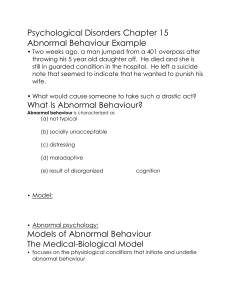
Psychological Disorders Chapter 15
... • Irrational and persistent fear and avoidance of a particular object or situation • 5 – 12% of the population has one or more specific phobias • Categories of specific phobias: ...
... • Irrational and persistent fear and avoidance of a particular object or situation • 5 – 12% of the population has one or more specific phobias • Categories of specific phobias: ...

lecture ch 15
... avoidance of a particular object or situation • 5 – 12% of the population has one or ...
... avoidance of a particular object or situation • 5 – 12% of the population has one or ...

Advances in Environmental Biology
... the other hand, an overview of the research done in the last decades in the field of psychological treatment of Obsessive - Compulsive show approximately between 60 to 85% of OCD patients after a full course of therapy with exposure / response prevention,reveald a significant improvement in symtoms ...
... the other hand, an overview of the research done in the last decades in the field of psychological treatment of Obsessive - Compulsive show approximately between 60 to 85% of OCD patients after a full course of therapy with exposure / response prevention,reveald a significant improvement in symtoms ...