Personality Disorders - Identification & Treatment
... • Understanding personality disorders using criteria from DSM-5. • Learn approaches for separating personality disorders from other major illnesses. • Review non-pharmacologic treatment approaches. ...
... • Understanding personality disorders using criteria from DSM-5. • Learn approaches for separating personality disorders from other major illnesses. • Review non-pharmacologic treatment approaches. ...

Abnormal Psychology - The Great Pretender: The Art of Passing
... Enduring pattern of inner experience or behavior that deviates from expectations of culture, manifested in two or more of the following: -- cognition (perception of self, others) -- affectivity (intensity, range of emotions) -- interpersonal functioning -- impulse control ...
... Enduring pattern of inner experience or behavior that deviates from expectations of culture, manifested in two or more of the following: -- cognition (perception of self, others) -- affectivity (intensity, range of emotions) -- interpersonal functioning -- impulse control ...
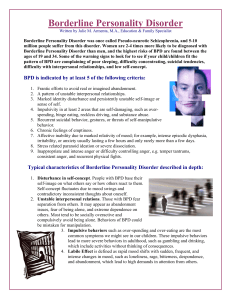
Borderline Personality Disorder
... 1. Disturbance in self-concept. People with BPD base their self-image on what others say or how others react to them. Self-concept fluctuates due to mood swings and contradictory inconsistent thoughts about oneself. 2. Unstable interpersonal relations. Those with BPD fear separation from others. It ...
... 1. Disturbance in self-concept. People with BPD base their self-image on what others say or how others react to them. Self-concept fluctuates due to mood swings and contradictory inconsistent thoughts about oneself. 2. Unstable interpersonal relations. Those with BPD fear separation from others. It ...

Psychological Disorders
... • The DSM-IV provides an invaluable tool to psychologists, but it doesn’t come without its criticisms • Some believe it can turn normal problems of living into “diseases” – i.e. ADHD or the argument over PMS • Also, some believe the DSM-IV makes diagnosis of disorders scientific when they are actual ...
... • The DSM-IV provides an invaluable tool to psychologists, but it doesn’t come without its criticisms • Some believe it can turn normal problems of living into “diseases” – i.e. ADHD or the argument over PMS • Also, some believe the DSM-IV makes diagnosis of disorders scientific when they are actual ...
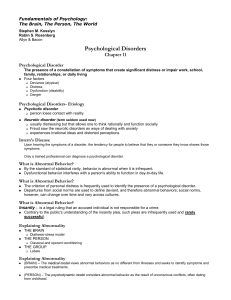
Psychological Disorders
... Diagnostic and Statistical Manual of Mental Disorders, 4th edition (DSM-IV-R) -Provides rules for diagnosing psychological disorders that have increased reliability. ...
... Diagnostic and Statistical Manual of Mental Disorders, 4th edition (DSM-IV-R) -Provides rules for diagnosing psychological disorders that have increased reliability. ...

Anxiety - Applecross Pyschological Services
... thoughts that are difficult to control (e.g. concern about contaminating or harming oneself or family). The obsessional thoughts often lead to uncontrollable compulsive rituals (e.g. cleaning, checking, counting) ...
... thoughts that are difficult to control (e.g. concern about contaminating or harming oneself or family). The obsessional thoughts often lead to uncontrollable compulsive rituals (e.g. cleaning, checking, counting) ...
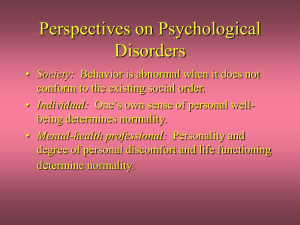
Perspectives on Psychological Disorders
... development of mood disorders. • cognitive distortions: An illogical and maladaptive response to early negative life events that leads to feelings of incompetence and unworthiness that are reactivated whenever a new situation arises that resembles ...
... development of mood disorders. • cognitive distortions: An illogical and maladaptive response to early negative life events that leads to feelings of incompetence and unworthiness that are reactivated whenever a new situation arises that resembles ...
PowerPoint Lecture Notes Presentation Chapter 2 Current
... Rates of DSM-IV Personality Disorders in the Community and in Treatment Settings ...
... Rates of DSM-IV Personality Disorders in the Community and in Treatment Settings ...

Psychological Disorders
... Anxiety Disorder: Panic Disorder Panic Disorder Symptoms: Minute-long episodes of intense dread which may include feelings of terror, chest pains, choking, or other frightening sensations. Anxiety is a component of both disorders. It occurs more in the panic disorder, making people avoid situations ...
... Anxiety Disorder: Panic Disorder Panic Disorder Symptoms: Minute-long episodes of intense dread which may include feelings of terror, chest pains, choking, or other frightening sensations. Anxiety is a component of both disorders. It occurs more in the panic disorder, making people avoid situations ...

Introduction to Psychology
... 6. Tobacco products are as addictive as heroin and cocaine 7. Anxiety is the number one reason people seek mental health services 8. Most major depressive episodes will end only if the person undergoes therapy 9. In N. America, today’s young adults are three times as likely as their grandparents to ...
... 6. Tobacco products are as addictive as heroin and cocaine 7. Anxiety is the number one reason people seek mental health services 8. Most major depressive episodes will end only if the person undergoes therapy 9. In N. America, today’s young adults are three times as likely as their grandparents to ...

Chapter 12: Psychological Disorders
... • Faulty thinking or distorted perceptions can cause psychological disorders ...
... • Faulty thinking or distorted perceptions can cause psychological disorders ...
Major Depressive Episode
... these experiences, that determine growth and development of personality ...
... these experiences, that determine growth and development of personality ...
Anxiety and Somatoform Disorders
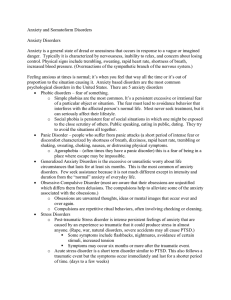
... Anxiety and Somatoform Disorders Anxiety Disorders Anxiety is a general state of dread or uneasiness that occurs in response to a vague or imagined danger. Typically it is characterized by nervousness, inability to relax, and concern about losing control. Physical signs include trembling, sweating, ...
... Anxiety and Somatoform Disorders Anxiety Disorders Anxiety is a general state of dread or uneasiness that occurs in response to a vague or imagined danger. Typically it is characterized by nervousness, inability to relax, and concern about losing control. Physical signs include trembling, sweating, ...
10:30 AM Anxiety - Vanderbilt University Medical Center
... • Discontinue gradually if regular use > one month Understand: If you start it, the patient runs the risk of long-term need for it Physical dependence is the result of the physician’s choice ...
... • Discontinue gradually if regular use > one month Understand: If you start it, the patient runs the risk of long-term need for it Physical dependence is the result of the physician’s choice ...
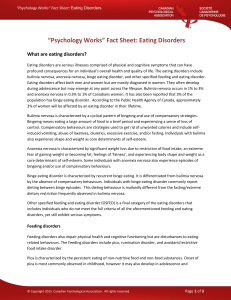
“Psychology Works” Fact Sheet: Eating Disorders
... “Psychology Works” Fact Sheet: Eating Disorders What are eating disorders? Eating disorders are serious illnesses comprised of physical and cognitive symptoms that can have profound consequences for an individual's overall health and quality of life. The eating disorders include bulimia nervosa, ano ...
... “Psychology Works” Fact Sheet: Eating Disorders What are eating disorders? Eating disorders are serious illnesses comprised of physical and cognitive symptoms that can have profound consequences for an individual's overall health and quality of life. The eating disorders include bulimia nervosa, ano ...

Mood Disorders
... newspaper story about their reunion, their longlost half-brother Frank Strickland called. He explained it would be a while before he could come see them—because he, too, was in jail, on drug, burglary, and larceny charges (Shepherd et al., 1990). According to a 2004 U.S. Justice Department report, 4 ...
... newspaper story about their reunion, their longlost half-brother Frank Strickland called. He explained it would be a while before he could come see them—because he, too, was in jail, on drug, burglary, and larceny charges (Shepherd et al., 1990). According to a 2004 U.S. Justice Department report, 4 ...
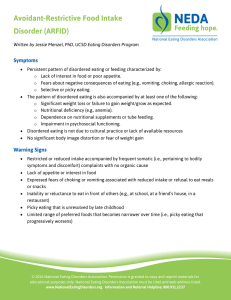
Avoidant-Restrictive Food Intake Disorder (ARFID)
... Nutritional deficiencies (e.g., anemia or iron deficiency) and malnutrition which may be characterized by fatigue, weakness, brittle nails, dry hair/hair loss, difficulty concentrating, and reduction in bone density. ...
... Nutritional deficiencies (e.g., anemia or iron deficiency) and malnutrition which may be characterized by fatigue, weakness, brittle nails, dry hair/hair loss, difficulty concentrating, and reduction in bone density. ...

EXPLORING PSYCHOLOGY (7th Edition in Modules) David Myers
... Explaining Mood Disorders Since depression is so prevalent worldwide, investigators want to develop a theory of depression that will suggest ways to treat it. Lewinsohn et al., (1985, 1998) note that a theory of depression should explain the following: 1. Behavioral and cognitive changes 2. Common ...
... Explaining Mood Disorders Since depression is so prevalent worldwide, investigators want to develop a theory of depression that will suggest ways to treat it. Lewinsohn et al., (1985, 1998) note that a theory of depression should explain the following: 1. Behavioral and cognitive changes 2. Common ...

Navigating the Kraepelinian Vortex2
... Developmental Coordination Disorder Stereotypic Movement Disorder Tourette’s Disorder Tic disorders (criteria for a “tic” have been standardized across all disorders) ...
... Developmental Coordination Disorder Stereotypic Movement Disorder Tourette’s Disorder Tic disorders (criteria for a “tic” have been standardized across all disorders) ...
Psychological Disorders - The Independent School
... an illness. Personality disorders represent enduring traits that are major components of personality. Personality Disorders ...
... an illness. Personality disorders represent enduring traits that are major components of personality. Personality Disorders ...
The Diagnostic and Statistical Manual of Mental Disorders * 5th
... 5. Recognition of life span issues related to specific disorders. ...
... 5. Recognition of life span issues related to specific disorders. ...
Psychological Disorders
... Photos of paintings by Krannert Museum, University of Illinois at Urbana-Champaign ...
... Photos of paintings by Krannert Museum, University of Illinois at Urbana-Champaign ...

File - Alphonse Asylum
... When physicians discovered that syphilis led to mental disorders, they started using medical models to review the physical causes of these disorders. ...
... When physicians discovered that syphilis led to mental disorders, they started using medical models to review the physical causes of these disorders. ...

Chapter 14: Psychological Disorders
... In schizophrenia, symptoms that reflect excesses or distortions of normal functioning, including delusions, hallucinations, and disorganized thoughts and behavior ...
... In schizophrenia, symptoms that reflect excesses or distortions of normal functioning, including delusions, hallucinations, and disorganized thoughts and behavior ...

perfectionism traits and perfectionistic self
... Conversion Disorders Old Hysteria or Hysterical Neuroses Thought to be restricted to women Pattern in which symptoms of some physical malfunction or loss of control appear with no organic pathology ...
... Conversion Disorders Old Hysteria or Hysterical Neuroses Thought to be restricted to women Pattern in which symptoms of some physical malfunction or loss of control appear with no organic pathology ...