Personality
... Personality disorders are a class of disorders marked by extreme, longstanding, inflexible personality traits that cause subjective distress or impaired social and occupational functioning. They are not so much severe mental disorders as dysfunctional styles of living. ...
... Personality disorders are a class of disorders marked by extreme, longstanding, inflexible personality traits that cause subjective distress or impaired social and occupational functioning. They are not so much severe mental disorders as dysfunctional styles of living. ...
Obsessive Compulsive Disorder helpguide.org
... Accumulating “junk” such as old newspapers or empty food containers. ...
... Accumulating “junk” such as old newspapers or empty food containers. ...

Symptoms Binge Eating Disorder
... • Need for control of everything in life, especially the body • Adolescents who feel overwhelmed and powerless desire to control something, and sometimes controlling body weight comes first ...
... • Need for control of everything in life, especially the body • Adolescents who feel overwhelmed and powerless desire to control something, and sometimes controlling body weight comes first ...
co-morbidity
... Early-onset OCD may have a stronger familial and hereditary component than late onset OCD (do Rosario-Campos, 2005; Hanna et al., 2005; Nestadt et al., 2000; Pauls et al., 1995). ...
... Early-onset OCD may have a stronger familial and hereditary component than late onset OCD (do Rosario-Campos, 2005; Hanna et al., 2005; Nestadt et al., 2000; Pauls et al., 1995). ...

Signs of Binge Eating Disorder
... • Need for control of everything in life, especially the body • Adolescents who feel overwhelmed and powerless desire to control something, and sometimes controlling body weight comes first ...
... • Need for control of everything in life, especially the body • Adolescents who feel overwhelmed and powerless desire to control something, and sometimes controlling body weight comes first ...

Chapter 15 pt. 2: Mood Disorders, Dissociation, Schizophrenia, and
... –Mood disorders are genetic –Have not found a single “depression” gene The ...
... –Mood disorders are genetic –Have not found a single “depression” gene The ...

Fractured Fairy Tales
... 1) Choose a fairy tale you are familiar with (refer to the list provided). Two teams may not use the same story (first come, first serve). 2) Using your book and any other research of the disorder, rewrite the story as it would be if the main character had that disorder. 3) Stories should NOT name t ...
... 1) Choose a fairy tale you are familiar with (refer to the list provided). Two teams may not use the same story (first come, first serve). 2) Using your book and any other research of the disorder, rewrite the story as it would be if the main character had that disorder. 3) Stories should NOT name t ...
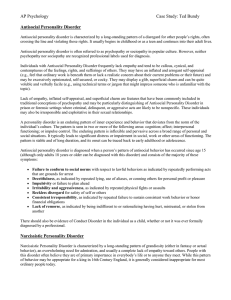
Antisocial Personality Disorder
... A personality disorder is an enduring pattern of inner experience and behavior that deviates from the norm of the individual’s culture. The pattern is seen in two or more of the following areas: cognition; affect; interpersonal functioning; or impulse control. The enduring pattern is inflexible and ...
... A personality disorder is an enduring pattern of inner experience and behavior that deviates from the norm of the individual’s culture. The pattern is seen in two or more of the following areas: cognition; affect; interpersonal functioning; or impulse control. The enduring pattern is inflexible and ...
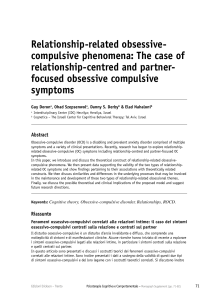
Relationship-related obsessive- compulsive phenomena: The case
... Self-perceptions, attachment insecurities and relationshipcentred OC phenomena Several authors have recently proposed that the transformation of intrusive thoughts into obsessions is moderated by the extent to which intrusive thoughts challenge core perceptions of the self (e.g., Aardema & O’Connor, ...
... Self-perceptions, attachment insecurities and relationshipcentred OC phenomena Several authors have recently proposed that the transformation of intrusive thoughts into obsessions is moderated by the extent to which intrusive thoughts challenge core perceptions of the self (e.g., Aardema & O’Connor, ...

What is Mental Health?
... every day, restlessness, weight loss or gain, appetite changes, suicidal thoughts • Causes may include chemical imbalance in brain and stressful life events (such as loss of a loved one, family issues, bullying, trauma, abuse, etc.) National Institute of Mental Health (NIMH), 2015; American Psycholo ...
... every day, restlessness, weight loss or gain, appetite changes, suicidal thoughts • Causes may include chemical imbalance in brain and stressful life events (such as loss of a loved one, family issues, bullying, trauma, abuse, etc.) National Institute of Mental Health (NIMH), 2015; American Psycholo ...

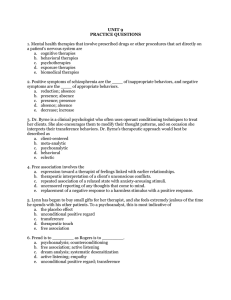
Practice Questions
... month she was suffering from migraines, the next month it was severe stomach cramps, and the following month it was arthritic pain. While her symptoms are real, doctors have found no physiological reason for them. It is possible that Tamara has a. conversion disorder b. dependent personality c. bord ...
... month she was suffering from migraines, the next month it was severe stomach cramps, and the following month it was arthritic pain. While her symptoms are real, doctors have found no physiological reason for them. It is possible that Tamara has a. conversion disorder b. dependent personality c. bord ...
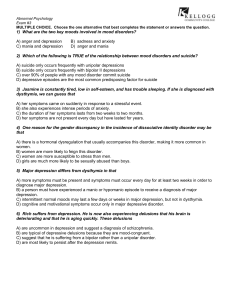
Test 3
... 22. In class, we discussed the diagnosis of Dependent Personality Disorder. As the therapist of an individual with this disorder, what was expressed as a primary concern or something that a clinician should attempt to refrain from when dealing with this client (hint: remember what happens to a ther ...
... 22. In class, we discussed the diagnosis of Dependent Personality Disorder. As the therapist of an individual with this disorder, what was expressed as a primary concern or something that a clinician should attempt to refrain from when dealing with this client (hint: remember what happens to a ther ...

Abnormal Psychology - West Morris Mendham High School
... or almost non-existent. There is a constant feeling of "walking on eggshells" - that something bad could happen at any time. Indecisiveness and uncertainty feel like constant companions. ...
... or almost non-existent. There is a constant feeling of "walking on eggshells" - that something bad could happen at any time. Indecisiveness and uncertainty feel like constant companions. ...

Chapter 1 - CCRI Faculty Web
... A pattern of behavioral and psychological symptoms that causes significant personal distress, impairs the ability to function in one or more important areas of daily life, or both ...
... A pattern of behavioral and psychological symptoms that causes significant personal distress, impairs the ability to function in one or more important areas of daily life, or both ...

Chapter 15 pt. 1: Perspectives on Psychological Disorders and Anxiety
... 3. maladaptive- harmful; causes suffering 4. unjustifiable- sometimes there’s a good reason ...
... 3. maladaptive- harmful; causes suffering 4. unjustifiable- sometimes there’s a good reason ...

File
... Antisocial personality disorder is characterized by a long-standing pattern of a disregard for other people’s rights, often crossing the line and violating those rights. It usually begins in childhood or as a teen and continues into their adult lives. Antisocial personality disorder is often referre ...
... Antisocial personality disorder is characterized by a long-standing pattern of a disregard for other people’s rights, often crossing the line and violating those rights. It usually begins in childhood or as a teen and continues into their adult lives. Antisocial personality disorder is often referre ...

Personality Disorders
... Personality disorder - - DSM - long term, stable pattern of unusual and inflexible personality traits that lead to functional impairment or distress ...
... Personality disorder - - DSM - long term, stable pattern of unusual and inflexible personality traits that lead to functional impairment or distress ...
The DSM-5
... During the development process, permission will not be granted for use of the diagnostic criteria. The criteria are subject to change, and it would be a disservice to the community to allow various preliminary versions to remain in circulation. For this reason, after the end of the current comment p ...
... During the development process, permission will not be granted for use of the diagnostic criteria. The criteria are subject to change, and it would be a disservice to the community to allow various preliminary versions to remain in circulation. For this reason, after the end of the current comment p ...

Link to PowerPoint
... • Need for control of everything in life, especially the body • Adolescents who feel overwhelmed and powerless desire to control something, and sometimes controlling body weight comes first ...
... • Need for control of everything in life, especially the body • Adolescents who feel overwhelmed and powerless desire to control something, and sometimes controlling body weight comes first ...

Abnormal Psychology
... a set of learned behavior that has become maladaptive— bad habits learned early on in life. Biological explanations look at the lower than normal stress hormones in antisocial personality disordered persons as responsible for their low responsiveness to threatening stimuli. Other possible causes ...
... a set of learned behavior that has become maladaptive— bad habits learned early on in life. Biological explanations look at the lower than normal stress hormones in antisocial personality disordered persons as responsible for their low responsiveness to threatening stimuli. Other possible causes ...
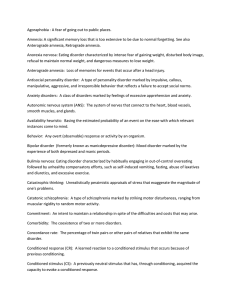
Agoraphobia : A fear of going out to public places. Amnesia: A
... happening together are greater than the odds of either event happening alone. Conversion disorder: A somatoform disorder characterized by a significant loss of physical function (with no apparent organic basis), usually in a single organ system. Culture-bound disorders: Abnormal syndromes found only ...
... happening together are greater than the odds of either event happening alone. Conversion disorder: A somatoform disorder characterized by a significant loss of physical function (with no apparent organic basis), usually in a single organ system. Culture-bound disorders: Abnormal syndromes found only ...
Abnormal Psychology - Solon City Schools
... • Anterior Cingulate Cortex monitors actions and checks for errors – elevated activity in OCD • Amygdala – fear circuits created in traumatic experiences ...
... • Anterior Cingulate Cortex monitors actions and checks for errors – elevated activity in OCD • Amygdala – fear circuits created in traumatic experiences ...

Mental Health Unit
... Do you have at least one hobby and enjoy it? Do you deal with stresses as they happen and don’t let them build up? Do you feel afraid, angry, sad, or jealous, but are not overwhelmed by ...
... Do you have at least one hobby and enjoy it? Do you deal with stresses as they happen and don’t let them build up? Do you feel afraid, angry, sad, or jealous, but are not overwhelmed by ...